General Biology 1 Exam 4 Questions & Answers Already Passed!!
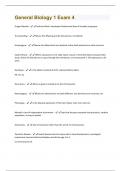
Gregor Mendel - Austrian Monk, developed fundamental laws of heredity using peas True-breeding - Means the offspring are like the parents, not hybrids Homozygous - Means the alleles/traits are identical, either both dominant or both recessive Cystic Fibrosis - Affects Caucasians in US, salty sweat, mucus in bronchial tubes and pancreatic ducts, failure of chloride ions to pass through the membrane, on chromosome 7, life expectancy is 35 years Genotype - Is the alleles received at birth, represented by letters AA, Aa, aa Gene locus - Where a gene is located at on the chromosome Heterozygous - Means the alleles/traits are both different, one dominant one recessive, Aa Phenotype - Is the physical expression of the trait, flower color, hair color etc. Mendel=s Law of Independent Assortment - Says that the gene separate during meiosis, random separation, no way to predict Autosomes - Any chromosome other than the sex (X, Y) chromosomes Tay-Sachs disease - Jewish disease lack of enzyme Hex A slow development, neurological impairment, become blind and helpless and die by age 3 or 4, on chromosome 15Phenylketonuria - Affects nervous system development, can=t metabolize amino acid phenylalanine, on chromosome 12 Sickle-Cell Anemia - In African Americans, on chromosome 11, Red Blood cells are shaped like half moons, because defective hemoglobin sticks together, patients are anemic, weak, poor circulation, kidney and heart failure Criteria for Genetic Material - 1. Must be able to store information used to control both the development & the metabolic activities of cells; 2. Must be stable so it can be replicated accurately during cell division and be transmitted for generation; and 3. Must be able to undergo mutations that provide the genetic variability required for evolution. Frederick Griffith: - Heat killed bacteria DNA was transformed into R bacteria and caused death Used mice and streptococcus, Determined that DNA hereditary information can pass from dead cells to live cells and transform them. Heterochromatin - Highly compact forms of DNA or chromosomes that is inactive or genes are infrequently transcribed, if at all Euchromatin - Loosely coiled DNA that is being transcribed Histones - Proteins that help form the nucleosome or proteins that DNA coils around to condense and form chromosomes Nucleosome - Each "bead" of DNA and its proteins or histones that it wraps around is called Protein-coding gene: - gene that is transcribed into mRNA Non-coding gene - gene that is transcribed into any other type of RNAElongation - Amino acids are added one at a time to the growing polypeptide Termination - Ribosome separates into two subunits and the polypeptide is released Translation Requires 3 steps - Initiation, elongation and termination Initiation - mRNA and the first tRNA are at the ribosome Function of a Ribosome - Reads the messenger RNA and directs the transfer RNA's with their amino acids to come in and attach Polyribosome - multiple ribosomes reading the mRNA at the same time, one after another Exons - expressed sections of mRNA
Written for
- Institution
- General Biology 1
- Course
- General Biology 1
Document information
- Uploaded on
- May 21, 2024
- Number of pages
- 6
- Written in
- 2023/2024
- Type
- Exam (elaborations)
- Contains
- Questions & answers
Subjects

Also available in package deal