
• Wrong document? Swap it for free
  • Written by students who passed
  • Immediately available after payment
  • Read online or as PDF
Sell
Where do you study
Your language
Document preview thumbnail
Preview 1 out of 8 pages
Exam (elaborations)

Mrl3701 Portfolio Memo - May/June 2024 - Semester 1 - Unisa - Due Date :- 20 May 2024 - Detailed Answers With References - Distinction Guaranteed

Document preview thumbnail
Preview 1 out of 8 pages

MRL3701 PORTFOLIO MEMO - MAY/JUNE 2024 - SEMESTER 1 - UNISA - DUE DATE :- 20 MAY 2024 - DETAILED ANSWERS WITH REFERENCES - DISTINCTION GUARANTEED Question 1 1.1 When a debtor is sequestrated, a Master is appointed to administer the estate. Answer the following questions regarding the appointment of the Master: (5) (a) In terms of which piece of legislation is the Master appointed? [1] (b) What is the pivotal role and function of the Master? [2] (c) What is meant by saying the Master is a “creature of statute”? [2] 1.2 Certain sections of the Insolvency Act 24 of 1936 have been amended over time, but it remains one of the oldest statutes of general application still in force. It is therefore difficult to synchronise the application of the Act with legal, economic, technological and commercial advances. It is imperative that the South African Insolvency Law be reformed. Discuss five (5) initiatives that have been identified that can assist in law reform. (5) 1.3 The Eastern Cape High Court has given a judgment of R80 000 against Jonah in favour of Zanele. Upon the demand of the officer whose duty it is to execute the judgment, Jonah fails to satisfy it and also fails to indicate to the officer disposable property sufficient to satisfy the judgment. The return made by the officer states that he has not found sufficient disposable property to satisfy the judgment. Explain to Zanele what the implications of the aforementioned facts may be. (10) 1.4 See the table below and match the columns to answer the following questions. You must therefore match three columns; case name, ratio decidendi of the case, and area of Insolvency Law applicable and answer the question as follows on your exam answer sheet (see example below). (15) CONFIDENTIAL 9 of 11 MRL3701 May/June 2024 EXAMPLE: 1. Case name: Joint Liquidators of Glen Anil v Hill Samuel 1982 (1) SA 103 (A). 2. Ratio decidendi of the case: The bonds in favour of Hill Samual did confer a preferent status. 3. Area of Insolvency Law applicable: Special Mortgages. Case Name: (1/2) Ratio decidendi of the case: (1) Area of Insolvency Law applicable: (1/2) Magnum Financial Holdings (Pty) Ltd v Summerly & Another NNO 1984 (1) SA 160 W Section 21 of the Insolvency Act 24 of 1936 authorises the Master that the trustee may attach the property of the Solvent Spouse. Disposition in the ordinary course of business. Hendriks NO v Swanepoel 1962 (4) SA 338 (A) With the disappearance of the companies substratum, if there is fraud committed, a deadlock in management, the dissolution of a partnership and oppression. Meaning of the word “debtor”. Harksen v Lane NO & Others 1998 (1) SA 300 (CC) The question to be decided was whether the trust before the court was susceptible of sequestration. Property which falls in the insolvent estate. Vorster NO v Steyn 1981 (2) A 831 (O) An exception to section 29 of the Insolvency Act 24 of 1936 is that a disposition is allowed if it is done in the ordinary course of business. When is it just an equitable for a company to be wound up by court. CONFIDENTIAL 10 of 11 MRL3701 May/June 2024 Rand Air (Pty) Ltd v Ray Bester Investments (Pty) Ltd 1985 (2) SA 345 (W) When someone applies for rehabilitation, a provision in the will of a deceased that the property bequeathed to the insolvent should go into trust if at the time the person is being rehabilitated, is nudum praeceptum. Vesting of the assets of the solvent spouse. 1.5 In terms of the Insolvency Act 24 of 1936, only married females and children born in wedlock will receive “immediate benefits” under a duly registered antenuptial contract. By referring to the relevant sections of legislation applicable, explain how this has the potential to violate the constitutional rights of individuals. In your answer you should include a discussion on Transformative Constitutionalism. (15) TOTAL QUESTION 1: [50] __________________________________________________________________________ Question 2 2.1 What is the legal effect of a contract when the insolvent enters into a contract which is prohibited? (5) 2.2 Explain whether an unrehabilitated insolvent may be appointed as a trustee of an insolvent’s estate. (5) 2.3 The Master may, under certain circumstances, refuse to appoint a trustee. Identify the instances when the Master may refuse to confirm the election of a trustee. (5) 2.4 In terms of the Insolvency Act 24 of 1936, the trustee may set aside dispositions if they are voidable. Provide a detailed discussion of a disposition in terms of section 31 of the Act. (10) TOTAL QUESTION 2: [25] __________________________________________________________________________ CONFIDENTIAL 11 of 11 MRL3701 May/June 2024 Question 3 3.1 Regarding the transfer of a business without prescribed notice, discuss section 34(1) of the Insolvency Act 24 of 1936. (10) 3.2 The liquidator of a company may in certain circumstances be removed from office before he has completed his duties as a liquidator. Discuss the instances where these rules apply. (10) 3.3 In the case of Business Rescue Proceedings, what does the phrase ‘rescuing the company’ mean? (5) TOTAL QUESTION 3: [25] __________________________________________________________________________ TOTAL MARKS: [100]

Content preview

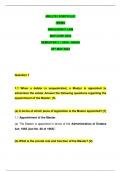
MRL3701 PORTFOLIO

MEMO

INSOLVENCY LAW

MAY/JUNE 2024

SEMESTER 1 – 2024 - UNISA

20th MAY 2024


Question 1


1.1 When a debtor is sequestrated, a Master is appointed to
administer the estate. Answer the following questions regarding the
appointment of the Master: (5)


(a) In terms of which piece of legislation is the Master appointed? [1]

1.1 Appointment of the Master:

(a) The Master is appointed in terms of the Administration of Estates
Act, 1965 (Act No. 66 of 1965)1.


(b) What is the pivotal role and function of the Master? [2]

Connected book
 image
Robert Sharrock Hockly\'s Insolvency Law
Publisher: 1996 ISBN: 9780702135460 Edition: Unknown

Document information

Uploaded on
May 20, 2024
Number of pages
8
Written in
2023/2024
Type
Exam (elaborations)
Contains
Questions & answers
$24.88

Wrong document? Swap it for free Within 14 days of purchase and before downloading, you can choose a different document. You can simply spend the amount again.
Written by students who passed
Immediately available after payment
Read online or as PDF

Seller avatar
Reputation scores are based on the amount of documents a seller has sold for a fee and the reviews they have received for those documents. There are three levels: Bronze, Silver and Gold. The better the reputation, the more your can rely on the quality of the sellers work.
StuddyBuddyTutor
2.9
(102)
Sold
619
Followers
374
Items
381
Last sold
4 weeks ago


Why students choose Stuvia

Created by fellow students, verified by reviews

Quality you can trust: written by students who passed their tests and reviewed by others who've used these notes.

Didn't get what you expected? Choose another document

No worries! You can instantly pick a different document that better fits what you're looking for.

Pay as you like, start learning right away

No subscription, no commitments. Pay the way you're used to via credit card and download your PDF document instantly.

Student with book image

“Bought, downloaded, and aced it. It really can be that simple.”

Alisha Student

Working on your references?

Create accurate citations in APA, MLA and Harvard with our free citation generator.

Working on your references?

Frequently asked questions


