Natural Sciences Clep Exam Review Questions And Answers, Rated A+
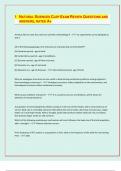
NATURAL SCIENCES CLEP EXAM REVIEW QUESTIONS AND ANSWERS, RATED A+ A theory fails to meet the criteria of scientific methodology if - -no experiments can be designed to test it All of the following geologic time intervals are characterized correctly EXCEPT (A) Cambrian period...age of birds (B) Carboniferous period...age of amphibians (C) Devonian period...age of fishes incorrect (D) Cenozoic era...age of mammals (E) Mesozoic era...age of dinosaurs - -(A) Cambrian period...age of birds Why are analogous structures are less useful in determining evolutionary patterns among organisms than homologous structures? - -Analogous structures reflect adaptation to the environment, and homologous structures reflect evolutionary ancestry. What causes antibiotic resistance? - -It is caused by overuse of antibiotics, which allows for selection of resistant bacteria. A population of seed-eating birds exhibits variation in the size of their beaks, with a mean beak size of 12 mm. Beak size is a heritable character that affects the size of seeds a bird may consume (e.g., larger beaks can crack larger seeds). After a drought, plants that produce smaller seeds are rare, but plants that produce larger seeds are still common. Which of the following evolutionary mechanisms will most influence the beak size of the bird population after a drought? - -Natural selection correct If the frequency of PTC tasters in a population is 91%, what is the frequency of the allele for non-tasting PTC? - -30% Two geographically isolated populations of foxes experience genetic drift and mutations over time, and eventually they can no longer interbreed successfully. This is an example of which type of speciation: - -allopatric The classification characteristics that define the genus of an animal or a plant are usually more general than those defining (A) a class (B) an order (C) a species (D) a family (E) a phylum - -(C) a species In the name Homo sapiens, the word sapiens refers to the - -species Which of the following animals is most closely related to the cheetah? (A) Chicken (B) Alligator (C) Frog (D) Squirrel (E) Eagle - -(D) Squirrel The chief site of energy production in the cell - -Mitochondrion The site of protein synthesis in the cell - -Riboso
Document information
- Uploaded on
- May 20, 2024
- Number of pages
- 9
- Written in
- 2023/2024
- Type
- Exam (elaborations)
- Contains
- Questions & answers