
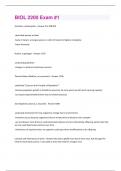
BIOL 2200 Exam #1 Questions And Answers Rated A+ New Update Assured Satisfaction
Aristotle, a philosopher - Answer-Pre-300 BCE -described species as fixed -Scale of nature: arranges species in order of lowest to highest complexity -linear hierarchy Hutton, a geologist - Answer-1795 -proposed gradualism -change is a slow but continuous process Thomas Robert Malthus, an economist - Answer-1798 -published "Essay on the Principle of Population'" -Human population growth is limited by resources; At some point we will reach carrying capacity, -can't grow exponentially forever due to limited resources Jean-Baptiste Lamarck, a naturalist - Answer-1809 -proposed mechanism for how organisms change due to environment -evolution occurs because organisms have an innate drive to become more complex -use and disuse: traits that are used extensively improve and are inherited by offspring, while traits that are not used deteriorate and lose over time -inheritance of acquired traits: an organism could pass these modifications to its offspring Lamarck and inheritance of traits - Answer-Idea that a giraffe once had a short neck, but through the need to reach food sources, it was able to drive the need for a longer neck-Change within a generation is inherited by their offspring; A giraffe with longer neck has offspring with longer neck, that will eventually become even longer Testing Lamarckian inheritance - Answer-August Weismann, a biologist; published Essays upon Heredity in 1889 -Went back to Lamarck's idea and discussed why changes in a generation are not always inherited by their offspring -5 generations of breeding, 68 parents, 901 offspring that ALL had tails -Recent data have suggested that there is an exception, epigenetics; There can be changes in what is active in the DNA and can be passed on to children Georges Cuvier, a paleontologist - Answer-1812 -published studies on fossils -Fossils as evidence of extinction; Organisms that were not well suited to their environment disappeared -opposed idea of evolution; New species due to immigration -extinction due to sudden events (flood) Charles Lyell, a geologist - Answer-1830 -published Principles of Geology -change is gradual -Processes that shape the earth have been uniform over time; same slow processes are responsible for rise and fall of mountains, valleys, etc. Charles Darwin, a naturalist - Answer- -voyage on the Beagle -Observations of geology, fossils, plants, and animals led Darwin to think about how species arise -- Foundation for his major work1844 - Answer-Darwin writes his essay on decent with modification 1858 - Answer-Wallace sends Darwin his hypothesis of natural selection -Proposed evolution via natural selection - Darwin and Wallace together presented their ideas to society 1859 - Answer-On the Origin of Species was published On the Origin of Species - Answer--Decent with modification: descendants of ancestral organism that lived in various habitats gradually accumulated modifications that fit them to specific ways of life; Species change over time; Species share a common ancestor -Species diversity due to branching from common ancestor in response to environment -Proposes natural selection as the mechanism for evolution The Darwinian revolution challenged - Answer-traditional views of a young earth inhabited by unchanging species Artificial selection studies - Answer-Darwin used artificial selection studies to illustrate trait variation and heritability -These studies refuted Lamarck's ideas because: Darwin demonstrated that both useful and useless traits can be inherited -selecting and breeding individuals that possess desired traits Natural selection - Answer--Principle that established Darwin as a great thinker -Many offspring are produced, not all survive -Traits vary among individuals within a population and may be heritable; Some variation is passed from parent to offspring, but some variation is not heritable -Some heritable traits give individuals an advantage in their environment -Advantageous traits, conferring higher fitness, become more common; If you are more fit because you have this trait, you need more offspring; Less fit people need less offspringIndividuals experience selection, but populations evolve - Answer--Selection acts on the individual; If you have advantageous trait, you are doing good -The population EVOLVES, individuals do not Descent with modification by natural selection explains - Answer-the adaptations of organisms and the unity and diversity of life Natural selection will favor individuals that are adapted to particular environment - Answer--In a certain environment, certain individuals will do better than other organisms -Changes in the environment lead to changes in favorable traits -New adaptations can lead to new species!!! -Up until Lamarck, people were convinced that organisms were static and they didn't change -- Ideas of adapting were a huge shift -Darwin provided a mechanism and explained how evolutionary changes actually occur Tenants of natural selection - Answer--Many offspring are produced, not all survive -Traits vary among individuals within a population and may be heritable -Some heritable traits give individuals an advantage in their environment -Advantageous traits, conferring higher fitness, become more common Natural selection can amplify/diminish only those heritable traits that - Answer-DIFFER among the individuals in a population evolution is supported by - Answer-an overwhelming amount of scientific evidence Direct observations of natural selection in nature - Answer--beak size in Galapagos finches (Darwin's finches) -coat color in beach mice (color related to sand color) -soapberry bugs (beak size related to food type)
Document information
- Uploaded on
- May 19, 2024
- Number of pages
- 33
- Written in
- 2023/2024
- Type
- Exam (elaborations)
- Contains
- Questions & answers


