
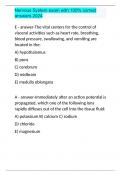
Nervous System exam with 100% correct answers 2024
E - answer-The vital centers for the control of visceral activities such as heart rate, breathing, blood pressure, swallowing, and vomiting are located in the: A) hypothalamus B) pons C) cerebrum D) midbrain E) medulla oblongata A - answer-Immediately after an action potential is propagated, which one of the following ions rapidly diffuses out of the cell into the tissue fluid: A) potassium B) calcium C) sodium D) chloride E) magnesium B - answer-The blood-brain barrier is effective against the passage of: A) nutrients such as glucose B) metabolic waste such as urea C) water D) anesthetics E) alcohol A - answer-The sympathetic and parasympathetic nervous systems are subdivisions of the: A) autonomic nervous system B) voluntary nervous system C) somatic nervous system D) central nervous system E) peripheral nervous system E - answer-An action potential: A) involves the outflux of negative ions to depolarize the membrane B) involves the influx of negative ions to depolarize the membrane C) is initiated by potassium ion movements D) involves the outflux of positive ions to depolarize the membrane E) is essential for nerve impulse propagation A - answer-Cell bodies of the sensory neurons of the spinal nerves are located in: A) the dorsal root ganglia of the spinal cord B) the thalamus C) the hypothalamus D) the ventral root ganglia of the spinal cord E) sympathetic ganglia B - answer-7) The effects of the sympathetic nervous system are essentially opposite of the: A) motor division B) parasympathetic nervous system C) sensory division D) central nervous system E) autonomic nervous system A - answer-Cerebrospinal fluid circulates through all of the following except: A) corpus callosum B) lateral ventricles C) fourth ventricle D) cerebral aqueduct E) subarachnoid space B - answer-Sally has a brain injury; she knows what she wants to say but canʹt vocalize the words. The part of her brain that deals with the ability to speak is the: A) central sulcus B) Brocaʹs area C) primary motor area D) longitudinal fissure E) gyrus A - answer-Which of these cells are not a type of neuroglia found in the CNS: A) Schwann cells B) oligodendrocytes C) ependymal cells D) astrocytes E) microglia D - answer-17) The elevated ridges of tissue on the surface of the cerebral hemispheres are known as __________ while the shallow grooves are termed __________. A) sulci; gyri B) tracts; ganglia C) ganglia; gyri D) gyri; sulci E) receptors; effectors C - answer-An action potential is caused by an influx of these ions into the cell: A) both potassium and sodium B) potassium C) sodium D) magnesium E) calcium A - answer-The function of the olfactory nerve concerns: A) smell B) chewing C) vision D) eye movement E) hearing B - answer-The gap between two communicating neurons is termed: A) node of Ranvier B) synaptic cleft C) effector D) cell body E) Schwann cell C - answer-The area of the brain stem that plays a role in consciousness and the awake/sleep cycles is the: A) cerebellum B) thalamus C) reticular activating system (RAS) D) pineal gland E) limbic system E - answer-A neuron with a cell body located in the CNS whose primary function is connecting other neurons is called a(n): A) efferent neuron B) glial cell C) afferent neuron D) satellite cell E) association neuron B - answer-Afferent nerves are called __________, and motor nerves are called __________. A) peripheral nerves; cranial nerves B) sensory nerves; efferent nerves C) cranial nerves; peripheral nerves D) motor nerves; sensory nerves E) mixed nerves; motor nerves D - answer-Loss of muscle coordination results from damage to the: A) hypothalamus B) cerebrum C) midbrain D) cerebellum E) thalamus D - answer-The olfactory area is found within the: A) occipital lobe B) parietal lobe C) frontal lobe D) temporal lobe E) pyramidal tract D - answer-The sciatic nerve is the largest nerve in the body resulting from a combination of which two nerves: A) pudendal and femoral nerves B) pudendal and common peroneal nerves C) pudendal and tibial nerves D) common fibular and tibial nerves E) femoral and tibial nerves D - answer-The substance that is released at axonal endings to propagate a nervous impulse is called: A) an ion B) an action potential C) the sodium-potassium pump D) a neurotransmitter E) nerve glue E - answer-Impulse conduction is fastest in neurons that are: A) sensory B) unmyelinated C) cerebral D) motor E) myelinated A - answer-Which one of the following represents the correct sequence from outermost to innermost layers of the meninges: A) dura mater, arachnoid mater, pia mater B) pia mater, dura mater, arachnoid mater C) arachnoid mater, dura mater, pia mater D) dura mater, pia mater, arachnoid mater E) pia mater, arachnoid mater, dura mater A - answer-The diffusion of potassium ions out of a neuron causes it to experience: A) repolarization B) an action potential C) a nerve impulse D) a graded potential E) depolarization B - answer-Damage to this nerve results in ʺwristdrop,ʺ the inability to extend the hand at the wrist: A) obturator B) radial C) axillary D) phrenic B - answer-35) Which of the following is a traumatic brain injury: A) aphasia B) cerebral edema C) cerebrovascular accident (CVA) D) Parkinsonʹs disease E) Alzheimerʹs disease A - answer-The peripheral nervous system consists of: A) the spinal and cranial nerves B) the brain and spinal cord C) spinal nerves only D) cranial nerves only E) the brain only E) femoral B - answer-The neuron processes that normally receive incoming stimuli are called: A) Schwann cells B) dendrites C) neurolemmas D) satellite cells E) axons E - answer-The cerebrospinal fluid: A) enters the four ventricles after filling and circulating through the subarachnoid space B) is secreted by the arachnoid villi C) is identical in composition to whole blood D) is secreted mostly by the ependymal cells lining the brain ventricles E) is continually formed mostly by the choroid plexuses E - answer-The term central nervous system refers to the: A) spinal cord and spinal nerves B) autonomic and peripheral nervous systems C) brain, spinal cord, and cranial nerves D) brain and cranial nerves E) brain and spinal cord D - answer-Which one of these effectors is NOT directly controlled by the autonomic nervous system: A) smooth muscle B) cardiac muscle C) most glands D) skeletal muscle E) abdominal organs D - answer-In contrast to the somatic nervous system, the autonomic nervous system: A) stimulates its effector cells B) has centers in the brain and spinal cord C) has both afferent and efferent fibers D) has two motor neurons E) has two afferent neurons C - answer-Which of the following is the correct sequence in a typical reflex arc: A) receptor, afferent neuron, efferent neuron, integration center, effector B) effector, efferent neuron, integration center, afferent neuron, receptor C) receptor, afferent neuron, integration center, efferent neuron, effector D) effector, afferent neuron, integration center, efferent neuron, receptor E) receptor, efferent neuron, integration center, afferent neuron, effector C - answer-The ability to respond to a stimulus is termed: A) polarized B) depolarized C) irritability D) all-or-none response E) conductivity C - answer-Which of the following effects is characteristic of the parasympathetic nervous system: A) increases metabolic rate B) stimulates sweat glands to produce perspiration C) decreases heart rate D) decreases urine output E) decreases activity of the digestive system B - answer-The midbrain, pons, and medulla oblongata are housed in the: A) diencephalon B) brain stem C) pineal gland D) hypothalamus E) cerebellum B - answer-Collections of nerve cell bodies inside the CNS are called: A) nuclei B) ganglia C) nerves D) tracts E) tracts or ganglia C - answer-The Schwann cell forms a myelin sheath around the: A) nucleus B) cell body C) axon D) nodes of Ranvier E) dendrites A - answer-The pituitary gland is most closely associated with the: A) hypothalamus B) medulla oblongata C) pineal gland D) midbrain E) thalamus A - answer-Muscles and glands are: A) effectors B) part of the central nervous system C) part of the peripheral nervous system D) receptors E) myelinated D - answer-White matters refers to myelinated fibers in the: A) SNS B) PNS C) ANS D) CNS E) both ANS and SNS C - answer-Control of temperature, endocrine activity, metabolism, and thirst are functions associated with the: A) thalamus B) cerebellum C) hypothalamus D) medulla oblongata E) cerebrum E - answer-The subarachnoid space lies directly between the: A) arachnoid mater and cerebellum B) arachnoid mater and cerebrum C) skull and arachnoid mater D) arachnoid mater and dura mater E) arachnoid mater and pia mater C - answer-The three major parts of the brain stem are the: A) basal nuclei, pineal body, and choroid plexus B) dura mater, arachnoid mater, and pia mater C) midbrain, pons, and medulla oblongata D) thalamus, epithalamus, and hypothalamus E) cerebrum, cerebellum, and diencephalon
Document information
- Uploaded on
- May 19, 2024
- Number of pages
- 20
- Written in
- 2023/2024
- Type
- Exam (elaborations)
- Contains
- Questions & answers


