
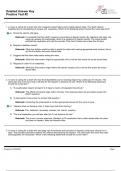
Exam 2 Practice ATI Detailed Answer Key 2024 with 100%Correct Answers.
Exam 2 Practice ATI Detailed Answer Key 2024 with 100%Correct Answers. 1. A nurse is caring for a client who has congestive heart failure and is taking digoxin daily. The client refused breakfast and is complaining of nausea and weakness. Which of the following actions should the nurse take first? A. Check the client's vital signs. Rationale: It is possible that the client's nausea is secondary to digoxin toxicity. By obtaining vital signs, the nurse can assess for bradycardia, which is a symptom of digoxin toxicity. The nurse should withhold the medication and call the provider if the client's heart rate is less than 60 bpm. B. Request a dietitian consult. Rationale: While the dietitian might be able to assist the client with making appropriate food choices, this is not the first action the nurse should take. C. Suggest that the client rests before eating the meal. Rationale: While this intervention might be appropriate, this is not the first action the nurse should take. D. Request an order for an antiemetic. Rationale: While this intervention might relieve the client's nausea, this is not the first action the nurse should take. 2. A nurse is caring for a client who has thrombophlebitis and is receiving heparin by continuous IV infusion. The client asks the nurse how long it will take for the heparin to dissolve the clot. Which of the following responses should the nurse give? A. "It usually takes heparin at least 2 to 3 days to reach a therapeutic blood level." Rationale: The effects of heparin begin within minutes. This response does not accurately answer the client's question. B. "A pharmacist is the person to answer that question." Rationale: Contacting the pharmacist is not the appropriate answer for the nurse to give. C. "Heparin does not dissolve clots. It stops new clots from forming." Rationale: This statement accurately answers the client's question. D. "The oral medication you will take after this IV will dissolve the clot." Rationale: This is not a correct response. Warfarin, a PO medication that is often started after the client has been on heparin, does not dissolve clots. 3. A nurse is caring for a client who has deep vein thrombosis and has been on heparin continuous infusion for 5 days. The provider prescribes warfarin PO without discontinuing the heparin. The client asks the nurse why both anticoagulants are necessary. Which of the following statements should the nurse make? Detailed Answer Key Practice Test #2 Created on:02/26/2024 Page 2 A. "Warfarin takes several days to work, so the IV heparin will be used until the warfarin reaches a therapeutic level." Rationale: Heparin and warfarin are both anticoagulants that decrease the clotting ability of the blood and help prevent thrombosis formation in the blood vessels. However, these medications work in different ways to achieve therapeutic coagulation and must be given together until therapeutic levels of anticoagulation can be achieved by warfarin alone, which is usually within 1 to 5 days. When the client's PT and INR are within therapeutic range, the heparin can be discontinued. B. "I will call the provider to get a prescription for discontinuing the IV heparin today." Rationale: Discontinuing the IV heparin is not indicated at this time. C. "Both heparin and warfarin work together to dissolve the clots." Rationale: Neither medication dissolves clots that have already formed. D. "The IV heparin increases the effects of the warfarin and decreases the length of your hospital stay." Rationale: Neither medication increases the effects of the other. 4. A nurse caring for a client who has hypertension and asks the nurse about a prescription for propranolol. The nurse should inform the client that this medication is contraindicated in clients who have a history of which of the following conditions? A. Asthma Rationale: Propranolol, a beta-blocker, is contraindicated in clients who have asthma because it can cause bronchospasms. Propranolol blocks the sympathetic stimulation, which prevents smooth muscle relaxation. B. Glaucoma Rationale: Beta-blockers are contraindicated in clients who have cardiogenic shock, but are not contraindicated in a client who has glaucoma. C. Depression Rationale: Beta-blockers are contraindicated in clients who have AV heart block, but are not contraindicated in clients who have depression. D. Migraines Rationale: Beta-blockers are used for prophylactic treatment of migraine headaches. 5. A nurse is preparing to administer verapamil by IV bolus to a client who is having cardiac dysrhythmias. For which of the following adverse effects should the nurse monitor when giving this medication? A. Hyperthermia Rationale: Temperature is not affected by verapamil. Detailed Answer Key Practice Test #2 Created on:02/26/2024 Page 3 B. Hypotension Rationale: Verapamil, a calcium channel blocker, can be used to control supraventricular tachyarrhythmias. It also decreases blood pressure and acts as a coronary vasodilator and antianginal agent. A major adverse effect of verapamil is hypotension; therefore, blood pressure and pulse must be monitored before and during parenteral administration. C. Ototoxicity Rationale: Verapamil is not toxic to the ear. D. Muscle pain Rationale: Verapamil does not cause muscle pain. 6. A nurse is caring for a client who has heart failure and a prescription for digoxin. Which of the following statements by the client indicates an adverse effect of the medication? A. "I can walk a mile a day." Rationale: Improving the client's cardiac output, which in turn will improve the client's exercise tolerance, is a therapeutic response to digoxin. B. "I've had a backache for several days." Rationale: Backaches are not an adverse effect of digoxin. C. "I am urinating more frequently." Rationale: Detailed Answer Key Practice Test #2 Created on:02/26/2024 Page 4 Improving the client's cardiac output, which in turn will increase blood flow to the kidneys and urination, is a therapeutic response to digoxin. D. "I feel nauseated and have no appetite." Rationale: Anorexia, nausea, vomiting, and abdominal discomfort are early signs of digoxin toxicity. 7. A nurse is caring for a client who is taking lisinopril. Which of the following outcomes indicates a therapeutic effect of the medication? A. Decreased blood pressure Rationale: Lisinopril, an ACE inhibitor, may be used alone or in combination with other antihypertensives in the management of hypertension and congestive heart failure. A therapeutic effect of the medication is a decrease in blood pressure. B. Increase of HDL cholesterol Rationale: This is not an intended effect of lisinopril. C. Prevention of bipolar manic episodes Rationale: This is not an intended effect of lisinopril. D. Improved sexual function Rationale: This is not an intended effect of lisinopril. Lisinopril may in fact cause sexual dysfunction and impotence.
Document information
- Uploaded on
- May 16, 2024
- Number of pages
- 55
- Written in
- 2023/2024
- Type
- Exam (elaborations)
- Contains
- Questions & answers


