ACSM EP Exam (Everything)100% CORECT SOLUTION GRADE A+ GUARANTEED
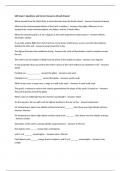
Which of the following is the MOST important exercise variable in preventing injuries? a. High intensity b. Longer bouts of duration c. Consecutive days of training d. Slow and gradual progression d. Slow and gradual progression The Framingham Heart Study started as a large cohort study in 1948 with the purpose of identifying and examining the effects of various risk factors for the development of which disease process? a. Cardiovascular disease b. Neuromotor disease c. Pulmonary disease d. Metabolic disease a. Cardiovascular disease To lessen the chance of injury, the ACSM-EP should: a. Assess the client's goal and rewrite it to be more realistic based on exercise testing results. b. Be diligent in choosing exercise modes and prescribing exercises that are based on an individual's current fitness level and desires. c. Determine the client's intensity threshold and work 10% of the time above that threshold for adaptation purposes. d. Start at a moderate to high level of intensity, frequency, and duration and progress slowly. b. Be diligent in choosing exercise modes and prescribing exercises that are based on an individual's current fitness level and desires. Which of the following is a skill-related parameter that might be addressed in a client's exercise program? a. Balance b. Flexibility c. Aerobic capacity d. Body composition a. Balance Which of the following is MOST accurate regarding submaximal exercise testing? a. It is generally considered safe for most individuals b. It requires medical supervision from a physician or other trained professional c. It requires medical clearance from the client's primary health care provider d. It is indicated for individuals under 45 years of age a. It is generally considered safe for most individuals For individuals younger than 30 years of age, the most common cause(s) of sudden cardiac death is/are: a. Head and cervical spine trauma. b. Congenital and hereditary abnormalities. c. Chronic obstructive pulmonary disease. d. Coronary artery disease. b. Congenital and hereditary abnormalities. Which of the following activities has the lowest risk of musculoskeletal injury? a. Weightlifting b. Jogging c. Basketball d. Walking d. Walking A 1995 joint position statement of the ACSM and CDC recommended that every adult accumulate how many minutes of activity per day? a. 60 minutes b. 10 minutes c. 30 minutes d. 15 minutes c. 30 minutes Which of the following is a skill-related aspect of physical activity? a. Strength b. Ability c. Coordination d. Endurance c. Coordination Which of the following is the most common risk factor that is associated with exercise? a. Sprain of the shoulder joint b. Injuries at the lumbar spine c. Injuries at the knee or foot d. Strain of the rotator cuff c. Injuries at the knee or foot Which of the following BEST describes the mechanism for the cause of sudden cardiac death? a. An erratic atrial rhythm during diastole b. A drop in blood pressure below 90/60 mm Hg c. Hypertensive response at rest or during exercise d. Plaque buildup that dislodges from an artery and causes a blood clot d. Plaque buildup that dislodges from an artery and causes a blood clot To minimize any emergent event during exercise testing or training, it is critical that the ACSM-EP: a. Assess the client's exercise intensity threshold and maintain intensity below it. b. Post highly visible emergency procedures and phone numbers in prominent areas. c. Conduct appropriate screening on each client as a first step. d. Obtain a signed informed consent to minimize liability. c. Conduct appropriate screening on each client as a first step. How can the total amount of energy expenditure associated with physical activity be determined? a. By considering the intensity of the activity b. By considering the duration of the activity c. By considering the frequency of the muscular contractions involved in the activity d. By determining the amount of muscle mass producing bodilty movements and the intensity, duration, and frequency of muscular contractions d. By determining the amount of muscle mass producing bodilty movements and the intensity, duration, and frequency of muscular contractions The relationship between physical activity and risk of developing cardiovascular disease can best be described as: a. Scientifically proven. b. Questionable pending further research. c. Dependent on CVD risk profile. d. A dose-response relationship. d. A dose-response relationship. The 2007 update to an ACSM/CDC recommendation for activity focused on the frequency recommendation; instead of "most, preferably all, days of the week," the update was changed to: a. Five days each week. b. Seven days a week. c. Most days of the week. d. All days of the week. a. Five days each week. Which of the following is the BEST way to minimize the risk of musculoskeletal injury as a client begins an exercise program? a. Set realistic exercise goals for the program b. Use programs that are effective with other clients c. Avoid the use of free weights for strength training d. Utilize lower-intensity, longer-duration cardio exercise a. Set realistic exercise goals for the program The skill-related components of physical fitness include: a. Speed, flexibility, coordination, balance, power, and strength. b. Agility, speed, coordination, balance, reaction time, and endurance. c. Speed, agility, coordination, balance, power, and reaction time. d. Agility, flexibility, coordination, balance, power, and endurance. c. Speed, agility, coordination, balance, power, and reaction time. Cardiovascular disease incidence and mortality are inversely related to both physical activity and: a. Strength. b. Physical Fitness. c. Weight. d. Age. b. Physical Fitness. For high school and college athletes, preparticipation screening primarily functions to: a. Detect potential cardiac issues. b. Assess joint integrity. c. Detect muscle weakness and imbalance. d. Assess functional capacity. a. Detect potential cardiac issues. Numerous epidemiological research efforts have demonstrated an inverse relationship between physical activity and: a. Morbidity. b. Cardiovascular disease. c. Health. d. Cancer. b. Cardiovascular disease. An update from a 2007 ACSM/CDC joint statement indicates that physical activity bouts of at least how many minutes can be accumulated toward the recommended total amount of daily physical activity? a. 5 minutes b. 10 minutes c. 15 minutes d. 30 minutes b. 10 minutes Over the past five decades, it has been estimated that occupational energy expenditure has declined by approximately how many calories per day? a. 50 b. 100 c. 250 d. 500 b. 100 Which of the following is a criterion used to determine if an individual could be classifed as sedentary/physically inactive? a. The performance of at least 30 minutes of moderate-intensity physical activity, on at least five days per week, performed for at least three months. b. The performance of at least 30 minutes of vigorous-intensity physical activity, on at least two days per week, performed for at least three months. c. The performance of at least 30 minutes of moderate-intensity physical activity, on at least five days per week, performed for at least one month. d. The performance of at least 30 minutes of vigorous-intensity physical activity, on at least three days per week, performed for at least one month. a. The performance of at least 30 minutes of moderate-intensity physical activity, on at least five days per week, performed for at least three months. The Aerobics Center Longitudinal Study has demonstrated that more physically fit individuals have reduced risk of cardiovascular disease and: a. Cancer. b. Stroke. c. Mortality. d. Heart disease. c. Mortality. To minimize musculoskeletal injury from the outset, which of the following should be prioritized? a. Beginning the client's program with a balanced circuit training regimen b. Making the client aware of early signs of potential injury c. Advising the client to "work through" pain d. Starting with high intensity during strength training b. Making the client aware of early signs of potential injury You notice a member of your fitness facility on the elliptical trainer who is shaking her left arm and rubbing her chest. She states that she is okay and tells you her chest is feeling tight. You should: a. Explain and demonstrate how she can later stretch her chest after her cool-down. b. Suggest that she switch to a nonweight-bearing mode such as cycling. c. Stop the exercise, have her immediately cool down by walking around, and monitor for additional signs or symptoms. d. Let her know that you were concerned, and encourage her to keep exercising. c. Stop the exercise, have her immediately cool down by walking around, and monitor for additional signs or symptoms. A 57-year-old female completes the PAR-Q+, answers "YES" to questions #3 and #6 on page 1. She then completes pages 2 and 3, answering "YES" to multiple follow-up questions on those pages. What is the recommended course of action for this individual? a. She may begin independent physical activity immediately b. She should seek physician consent prior to beginning physical activity c. She may begin supervised physical activity only d. She should wait one year and fill out the PAR-Q+ again at that time b. She should seek physician consent prior to beginning physical activity The primary purpose of the informed consent is to: a. Inform the participant of any personal and confidential information that will be collected. b. Inform of any risks involved with exercise testing and/or exercise training. c. Inform of the purpose of all exercise tests that will be performed. d. Inform how the data collected will be stored. e. All of the answers are correct. e. All of the answers are correct. Which of the following allows for a self-guided screening prior to physical activity? a. Physical Activity Readiness Questionnaire-Plus b. Global Physical Activity Questionnaire c. Minnesota Leisure Time Activity Survey d. Jenkins Activity Survey a. Physical Activity Readiness Questionnaire-Plus The risk factor for obesity is a BMI at or greater than: a. 45 kg/m2. b. 30 kg/m2. c. 15 kg/m2. d. 60 kg/m2 b. 30 kg/m2. Initial interviews with clients should include health history, exercise readiness forms, and inquiries about: CONTINUED
École, étude et sujet
- Établissement
- ACSM EP
- Cours
- ACSM EP
Infos sur le Document
- Publié le
- 16 mai 2024
- Nombre de pages
- 145
- Écrit en
- 2023/2024
- Type
- Examen
- Contient
- Questions et réponses
Sujets
-
which of the following is the most important exerc
-
the framingham heart study started as a large coho
-
to lessen the chance of injury the acsm ep should