
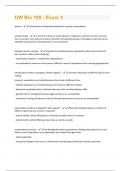
UW Bio 180 - Exam 3 questions and answers graded A+
species - evolutionarily independent population or group of populations synapomorphy - a trait that is found in certain groups of organisms and their common ancestor, but is missing in more distant ancestors; identifies monophyletic groups; homologous traits that can be identified at the genetic, developmental, or structural level biological species concept - reproductive isolation between populations (they don't breed and don't produce viable, fertile offspring) - reproductive isolation = evolutionary independence - not applicable to asexual or fossil species; difficult to assess if populations don't overlap geographically reproductive isolation: prezygotic ("before-zygote") - prevents individuals of different species from mating temporal: populations are isolated because they breed at different times - habitat: populations are isolated because they breed in different habitats - behavioral: populations don't interbreed because their courtship displays differ - gametic barrier: matings fail because eggs and sperm are incompatible - mechanical: matings fail because male and female reproductive structures are incompatible reproductive isolation: postzygotic ("after-zygote") - offspring of matings between members of different species do not survive or reproduce - hybrid viability: hybrid offspring don't develop normally and die as embryos - hybrid sterility: hybrid offspring mature but are sterile as adults morphospecies concept - morphologically distinct populations; distinguishing features are most likely to arise if populations are independent and isolated from gene flow - widely applicable - researchers disagree how much or what kinds of morphological distinction indicate speciation- misidentifies polymorphic species; misses cryptic species polymorphic species - a species with many different morphological types or stages or more than one phenotype cryptic species - differ in traits other than morphology phylogenetic species concept - identifies species based on the evolutionary history of populations - all species form a monophyletic group - species are defined as the smallest monophyletic group on a phylogentic tree - widely applicable; based on testable criteria - relatively few well-estimated phylogenies are currently available monophyletic ("one-tribe") group - evolutionary unit that includes an ancestral population and all of its descendants but no other (also called a lineage, or clade) subspecies - populations that live in discrete geographic areas and have distinguishing features, but aren't distinct enough to be called separate species speciation - a process typically caused by the genetic isolation from a main population resulting in a new genetically distinct species (the first requirement of speciation is the interruption of gene flow) allopatry ("different-homeland") - condition in which two or more populations live in different geographic areas allopatric speciation - speciation that begins with geographic isolation, occurs through dispersal or vicariance vicariance - the physical splitting of a habitat into two or more subgroups that are physically isolated from one anotherbiogeography - the study of how species and populations are distributed geographically sympatry - condition in which two or more populations live in the same geographic area, or close enough to permit interbreeding sympatric speciation - speciation that occurs when there is no geographic barrier present - based on external events such as disruptive selection for extreme phenotypes based on different ecological niches - based on internal events such as chromosomal mutations polyploidy - occurs when an error in meiosis or mitosis results in a doubling of the chromosome number (this is a massive mutation). polyploid individuals are reproductively isolated from the original diploid population and thus evolutionarily independent because breeding between diploids and tetraploids generally results in sterile offspring 1. autopolyploid 2. allopolyploid autopolyploid ("same-many-form") - individuals are produced when a mutation results in a doubling of chromosome number and the chromosomes all come from the same species allopolyploid ("different-many-form") - individuals are created when parents that belong to different species mate and produce offspring with two different sets of chromosomes phylogeny - evolutionary history of a group of organisms phylogenetic tree - a family tree that shows the evolutionary ancestor-descendant relationships among populations, species, or higher taxa thought to exist among groups of organisms branch - represents a population through time node - a fork that within a tree where a branch splits into two or more branchesoutgroup - a taxon that is outside of the taxa being looked at; this species diverged prior to the taxa being looked at root - most ancestral branch of the tree tip (terminal node) - endpoint of a branch; represents a living or extinct group of genes, species, families, phyla, or other taxa polytomy - a branch point from which more than two descendant taxa emerge; indicates that the evolutionary relationships among the descendant taxa are not yet clear
Document information
- Uploaded on
- May 16, 2024
- Number of pages
- 7
- Written in
- 2023/2024
- Type
- Exam (elaborations)
- Contains
- Questions & answers


