
UW Psych 202 Final Exam Review Questions & Answers Already Graded A+
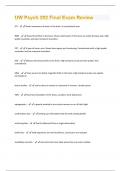
DTI - Shows movement of water in the brain. A connectional scan. fMRI - Scans blood flow in the brain. Shows which parts of the brain are active during a task. High spatial resolution and poor temporal resolution. PET - A type of tracer scan. Shows how organs are functioning. Connectional with a high spatial resolution and low temporal resolution EEG - Detects electrical activity in the brain. High temporal acuity and low spatial. Also correlational. MEG - Uses sensors to detect magnetic fields in the brain. High temporal acuity, low spatial. Correlational lesion studies - can be done in animals or observed in humans. Usually causal TMS - Electrical stimulation of the brain, usually to treat depression. optogenetics - a genetic method to turn select neurons on or off with light confirmation bias - Seeking out information that fits with existing beliefs anchoring bias - Overly influenced from a single observation belief bias - Valid arguments are hard to believe, conclusions are rejected availability heuristic - Scenarios feel more likely when they are easily recalledaffect heuristic - "How do I feel about it?" rather than "What do I think about it?" illusory correlational - Perceiving a relationship between events not actually connected peripheral nervous system - somatic and autonomic nervous sytem central nervous system - brain and spinal cord somatic nervous system - how we perceive what's going on with our body (sensations) and respond to those perceptions (voluntary movements) autonomic nervous system - involuntary perception and regulation within our body parasympathetic nervous system - rest and regeneration sympathetic - fight or flight forebrain - telencephalon and diencephalon midbrain - mesencephalon hindbrain - metencephalon and myelencephalon telencephalon - cortex, basal ganglia, limbic system diencephalon - thalamus, hypothalamus, pituitary
Document information
- Uploaded on
- May 16, 2024
- Number of pages
- 10
- Written in
- 2023/2024
- Type
- Exam (elaborations)
- Contains
- Questions & answers


