
• Wrong document? Swap it for free
  • Written by students who passed
  • Immediately available after payment
  • Read online or as PDF
Sell
Where do you study
Your language
Document preview thumbnail
Preview 2 out of 6 pages
Exam (elaborations)

WSU-Human Development Exam 1 fully solved & updated

Document preview thumbnail
Preview 2 out of 6 pages

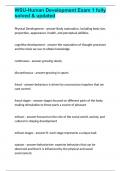
Physical Development - answer-Body maturation, including body size, proportion, appearance, health, and perceptual abilities. cognitive development - answer-the maturation of thought processes and the tools we use to obtain knowledge continuous - answer-growing slowly discontinuous - answer-growing in spurts freud - answer-behaviour is driven by unconscious impulses that we cant control freud stages - answer-stages focused on different parts of the body, making stimulation to those parts a source of pleasure erikson - answer-focused on the role of the social world, society, and cultural in shaping development erikson stages - answer-8- each stage represents a unique task watson - answer-behaviorism- examine behaviors that can be observed and that it is influenced by the physical and social environment classical condition - answer-pavlov- the baby and the forehead finger. a form of learning in which the person comes to associate environment stimuli w physiological operant conditioning - answer-skinner-repeat behavior that have pleasant outcome and stop behavior with unpleasant outcomes social learning theory - answer-Albert Bandura- role of thought and emotions as contributors to development. ng bad about an action and not doing it again. observational learning - answer-Albert Bandura- we learn by watching others reciprocal determinism - answer-individuals and the environment interact with each other . individuals as active in their development cognitive theory - answer-the role of thought on behavior piagets cognitive theory - answer-active explorers of our world, learning by interacting with the world around us. prigets cognitive theory stages - answer-4 sensorimotor preoperational concrete operational formal operational information processing theory - answer-views thinking as information processing(computer) vygotsky sociocultural theory - answer-culture is transmitted from one generation to the next . interaction with more mature peers bronferbrenners - answer-micro-family meso-family vs school exo-setting macro-culture chro-time ethology - answer-study of the evolutionary history of behavior and its survival value evolutionary development theory - answer-proposes that behavioral patterns in child and adult development are present because they help us survive, reproduce, or acquire resources that support survival and reproduction self-report measures - answer-interviews and questionnaires. in person, phone, or internet open-ended interview - answer-flexible. begins with a question and then falls up with a question. per,ts participation to explain thought in their own way structured interview - answer-less flexible. same questions to everyone Naturalists observation - answer-observe, record behavior in natural real-world setting structured observation - answer-recorded behavior in a cultural environment case study - answer-gathering info from many vations, interviews, conversations, family and peers correlation research - answer-examine relations among measured characteristic, behaviors, and events experiment research - answer-procedure that use control to determine causal relationships among factors knows as variables dependent - answer-manipulated systematically by the researcher during experiment independent variable - answer-expected to change ? cross-sectional research - answer-comparing groups of people of different ages at one time longitudinal research - answer-a group of people studied at many points in time sequential research - answer-info about age, cohort, age-related change informed consent - answer-they're informed voluntariness - answer-people have the right to conceal their identity on all information and reports obtained in the course of reacher child-centered - answer-kids taking learning into their own hands academically centered programmed - answer-teacher-directed programs associated with some problem how does culture influence the education environment? - answer-efe children learn through attendshool. labor work. little adult-child interaction

Content preview

WSU-Human Development Exam 1 fully
solved & updated
Physical Development - answer-Body maturation, including body size,
proportion, appearance, health, and perceptual abilities.
cognitive development - answer-the maturation of thought processes
and the tools we use to obtain knowledge
continuous - answer-growing slowly
discontinuous - answer-growing in spurts
freud - answer-behaviour is driven by unconscious impulses that we cant control
freud stages - answer-stages focused on different parts of the body, making stimulation to those parts a source of pleasure
erikson - answer-focused on the role of the social world, society, and cultural in shaping development
erikson stages - answer-8- each stage represents a unique task
watson - answer-behaviorism- examine behaviors that can be observed and that it is influenced by the physical and social environment WSU-Human Development Exam 1 fully
solved & updated
classical condition - answer-pavlov- the baby and the forehead finger.
a form of learning in which the person comes to associate environment stimuli w physiological
operant conditioning - answer-skinner-repeat behavior that have pleasant outcome and stop behavior with unpleasant outcomes
social learning theory - answer-Albert Bandura- role of thought and emotions as contributors to development. ex.feeling bad about an action and not doing it again.
observational learning - answer-Albert Bandura- we learn by watching others
reciprocal determinism - answer-individuals and the environment interact with each other . individuals as active in their development
cognitive theory - answer-the role of thought on behavior
piagets cognitive theory - answer-active explorers of our world, learning by interacting with the world around us.
prigets cognitive theory stages - answer-4


Document information

Uploaded on
May 15, 2024
Number of pages
6
Written in
2023/2024
Type
Exam (elaborations)
Contains
Questions & answers
$8.49

Wrong document? Swap it for free Within 14 days of purchase and before downloading, you can choose a different document. You can simply spend the amount again.
Written by students who passed
Immediately available after payment
Read online or as PDF

Seller avatar
Reputation scores are based on the amount of documents a seller has sold for a fee and the reviews they have received for those documents. There are three levels: Bronze, Silver and Gold. The better the reputation, the more your can rely on the quality of the sellers work.
BRAINSCAPE1
4.4
(20)
Sold
142
Followers
15
Items
11130
Last sold
1 week ago


Why students choose Stuvia

Created by fellow students, verified by reviews

Quality you can trust: written by students who passed their tests and reviewed by others who've used these notes.

Didn't get what you expected? Choose another document

No worries! You can instantly pick a different document that better fits what you're looking for.

Pay as you like, start learning right away

No subscription, no commitments. Pay the way you're used to via credit card and download your PDF document instantly.

Student with book image

“Bought, downloaded, and aced it. It really can be that simple.”

Alisha Student

Working on your references?

Create accurate citations in APA, MLA and Harvard with our free citation generator.

Working on your references?

Frequently asked questions
