
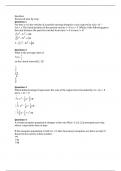
For time t ≥ 0, the velocity of a particle moving along the x-axis is given by v(t) = x3 − 3x2 + x. The initial position of the particle at time t = 0 is x = 3. Which of the following gives the total distance the particle traveled from time t = 0 to time
Question Answered step-by-step Question 1 For time t ≥ 0, the velocity of a particle moving along the x-axis is given by v(t) = x3 − 3x2 + x. The initial position of the particle at time t = 0 is x = 3. Which of the following gives the total distance the particle traveled from time t = 0 to time t = 4? Question 2 What is the average value of on the closed interval [1, 3]? Question 3 Which definite integral represents the area of the region that is bounded by 3x + 3y2 = 0 and y = 2x + 1? Question 4 A certain mosquito population changes at the rate M(t) = 12.1(1.2)t mosquitos per day, where t represents time in days. If the mosquito population is 649 at t = 0, then how many mosquitos are there on day 5? Round to the nearest whole number. 99 735 748Question 5 The water level of a certain body of water is changing at a rate of inches per hour, where t represents hours since 12 a.m. Part A: Using correct units, explain the meaning of in terms of the context of this problem. (1 point) Part B: Write the integral that represents the number of inches that the water level changes from 10 a.m. to 3 p.m. Part C: Use your calculator to evaluate your integral from Part B. Explain the meaning of the answer in terms of the context. Part D:What is the average hourly number of inches that the water level changes for this lake in one day? Question 6 For the regions A and B shown in the graph: Part A: Discuss the limits of integration. Part B: Set up an integral expression that represents the total area. Part C: Calculate the total area. Image transcription text
Document information
- Uploaded on
- May 14, 2024
- Number of pages
- 14
- Written in
- 2023/2024
- Type
- Exam (elaborations)
- Contains
- Questions & answers


