

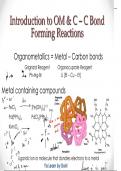
One of the LM in Organic Chemistry
For Organic Chemistry, class notes are particularly crucial due to the complexity and volume of material covered. These notes should include detailed descriptions of chemical reactions, mechanisms, and the structure and properties of organic molecules. Efficient notes often feature: Reaction Equations and Mechanisms: Clear illustrations of reactions, including reactants, products, and intermediates. Annotations may indicate conditions like temperature and catalysts. Structural Formulas: Detailed drawings of molecular structures, including functional groups and stereochemistry. Important Definitions and Terminology: Concise explanations of key terms like electrophilicity, nucleophilicity, and resonance. Examples and Problem Solving: Typical examples discussed in class, along with step-by-step breakdowns of problem-solving techniques used in organic transformations. Summaries of Key Concepts: Quick-reference summaries of major topics like reaction types (addition, elimination, substitution), synthesis strategies, and analytical methods used in organic chemistry. Organizing these notes in a logical sequence that mirrors your coursework can greatly enhance your ability to understand and apply organic chemistry principles effectively.
Document information
- Uploaded on
- May 13, 2024
- Number of pages
- 22
- Written in
- 2023/2024
- Type
- Class notes
- Professor(s)
- Dr.friese
- Contains
- Lm18


