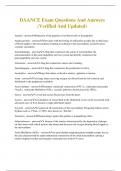
DAANCE Exam Questions And Answers (Verified And Updated)
DAANCE Exam Questions And Answers (Verified And Updated) Anemia - answerReduction of the quantity of red blood cells or hemoglobin. Angina pectoris - answerChest pain with the feeling of suffocation usually due to deficiency of blood supply to the myocardium resulting in ischemia to the myocardium, caused by poor coronary circulation. Anticholinergic - answerA drug that counteracts the action of ecetylcholine, the neurotransmitter of the parasympathetic nervous system and thereby counteracts the parasympathetic nervous system. Antiemetic - answerA drug that counteracts nausea and vomiting. Antisialogogue - answerA drug that counteracts the production of saliva. Anxiolytics - answerDrugs that reduce or dissolve anxiety, agitation or tension. Aorta - answerVery large artery receiving oxygen rich blood from the left ventricle and distributed to the peripheral circulation. Arrest rhythms - answerPremature ventricular contractions (PVC's), ventricular tachycardia (Vtach.), ventricular fibrillation (Vfib.), asystole, pulseless electrical activity (PEA). Artery - answerA vessel that carries blood away from the heart. Ascites - answerAccumulation of serous fluid in the abdominal cavity can be associated with advanced cases of liver disease or right sided heart failure. Asystole - answerCessation of all contractions of the myocardium. Frequently follows arrest rhythms such as VTack. or VFib. Also known as "flat line". Ataractics - answerPharmacologic agents that produce a tranquilizing effect. Atherosclerosis - answerA disease of the arteries characterized by the deposition of plaque on their inner walls which narrows the lumen and decreases the oxygen-bearing blood supply to the myocardium Atrial fibrillation (AFib.) - answerAn atrial rhythm originating from multiple ectopic foci in the atria characterized by rapid randomized contractions of the atrial myocardium causing a totally irregular baseline and irregular ventricular rate with no P waves. Atrial flutter - answerAn atrial dysrhythmia represented by multiple flutter waves between each QRS on the ECG, considered a more significant abnormal rhythm and warrants a cardiovascular evaluation. Atrial (supraventricular) rhythms - answerDysrhythmias in which the pacemaker originates from ectopic foci (instead of the SA node) in the atria above the level of the ventricles. Atrial tachycardia - answerRapid heart rate originating from the atria represented by a rate of 150-250, merged P and T waves and a narrow QRS. AKA supraventricular tachycardia. Atrioventricular block - answerThe blockage of the wave of depolarization from the SA node to the AV node represented as no P wave, prolonged or variable PR interval or missed beats. Rated by severity 1st, 2nd, and 3rd degree. Atrioventricular node - answerA microscopic bundle of heart muscle fibers located at the base of the atria above the ventricles responsible for transmitting the wave of depolarization from the SA node to the bundle of his. Autonomic nervous system - answerPart of the nervous system that controls smooth muscle, heart muscle and glands. We cannot consciously control this system but areas of the brain and spinal cord do. Contains the sympathetic and parasympathetic components. Balanced anesthesia - answerAnesthesia that relies on the use of several agents together to utilize the best aspects of each but in smaller doses to provide analgesia, amnesia, relaxation/immobility,and hypnosis. Barbiturates - answerA group of pharmacologic agents that have sedative properties and produce amnesia and a hypnotic effect. Absorbed by body fat and are introduced into the blood stream slowly prolonging their effects. Detoxified in the liver. Baroreceptor - answerA sensory nerve ending associated with the parasympathetic nervous system that is stimulated by an increase in blood pressure. Located in the aorta, carotid arteries and ventricles. Blood dyscrasia - answerAny abnormal condition of the blood, clotting disorders. Brachial artery - answerPasses through the antecubital fossa then branches out. To be avoided with venipuncture Brachiocephalic artery - answerOne of the branches from the aorta that supply the right side of the head, neck, and right arm with blood. Bradycardia - answerSlow heart rate, less than 60 bpm. Bronchiole - answerSmallest branches of the bronchi measuring 1mm and terminate in the alveoli.
Written for
- Institution
- DAANCE
- Course
- DAANCE
Document information
- Uploaded on
- May 11, 2024
- Number of pages
- Unknown
- Written in
- 2023/2024
- Type
- Exam (elaborations)
- Contains
- Questions & answers
Subjects
-
daance exam questions and answers verified and up

Also available in package deal