

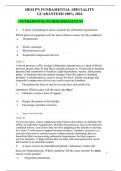
HESI PN FUNDAMENTAL SPECIALITY GUARANTEED 100% 2024.
3. A nurse reviews an immobilized patient’s laboratory results and discovers hypercalcemia. Which condition will the nurse monitor for most closely in this patient? 1 a. Hypostatic pneumonia b. Renal calculi c. Pressure ulcers d. Thrombus formation ANS: B Renal calculi are calcium stones that lodge in the renal pelvis or pass through the ureters. Immobilized patients are at risk for calculi because they frequently have hypercalcemia. Hypercalcemia does not lead to hypostatic pneumonia, pressure ulcers, or thrombus formation. Immobility is one cause of hypostatic pneumonia, which is inflammation of the lung from stasis or pooling of secretions. A pressure ulcer is an impairment of the skin that results from prolonged ischemia (decreased blood supply) within tissues. A thrombus is an accumulation of platelets, fibrin, clotting factors, and cellular elements of the blood attached to the interior wall of a vein or artery, which sometimes occludes the lumen of the vessel. 4. A nurse is caring for an immobile patient. Which metabolic alteration will the nurse monitor for in this patient? a. Increased appetite b. Increased diarrhea c. Increased metabolic rate d. Altered nutrient metabolism ANS: D Immobility disrupts normal metabolic functioning: decreasing the metabolic rate, altering the metabolism of carbohydrates, fats, and proteins; causing fluid, electrolyte, and calcium imbalances; and causing gastrointestinal disturbances such as decreased appetite and slowing of peristalsis, leading to constipation. 5. A nurse is preparing a care plan for a patient who is immobile. Which psychosocial aspect will the nurse consider? a. Loss of bone mass b. Loss of strength c. Loss of weight d. Loss of hope ANS: D 2 Loss of hope is a psychosocial aspect. Patients with restricted mobility may have some depression. Depression is an affective disorder characterized by exaggerated feelings of sadness, melancholy, dejection, worthlessness, emptiness, and hopelessness out of proportion to reality. All the rest are physiological aspects: bone mass, strength, and weight. 6. AThe nurse is preparing to lift a patient. Which action will the nurse take first? a. Position a drawsheet under the patient. b. Assess weight and determine assistance needs. c. Delegate the task to a nursing assistive personnel. d. Attempt to manually lift the patient alone before asking for assistance. NS: B When lifting, assess the weight you will lift, and determine the assistance you will need. The nurse has to assess before positioning a drawsheet or delegating the task. Manual lifting is the last resort, and it is used when the task at hand does not involve lifting most or all of the patient’s weight; most facilities have a no-lift policy. 7. The nurse is caring for an older-adult patient who has been diagnosed with a stroke. Which intervention will the nurse add to the care plan? Encourage the patient to perform as many self-care activities as a. possible. b. Provide a complete bed bath to promote patient comfort. c. Coordinate with occupational therapy for gait training. d. Place the patient on bed rest to prevent fatigue. ANS: A Nurses should encourage the older-adult patient to perform as many self-care activities as possible, thereby maintaining the highest level of mobility. Sometimes nurses inadvertently contribute to a patient’s immobility by providing unnecessary help with activities such as bathing and transferring. Placing the patient on bed rest without sufficient ambulation leads to loss of mobility and functional decline, resulting in weakness, fatigue, and increased risk for falls. After a stroke or brain attack, a patient likely receives gait training from a physical therapist; speech rehabilitation from a speech therapist; and help from an occupational therapist for ADLs such as dressing, bathing and toileting, or household chores.
Document information
- Uploaded on
- May 9, 2024
- Number of pages
- 14
- Written in
- 2023/2024
- Type
- Exam (elaborations)
- Contains
- Questions & answers


