
COM 316 Exam 1
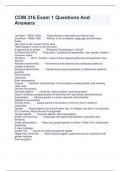
COM 316 Exam 1 Questions And Answers 1st Wave - 1900s-1930s - Equal access to education and right to vote 2nd Wave - 1960s-1980 - Women in the workplace, wage gap, discrimination Power. Men went to war, women had to work *Most research comes to the 2nd wave 3 approaches to gender - Biological, Psychological, Cultural 3rd Wave 80s-2010s - Exploration, intersectional oppression, race, gender, location, economic status 4th Wave - 2012 - Present - Internet tool to spread awareness and generate more activism Alternative femininities - Performance and behavior that challenges traditional models of behavior Biological determinism: - Gender binary places emphasis on differences based on genetics Chromosomes Hormones Brain development Cultural - Symbolic Interactionism: Communication creates gender and meaning rather than Gender Pre-existing Domestic Sphere - Home life, raising children, promoting family Ways of building conceptualization of femininity that reproduces male dominance Essentialism - Reduce gender to certain essential characteristics Related to sex qualities feminist theory - always seems to be position in terms of how it relates to masculinity Gender - Psychological and cultural terms vary. It changes over time, it is a process. EX. Feminine, Masculine and Transgender Gender identity - Personal Identity. Self Interpretation gender maneuvering - Challenges the relationship between masculinity and femininity gender presentation - Ways you present gender to others. Verbal, Non-verbal ways presenting A clear message. gender role - Social role that accompanies gender Hegemonic Femininity - Most cultural support, organized around compliance with gender relations And exceptions hegemonic masculinity - Social dominance, culture practices, discursive centrality, alternatives In the spotlight heterosexual matrix - Sex - Gender - sexuality Sex: you are born an man or woman Gender: behave masculine or feminine Sexuality: Assumed automatically attracted to opposite sex Intergender - Within same gender Intersex - Born with ambiguous sex traits May include Male or female chromosomes and genitalia May not appear till puberty Intragender - Across gender pariah femininities - Woman who are judged and demonized for not being feminine enough Ex. Shunned and pushed out of circle Psychological - Become our gender through early childhood experiences Hard wired into person personality Social Learning Theory: Social Interactions Cognitive development: We construct knowledge Public Sphere - Decision making, voting and business queer theory - Questions all forms of sex and sexuality categorization. Particulary heteronormative Rapport - Building relationships, connecting collaboratively and showing empathy Report - Focuses on instrumentality, task orientation, asserting oneself and competitiveness Sex - Inate biological characteristics EX. Genitalia, chromosomes and hormones Sexuality - Sexual Orientation Social constructionism - Social world through our behavior Constructed in "doing" of gender Performativity standpoint theory - Social groups to which one belongs affects perception of the world Develop specific skills, norms and values from lived experiences Two-culture theory: - Woman and men are similar, problems arise from different culture Boys and girls are socialized into different language groups Girls: Learn communication style for creating and maintaining close behaviors of clothes Boys: Play in larger groups, competition,
Document information
- Uploaded on
- May 8, 2024
- Number of pages
- 2
- Written in
- 2023/2024
- Type
- Exam (elaborations)
- Contains
- Questions & answers


