

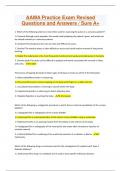
AAMA Practice Exam Revised Questions and Answers / Sure A+
1. Which of the following arteries is most often used for assessing the pulse on a conscious patient? A. Femoral Although easily palpable, this would entail palpating the patient's groin, and would not be utilized routinely in a conscious patient. B. Temporal The temporal artery can be small and difficult to assess. C. Brachial The brachial artery is often difficult to access and could require removal of long sleeve clothing. D. Radial The radial pulse is the most frequently monitored and easily accessible pulse in the body. E. Dorsalis pedis This pulse can be difficult to palpate and would necessitate the removal of shoes and socks. - D radial The process of tapping the body to detect signs of disease is known as which of the following? A. MensurationMensuration is measuring. B. PercussionPercussion involves tapping on the body with fingers or a reflex hammer. C. AuscultationAuscultation is listening to sounds within the body. D. InspectionInspection is observing to detect objective data. E. PalpationPalpation is touching the body. - B. Percussion Which of the following is a diagnostic procedure in which there is internal visualization of the urinary bladder? A. CystographyThis is radiography of the urinary bladder. B. CystoscopyThis is visual examination of the interior urinary bladder using a cystoscope. C. NephrostomyThis is an opening created from the kidney to the exterior of the body. D. PyelographyThis is radiography of the renal pelvis and ureter after intravenous injection of contrast material. E. Urethral dilationThis is widening of the urethra by insertion of a catheter or dilator. - B. Cystoscopy
Document information
- Uploaded on
- May 7, 2024
- Number of pages
- 13
- Written in
- 2023/2024
- Type
- Exam (elaborations)
- Contains
- Questions & answers


