HUBS 191 Full Exam with Complete and Verified Solutions
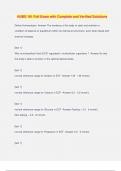
HUBS 191 Full Exam with Complete and Verified Solutions Define Homeostasis -Answer-The tendency of the body to seek and maintain a condition of balance or equilibrium within its internal environment, even when faced with external changes [lect 1] Why is extracellular fluid (ECF) regulated in multicellular organisms ? -Answer-So that the body is able to function in the optimal desired state. [lect 1] normal reference range for Sodium in ECF -Answer-135 - 145 mmol/L [lect 1] normal reference range for Calcium in ECF -Answer-2.2 - 2.6 mmol/L [lect 1] normal reference range for Glucose in ECF -Answer-Fasting = 3.5 - 6 mmol/L Non-fasting = 3.5 - 8 mmol/L [lect 1] normal reference range for Potassium in ECF -Answer-3.5 - 5 mmol/L [lect 1] normal reference range for pH in ECF -Answer-7.35 - 7.45 [lect 1] normal reference range for the Core Body Temperature -Answer-36 - 37.5 degrees celsius [lect 1] Outline selected transport mechanisms across cell membranes -Answer-Simple Diffusion (e.g osmosis) - passive Carrier Mediated Passive Transport ( Diffusion Channels ) Primary Active Transport Endocytosis Exocytosis [lect 1] Osmosis -Answer-The net movement of water across a membrane towards a lower concentration (higher solute concentration) until equilibrium is reached. [lect 1] Osmolarity -Answer-Total number of solute particles per litre of solution [lect 1] Tonicity -Answer-The effect that a solution has on cell volume Hypertonic - shrink Hypotonic - swell Isotonic - no change [lect 1] Describe the functions of the Skeletal System -Answer-Support , Movement, Protection , Storage , RBS formation [lect 5] Two Types of Bone -Answer-Cancellous bone - found where shock absorption is required . Compact bone - found where strength and load bearing is required. [lect 5] Long Bones -Answer-Longer than they are wide. Have a diaphysis, and epiphysis. Functions as levers for movement. Thicker compact bone in diaphysis. [lect 5] Short Bones -Answer-Have near equal length and width. Weight bearing and shock absorption. Mostly cancellous bone. [lect 5] Flat Bones -Answer-Protection - cranial bones. Muscle attachment - Scapula. Thin plates of compact bone, some cancellous bone. [lect 5] Irregular bones -Answer-Variable in shape and function [lect 5] Parts of the axial skeleton -Answer-Skull Vertebral Column Rib Cage [lect 5] Components of Skull -Answer-Cranium , mandible and facial bones [lect 5] Components of the vertebral column. -Answer-Cervical (7) Thoracic (12) Lumbar (5) Sacrum Coccyx [lect 5] Components of the rib cage -Answer-Sternum and ribs [lect 5] Components of the Appendicular skeleton -Answer-Arm , forearm, thigh , leg. [lect 5] In bipedalism , lower limbs are for ? Upper libs are for ? -Answer-Lower limbs are for stability and locomotion, upper limbs for manipulation [lect 5] Limb attachment -Answer-Pectoral Girdle : Clavicle and scapula Pelvic Girdle : Hip bones (2) and sacrum
Document information
- Uploaded on
- May 6, 2024
- Number of pages
- 22
- Written in
- 2023/2024
- Type
- Exam (elaborations)
- Contains
- Questions & answers