

3.3.6 Organic analysis
3.3.6.1 Identification of functional groups by test-tube reactions
ACIDIC COMPOUND suggests it’s a carboxylic acid.
SOLID COMPOUND suggests it’s a long carbon chain or has ionic bonding.
LIQUID COMPOUND suggests medium length carbon chain/polar/hydrogen
bonding.
GAS COMPOUND suggests short carbon chain, little or no polarity.
DISSOLVABLE COMPOUND suggests polar groups.
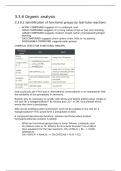
CHEMICAL TESTS FOR FUNCTIONAL GROUPS:
How could you tell if R-X was a chloroalkane, bromoalkene or an iodoalkane? Test
the solubility of the precipitate in ammonia.
Explain why its necessary to acidify with dilute acid before adding silver nitrate in
the test for a halogenoalkane? To remove any CO 32- or OH- ions present which
would also form a precipitate.
Why would acidifying with hydrochloric acid not be suitable in the test for a
halogenoalkane? This would form a precipitate of AGCl.
A compound decolourises bromine solution and fizzes when sodium
hydrogencarbonate solution is added:
What two functional groups does it have? Alkane, carboxylic acid
Its relative mass is 72. What is its structural formula? CH 2=CHO2H
Give equations for the two reactions: CH2=CHO2H + Br2 -> CH2Br-
CHBrCO2H,
CH2=CHO2H + NaHCO3 -> CH2CHCO2Na + H2O + CO2
, 3.3.6.2 Mass spectrometry
Mass spectrometry is the main method for finding the relative atomic masses of
atoms and finding the relative molecular mass of organic compounds.
In Mass spectrometry the ions of a sample can break up or fragment as
they pass through the instrument.
Mass spectrum of Ethanol,
when ethanol is ionised, it
forms the ion C2H5OH+
which is also called the
molecular ion. Many of
these ions then break up
due to some bonds breaking
as they’re ionised which
means there are other ions
of smaller molecular mass –
fragmentation.
Each of these fragment ions
produce a line in the spectrum which give information that helps to determine
the structure of the compound and basically act as a fingerprint to help identify
it.
High resolution mass spectrometry
Mass spectra often show masses to the nearest whole number only whereas
mass spectrometers can measure masses to ¾ d.p. So using this method you
can work out the molecular formula of the parent ion while making note that
isotopes of atoms don’t have exactly whole number atomic masses (except
carbon-12 which is 12 by definition), 16O = 15.99491 and 1H = 1.007829.
A parent ion of mass 200, nearest whole Num, could have the molecular
formulae of C10H16O4/C11H4O4/C11H20O3. Adding up the accurate atomic masses
gives the following molecular masses:
3.3.6.1 Identification of functional groups by test-tube reactions
ACIDIC COMPOUND suggests it’s a carboxylic acid.
SOLID COMPOUND suggests it’s a long carbon chain or has ionic bonding.
LIQUID COMPOUND suggests medium length carbon chain/polar/hydrogen
bonding.
GAS COMPOUND suggests short carbon chain, little or no polarity.
DISSOLVABLE COMPOUND suggests polar groups.
CHEMICAL TESTS FOR FUNCTIONAL GROUPS:
How could you tell if R-X was a chloroalkane, bromoalkene or an iodoalkane? Test
the solubility of the precipitate in ammonia.
Explain why its necessary to acidify with dilute acid before adding silver nitrate in
the test for a halogenoalkane? To remove any CO 32- or OH- ions present which
would also form a precipitate.
Why would acidifying with hydrochloric acid not be suitable in the test for a
halogenoalkane? This would form a precipitate of AGCl.
A compound decolourises bromine solution and fizzes when sodium
hydrogencarbonate solution is added:
What two functional groups does it have? Alkane, carboxylic acid
Its relative mass is 72. What is its structural formula? CH 2=CHO2H
Give equations for the two reactions: CH2=CHO2H + Br2 -> CH2Br-
CHBrCO2H,
CH2=CHO2H + NaHCO3 -> CH2CHCO2Na + H2O + CO2
, 3.3.6.2 Mass spectrometry
Mass spectrometry is the main method for finding the relative atomic masses of
atoms and finding the relative molecular mass of organic compounds.
In Mass spectrometry the ions of a sample can break up or fragment as
they pass through the instrument.
Mass spectrum of Ethanol,
when ethanol is ionised, it
forms the ion C2H5OH+
which is also called the
molecular ion. Many of
these ions then break up
due to some bonds breaking
as they’re ionised which
means there are other ions
of smaller molecular mass –
fragmentation.
Each of these fragment ions
produce a line in the spectrum which give information that helps to determine
the structure of the compound and basically act as a fingerprint to help identify
it.
High resolution mass spectrometry
Mass spectra often show masses to the nearest whole number only whereas
mass spectrometers can measure masses to ¾ d.p. So using this method you
can work out the molecular formula of the parent ion while making note that
isotopes of atoms don’t have exactly whole number atomic masses (except
carbon-12 which is 12 by definition), 16O = 15.99491 and 1H = 1.007829.
A parent ion of mass 200, nearest whole Num, could have the molecular
formulae of C10H16O4/C11H4O4/C11H20O3. Adding up the accurate atomic masses
gives the following molecular masses:


