

Summary articles TM
Slater & Narver (1998): Customer-led and market-oriented
Introduction
Customer-led marketing has been criticized by many. E.g. ‘Firms lose their position of industry leadership …
because they listen too carefully to their customers’.
However, these views are seemingly at odds with the marketing concept that is the foundation of modern
marketing.
Marketing concept = It is an organizations’ purpose to discover needs and wants in its target markets and to
satisfy those needs more effectively and efficiently than competitors.
Market orientation is an ‘implementation of the marketing concept’.
There is a strong relationship between market orientation and a businesses performance (e.g. profitability,
sales growth, new product success etc.). Market orientation is essential to success.
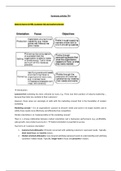
Two forms of ‘customer orientation’:
1. Customer-led philosophy: Primarily concerned with satisfying customers’ expressed needs. Typically,
short-term focus and reactive nature.
2. Market-oriented philosophy: Goes beyond satisfying expressed needs to understanding and satisfying
customers’ hidden needs. Typically, longer-term in focus and proactive in nature.
, The customer-led business
Definition:
- Customer-led businesses focus on understanding the expressed desires of the customers in their
served markets and on developing products and services that satisfy those desires.
- Research: focus groups, customer surveys
- Close relationships with important customers
- Successful in retail banking
- Many customer information files
Downsides:
- Reactive
- Short term in focus
- Leads to adaptive rather than generative learning
o It is hard to develop a valid measure of customer satisfaction
o Customer satisfaction often overwhelms other strategic performance indicators (e.g. new
product success or organizational learning), hence, management is likely to focus only on the
short term and only improve current products and services (not take risks).
- ‘Tyranny of the served market’:
o Existing customer can substantially constrain a firm’s ability to innovate because the innovations
may threaten the existing customers.
o Customer are lacking in foresight: hidden needs cannot be articulated by customers and hence
they cannot help devise solutions to those needs.
o Unwilling to risk displeasing existing powerful customers
The market-oriented business
Definition:
- Long-term focus
- Generative (vermogen om te groeien) learners critical for innovation
- Market-oriented businesses are committed to understanding both the expressed and hidden needs of
their customers, and the capabilities and plans of their competitors through the processes of acquiring
and evaluating market information in a systematic and anticipating manner.
- Sharing the knowledge broadly throughout the organization
o It is market-orientation not marketing-orientation – the entire organization is directed at
creating superior customer value
- Acting in a coordinated and focused manner
, - Combine traditional market research with other techniques to discover customers’ latent needs and to
drive generative learning: e.g. observation and market experiments.
- Work closely with lead users:
o Looking at the most sophisticated and demanding customers instead of the most powerful
customers.
o Also escape the tyranny of the served market by searching for unserved markets. An
unserved market represent potential.
Implications for competitive advantage
Stable/predicatable environment (e.g. banking):
- Responding quickly customer relationships CA
Turbulent environment:
- Ability to anticipate CA
- Different kind of customers provide different types of information:
o Early adopters are lead-users and tend to be market visionaries (so listen to them!)
o Early adopters = willing to accept a partial, but potentially superior, solution from the supplier
and work closely with the supplier to refine the product to meet their needs.
o Use feedback of these early adopters to be adopted by the early majority.
o Early majority = pragmatists that require a clear understanding of how adoption of the new
technology will create economic value for them (no true lead-users).
- A market orientation consists of norms for behaviour that guide the business in learning quickly from
and about different types of needs and responding in an entrepreneurial manner to deliver superior
customer value. The capabilities arising from a market orientation enable the business to identify and
exploit discontinuities in its served market(s) as well as unserved markets. As a form of business
culture, a market-orientation approach is difficult for competitors to observe, understand and imitate
and thus a competitive advantage.
Conclusion
, - Two different approaches for businesses to actively attempt to understand their markets.
- Innovation is key in marketing!
Narver & Slater (1990): The effect of a market orientation on business profitability
- Article develop a valid measurement of market orientation.
- Article analyses the effect of market orientation on a business’ profitability.
- Sample of 140 businesses
Introduction
Market orientation and performance: The conceptual model
- For organizations to achieve consistently above-normal market performance, it must create a
sustainable competitive advantage: sustainable superior value to customers.
- Logic of SCA: for a buyer to purchase offering X, he/she must perceive that the expected value to him
of that offering exceeds the expected value to him of any alternative solution.
- Definition of value: The difference between what the buyer perceives as the offering’s expected
benefits and what the buyer perceives as its expected total acquisition and use costs. So, create more
value
o Decrease costs, or;
o Increase value
- Market-orientation is the organization culture that most effectively and efficiently creates the
necessary behaviours for the creation of superior value for buyers and, thus, continuous superior
performance for the business.
- Market-oriented businesses continuously examine alternative sources of SCA to see how it can be
most effective in creating value for its present and future target buyers.
On the content of market-orientation
Market-orientation consists of three behavioural components:
1. Customer orientation: understanding the customers entire value chain and how this evolves over
time.
2. Competitor orientation: understanding the (potential-)competitors’ short-term strengths and
weaknesses and long-term capabilities and strategies
3. Interfunctional coordination: A business’s coordinated efforts beyond the marketing department.
Every department can potentially contribute to the creation of value for buyers.
Market-orientation consists out of two decision criteria:
1. Long-term focus: Both in relation to profits and in implementing each of the three behavioural
components.
2. Profitability: The objective of market-orientation is profitability.
On developing a valid measure of market orientation
Hypothesis of the content of market orientation
The hypothesize is a one-dimension construct because the three behavioural components and two decision
criteria are conceptually closely related. For businesses to maximize its long-run profits, it must continuously
create superior value for its target customers. To create continuous superior value for customers, a business
must be customer oriented, competitor oriented, and interfunctionally coordinated. From the literature
Slater & Narver (1998): Customer-led and market-oriented
Introduction
Customer-led marketing has been criticized by many. E.g. ‘Firms lose their position of industry leadership …
because they listen too carefully to their customers’.
However, these views are seemingly at odds with the marketing concept that is the foundation of modern
marketing.
Marketing concept = It is an organizations’ purpose to discover needs and wants in its target markets and to
satisfy those needs more effectively and efficiently than competitors.
Market orientation is an ‘implementation of the marketing concept’.
There is a strong relationship between market orientation and a businesses performance (e.g. profitability,
sales growth, new product success etc.). Market orientation is essential to success.
Two forms of ‘customer orientation’:
1. Customer-led philosophy: Primarily concerned with satisfying customers’ expressed needs. Typically,
short-term focus and reactive nature.
2. Market-oriented philosophy: Goes beyond satisfying expressed needs to understanding and satisfying
customers’ hidden needs. Typically, longer-term in focus and proactive in nature.
, The customer-led business
Definition:
- Customer-led businesses focus on understanding the expressed desires of the customers in their
served markets and on developing products and services that satisfy those desires.
- Research: focus groups, customer surveys
- Close relationships with important customers
- Successful in retail banking
- Many customer information files
Downsides:
- Reactive
- Short term in focus
- Leads to adaptive rather than generative learning
o It is hard to develop a valid measure of customer satisfaction
o Customer satisfaction often overwhelms other strategic performance indicators (e.g. new
product success or organizational learning), hence, management is likely to focus only on the
short term and only improve current products and services (not take risks).
- ‘Tyranny of the served market’:
o Existing customer can substantially constrain a firm’s ability to innovate because the innovations
may threaten the existing customers.
o Customer are lacking in foresight: hidden needs cannot be articulated by customers and hence
they cannot help devise solutions to those needs.
o Unwilling to risk displeasing existing powerful customers
The market-oriented business
Definition:
- Long-term focus
- Generative (vermogen om te groeien) learners critical for innovation
- Market-oriented businesses are committed to understanding both the expressed and hidden needs of
their customers, and the capabilities and plans of their competitors through the processes of acquiring
and evaluating market information in a systematic and anticipating manner.
- Sharing the knowledge broadly throughout the organization
o It is market-orientation not marketing-orientation – the entire organization is directed at
creating superior customer value
- Acting in a coordinated and focused manner
, - Combine traditional market research with other techniques to discover customers’ latent needs and to
drive generative learning: e.g. observation and market experiments.
- Work closely with lead users:
o Looking at the most sophisticated and demanding customers instead of the most powerful
customers.
o Also escape the tyranny of the served market by searching for unserved markets. An
unserved market represent potential.
Implications for competitive advantage
Stable/predicatable environment (e.g. banking):
- Responding quickly customer relationships CA
Turbulent environment:
- Ability to anticipate CA
- Different kind of customers provide different types of information:
o Early adopters are lead-users and tend to be market visionaries (so listen to them!)
o Early adopters = willing to accept a partial, but potentially superior, solution from the supplier
and work closely with the supplier to refine the product to meet their needs.
o Use feedback of these early adopters to be adopted by the early majority.
o Early majority = pragmatists that require a clear understanding of how adoption of the new
technology will create economic value for them (no true lead-users).
- A market orientation consists of norms for behaviour that guide the business in learning quickly from
and about different types of needs and responding in an entrepreneurial manner to deliver superior
customer value. The capabilities arising from a market orientation enable the business to identify and
exploit discontinuities in its served market(s) as well as unserved markets. As a form of business
culture, a market-orientation approach is difficult for competitors to observe, understand and imitate
and thus a competitive advantage.
Conclusion
, - Two different approaches for businesses to actively attempt to understand their markets.
- Innovation is key in marketing!
Narver & Slater (1990): The effect of a market orientation on business profitability
- Article develop a valid measurement of market orientation.
- Article analyses the effect of market orientation on a business’ profitability.
- Sample of 140 businesses
Introduction
Market orientation and performance: The conceptual model
- For organizations to achieve consistently above-normal market performance, it must create a
sustainable competitive advantage: sustainable superior value to customers.
- Logic of SCA: for a buyer to purchase offering X, he/she must perceive that the expected value to him
of that offering exceeds the expected value to him of any alternative solution.
- Definition of value: The difference between what the buyer perceives as the offering’s expected
benefits and what the buyer perceives as its expected total acquisition and use costs. So, create more
value
o Decrease costs, or;
o Increase value
- Market-orientation is the organization culture that most effectively and efficiently creates the
necessary behaviours for the creation of superior value for buyers and, thus, continuous superior
performance for the business.
- Market-oriented businesses continuously examine alternative sources of SCA to see how it can be
most effective in creating value for its present and future target buyers.
On the content of market-orientation
Market-orientation consists of three behavioural components:
1. Customer orientation: understanding the customers entire value chain and how this evolves over
time.
2. Competitor orientation: understanding the (potential-)competitors’ short-term strengths and
weaknesses and long-term capabilities and strategies
3. Interfunctional coordination: A business’s coordinated efforts beyond the marketing department.
Every department can potentially contribute to the creation of value for buyers.
Market-orientation consists out of two decision criteria:
1. Long-term focus: Both in relation to profits and in implementing each of the three behavioural
components.
2. Profitability: The objective of market-orientation is profitability.
On developing a valid measure of market orientation
Hypothesis of the content of market orientation
The hypothesize is a one-dimension construct because the three behavioural components and two decision
criteria are conceptually closely related. For businesses to maximize its long-run profits, it must continuously
create superior value for its target customers. To create continuous superior value for customers, a business
must be customer oriented, competitor oriented, and interfunctionally coordinated. From the literature


