
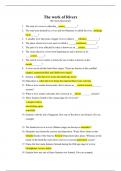
The work of Rivers
(Revision Questions)
1. The start of a river is called the__source__________?
2. The total area drained by a river and its tributaries is called the river _drainage
basin______?
3. A smaller river that joins a bigger river is called a ___tributary__________?
4. The place where two rivers meet is called a ______confluence________?
5. The part of a river affected by tides is known as an __estuary__________?
6. The route taken by a river from beginning to end is known as its
____course______?
7. The end of a river (where it enters the sea or lake) is known as the
mouth________?
8. A river can be divided into three stages. These are known as the youthful
(upper), mature(middle) and Old(lower) stages?
9. Erosion is when the river wears the landscape away?
10. Deposition is when the river drops the material that it was carrying.
11. When a river erodes downwards, this is known as __vertical erosion________
erosion?
12. When a river erodes outwards, this is known as __lateral________ erosion?
13. Three features found in the young stage of a river are?
v-shaped valleys
interlocking spurs
waterfalls
14. Explain, with the aid of diagrams, how one of the above are formed. Give an
example.
15. The bends/curves in a river (Mature stage) are known as meanders?
16. Meanders are formed by erosion and deposition. Water flows faster on the
Outside/Inside of the bend so Erosion/Deposition takes place. Whereas on the
inside of the bend the water flows slower so erosion/deposition occurs?
17. Name the four main features formed during the Old age stage of a river.
Floodplains, levees, deltas
18. Explain how any one of these features was formed. Give an example.
(Revision Questions)
1. The start of a river is called the__source__________?
2. The total area drained by a river and its tributaries is called the river _drainage
basin______?
3. A smaller river that joins a bigger river is called a ___tributary__________?
4. The place where two rivers meet is called a ______confluence________?
5. The part of a river affected by tides is known as an __estuary__________?
6. The route taken by a river from beginning to end is known as its
____course______?
7. The end of a river (where it enters the sea or lake) is known as the
mouth________?
8. A river can be divided into three stages. These are known as the youthful
(upper), mature(middle) and Old(lower) stages?
9. Erosion is when the river wears the landscape away?
10. Deposition is when the river drops the material that it was carrying.
11. When a river erodes downwards, this is known as __vertical erosion________
erosion?
12. When a river erodes outwards, this is known as __lateral________ erosion?
13. Three features found in the young stage of a river are?
v-shaped valleys
interlocking spurs
waterfalls
14. Explain, with the aid of diagrams, how one of the above are formed. Give an
example.
15. The bends/curves in a river (Mature stage) are known as meanders?
16. Meanders are formed by erosion and deposition. Water flows faster on the
Outside/Inside of the bend so Erosion/Deposition takes place. Whereas on the
inside of the bend the water flows slower so erosion/deposition occurs?
17. Name the four main features formed during the Old age stage of a river.
Floodplains, levees, deltas
18. Explain how any one of these features was formed. Give an example.


