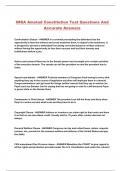
IMSA Amstud Constitution Exam Questions And Answers Solved 100% Correct!!
Confrontation Clause - Accused shall have the right to be confronted by an opposing witness Commander in Chief Clause - The President shall be Commander in Chief of the Army and Navy of the United States, and of the Militia of the several States, when called into the actual Service of the United States. Due Process (5th Amendment) - The federal government shall deprive nobody of life, liberty, or property without due process of the law Due Process (14 Amendment) - The state government shall deprive nobody of life, liberty, or property without due process of the law Equal Protection Clause - No state shall make laws that abridge the priviliges or immunities of a certain group of people Takings Clause - Private property may not be taken without proper compensation Grand Juries Clause - No person shall be held to answer for an infamous crime, unless on a presentment or indictment of a Grand Jury Supremacy Clause - Federal law is supreme over state law Advice and Consent Clause - The president can make treaties if backed up by 2/3 of the Senate. The president can also appoint public officials like Supreme Court Judges with the consent of the Senate Copyright Clause - Authors and inventors have the exclusive right to their respective writings and discoveries for a limited amount of timeElastic Clause - Congress has the power to make "necessary and proper" laws that aren't explicitly defined within the Constitution. The Supreme Court may claim judicial review over these laws. Enumerated vs. Implied Powers - Enumerated powers are specifically defined in the constitution, while implied powers are extrapolations of those enumerated powers. Establishment Clause - Congress shall make no law respecting the establishment of religion Free Exercise Clause - Citizens are allowed to exercise whatever religion they believe in Full Faith and Credit Clause - Each state must accept the public acts, records, and judicial proceedings of every other state General Welfare Clause - Gives Congress the power to tax to provide for the general welfare Interstate Commerce Clause - Congress has the power to regulate commerce between both foreign nations and neighboring states Naturalization Clause - Congress has the power to make all laws regarding citizenship and immigration Necessary and Proper Clause - Same as the Elastic Clause Priviliges and Immunities Clause - All citizens in a state must enjoy equal privileges and immunities Search and Seizure Clause - Protection against Unreasonable Search and Seizure without an official warrant Speech or Debate Clause - Statements made during Congressional meetings may not be used against individuals as evidenceSpeedy Trial Clause - Everyone has a right to a speedy, public trial in front of a jury, and right to an attorney Spendings Clause - Congress has the power to lay and collect taxes, this extends outside of what is explicitly defined in the Constitution War Clause - Congress has the power to declare war, support the Army and Navy, and make laws for the regulation of military forces
Written for
- Institution
- IMSA Amstud Constitution
- Course
- IMSA Amstud Constitution
Document information
- Uploaded on
- April 29, 2024
- Number of pages
- 3
- Written in
- 2023/2024
- Type
- Exam (elaborations)
- Contains
- Questions & answers
Subjects

Document also available in package deal