

Pathophysiology Chapter 7- Test Bank with Answers and Rationales
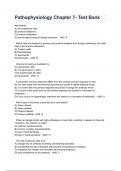
Pathophysiology Chapter 7- Test Bank Neutrophils: A) are phagocytic cells. B) produce histamine. C) produce antibodies. D) are elevated during an allergic response. - ANS A Which cells are required to process and present antigens from foreign material as the initial step in the immune response? A) T-helper cells B) Macrophages C) Eosinophils D) Monocytes - ANS B Humoral immunity is mediated by: A) natural killer cells. B) T lymphocytes (T cells). C) B lymphocytes (B cells). D) neutrophils. - ANS C A secondary immune response differs from the primary immune response in that: A) it is more rapid than the primary response and results in higher antibody levels. B) it is slower than the primary response and doesn't change the antibody levels. C) it occurs at the same time as the primary response but results in a decrease in antibodies. D) it only occurs in hyperallergic reactions and results in a decrease of antibodies. - ANS A Which type of immunity is provided by a vaccination? A) Active natural B) Active artificial C) Passive natural D) Passive artificial - ANS B When an allergen binds with IgE antibodies on mast cells, resulting in release of chemical mediators, this reaction is called: A) cytotoxic hypersensitivity. B) immune complex hypersensitivity. C) type I hypersensitivity. D) type IV hypersensitivity. - ANS C The role of memory cells is to: A) change into an antibody-secreting cell following activation. B) immediately secrete antibodies following the first exposure to antigen. C) recognize the antigen and stimulate the immune response. D) bind complement to the antibody. - ANS C Which statement applies to contact dermatitis? A) It occurs when IgE antibodies on the skin react with the causative substance. B) It may result from ingested foods. C) Urticaria (hives) gradually spread over the body. D) A type IV reaction occurs in affected areas. - ANS D Which of the following causes anaphylaxis? A) A severe, systemic allergic reaction B) Type III hypersensitivity C) Cell-mediated hypersensitivity D) Immune complex deposits in many tissues - ANS A
Document information
- Uploaded on
- April 29, 2024
- Number of pages
- 5
- Written in
- 2023/2024
- Type
- Exam (elaborations)
- Contains
- Questions & answers


