

Renske de Veer (rdeveer)
Summary Infectious diseases and global health
HC 1: Clinical presentation, biology, and treatment
HIV is a RNA retrovirus infecting CD4 T-cells in the blood: RNA is transcriptased into cDNA. cDNA is
integrated into our genome.
- Reverse transcriptase: virus brings this enzyme to make cDNA from RNA.
- Integrase: integrating piece of cDNA into our genome stimulating it to produce new virus
particles.
- Protease: necessary for viral assembly.
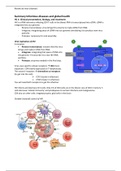
Viral replication of HIV
3 enzymes:
• Reverse transcriptase: enzyme that the virus
brings and makes C DNA from RNA.
• Integrase: integrating that piece of DNA into
the genome → transcribe it to new HIV-RNA
particles.
• Protease: enzymes needed in the final step.
Virus uses specific cellular receptors → CD4 most
important. CD4 mainly expressed on T lymphocytes.
The second receptors → chemokine co-receptors
(to get into the cell):
• CCR 5 (early in infection)
• CYCR 4 (later in infection)
You will need both receptors to get the infection.
HIV infects and destroys CD 4 cells. Only 1% of CD4 cells are in the blood. Loss of CD4+ memory T-
cells decrease ‘cellular immunity’ and predisposes to certain infections and malignancies.
CD4 also on other cells: megakaryocytes, glial cells in the brain
Durable (natural) control of HIV
,Renske de Veer (rdeveer)
- Higher viral setpoint: faster CD4 cell decline
- Preferential (irreversible) loss of certain T-cell populations (specific CD4 cells (specific
recognize tb cells) → early/more loss)
o Especially gut Th17 cells (translocation/immune activation)
The earlier we treat → the more we can preserve the immune system → the more we limit the viral
reservoir : goes to brain, intestine, prostate, etc → earlier to treat the better.
1. Primary HIV
o Usually 2-4 weeks after infection
o Flu-like syndrome
▪ Fever, lymphadenopathy, pharyngitis, rash, meningoencephalitis
o Laboratory
▪ Mononucleosis (atypical lymphocytes)
▪ High plasma HIV-RNA
▪ Incomplete antibody response
▪ Temporary drop in CD4
2. Progressive CD4 cell loss
o People become susceptible to opportunistic infections.
3. Besides infections and AIDS
o Cardiovascular disease
o ‘Normal’ malignancies
o Allergy and autoimmune disease
o Rapid ‘aging’ and many organ systems
▪ Liver, kidney, brain, lungs, bone
o Patients liver longer: chronic disease
Natural course of disease after infection is variable
- Acute HIV (viral syndrome)
- Many patients with asymptomatic infection
- Opportunistic infections & malignancies (AIDS)
- Antiretroviral treatment (ART)
- Targets for treatment
o The 3 important enzymes (RT inhibitors
+ protease inhibitor → fusion
inhibitors)
o Entry blockers: block the binding to the
co-receptor
,Renske de Veer (rdeveer)
- When to use it:
o For AIDS-symptomatic patients
o To prevent AIDS
o To prevent transmission
o To slow ‘chronic HIV’
- Problems with ART
o Safety (drug allergy)
o Side effect
▪ Protease inhibitors: diarrhea
▪ Neurocognitive & psychiatric side effects
▪ Anemia, nausea
▪ Muscle pain
o Long-term toxicity:
▪ Mitochondrial toxicity
• Associated with all the drugs
• Screen for hyperlactatemia
• Lipodystrophy
▪ Pancreatitis
▪ Kidney stones
▪ Insulin resistance
▪ Cariomyopathy
▪ Osteoporosis
▪ Kidney function
▪ etc
o Adherence
o Resistance
o Drug-drug interactions: cytochromes (inducer/inhibitor)
o ‘Immune reconstitution’
HIV as a chronic disease
- Phenotype is changing
- Cardiovascular disease, diabetes, malignancies, liver disease, kidney function loss, cognitive
function, depression, substance abuse, co-infections, ‘frailty’.
, Renske de Veer (rdeveer)
HC 2: Disease heterogeneity
Many disease have typical disease presentation & disease course.
Knowing a disease is relevant to know which treatment to give, and provides a prognosis.
➔ A diagnosis informs how treatment will change natural course.
Diseases show heterogeneity in
- Onset (why one person gets a disease/diagnosis and why another doesn’t)
- Symptoms
- Natural progression
- Treatment response and outcomes
Heterogeneity can be caused by:
- Disease
o Time of diagnosis (misdiagnosis)
▪ Distribution of all people (e.g. older people) → people who are in the lower
bit of the curve (below the average) → combination of people who are in the
pre-stage and people who don’t have the disease (mixed group) →
heterogeneity in the progression. (misdiagnosis of people that are not really
in the pre-stage)
o Nosological variants
▪ Some diseases have a group of symptoms that don’t say much about the
course itself (dementia: syndrome, not a disease → many common types). →
different course underlying the disease.
▪ Early and late form (onset) of a disease (dementia: people diagnosis on early
age and later age; family in which everyone gets alzheimer’s disease. People
with early from tend to progress much faster).
o Disease severity
▪ People with a lower CD4 have the chance of HIV but also for HAND
- Patient (More than 75% of all older people have more than 2 (or more) disease).
o Comorbidity: presence of one or more additional diseases or disorders co-occuring
with a primary disease or disorder. Usually people with higher comorbidity progress
faster compared to people with lower comorbidity.
o Frailty (vulnerability)
▪ A patient changes when time goes on en becomes more/less frail, get
more/less comorbidity which may in/decrease in severity.
▪ Frailty measures state, no performance
o Resilience (resilience of people and how they deal with health)
▪ The ability to bounce back when being perturbated by health stressors: how
does one response.
• Resistance
• Recovery
• Adaptability
- Care
o Quality of Care
- Wider context: environmental factors/social life/etc
o Informal caregiver
▪ Social relationship determine a better prognosis
o Social functioning
▪ Better quality of life results in a lower mortality risk
Summary Infectious diseases and global health
HC 1: Clinical presentation, biology, and treatment
HIV is a RNA retrovirus infecting CD4 T-cells in the blood: RNA is transcriptased into cDNA. cDNA is
integrated into our genome.
- Reverse transcriptase: virus brings this enzyme to make cDNA from RNA.
- Integrase: integrating piece of cDNA into our genome stimulating it to produce new virus
particles.
- Protease: necessary for viral assembly.
Viral replication of HIV
3 enzymes:
• Reverse transcriptase: enzyme that the virus
brings and makes C DNA from RNA.
• Integrase: integrating that piece of DNA into
the genome → transcribe it to new HIV-RNA
particles.
• Protease: enzymes needed in the final step.
Virus uses specific cellular receptors → CD4 most
important. CD4 mainly expressed on T lymphocytes.
The second receptors → chemokine co-receptors
(to get into the cell):
• CCR 5 (early in infection)
• CYCR 4 (later in infection)
You will need both receptors to get the infection.
HIV infects and destroys CD 4 cells. Only 1% of CD4 cells are in the blood. Loss of CD4+ memory T-
cells decrease ‘cellular immunity’ and predisposes to certain infections and malignancies.
CD4 also on other cells: megakaryocytes, glial cells in the brain
Durable (natural) control of HIV
,Renske de Veer (rdeveer)
- Higher viral setpoint: faster CD4 cell decline
- Preferential (irreversible) loss of certain T-cell populations (specific CD4 cells (specific
recognize tb cells) → early/more loss)
o Especially gut Th17 cells (translocation/immune activation)
The earlier we treat → the more we can preserve the immune system → the more we limit the viral
reservoir : goes to brain, intestine, prostate, etc → earlier to treat the better.
1. Primary HIV
o Usually 2-4 weeks after infection
o Flu-like syndrome
▪ Fever, lymphadenopathy, pharyngitis, rash, meningoencephalitis
o Laboratory
▪ Mononucleosis (atypical lymphocytes)
▪ High plasma HIV-RNA
▪ Incomplete antibody response
▪ Temporary drop in CD4
2. Progressive CD4 cell loss
o People become susceptible to opportunistic infections.
3. Besides infections and AIDS
o Cardiovascular disease
o ‘Normal’ malignancies
o Allergy and autoimmune disease
o Rapid ‘aging’ and many organ systems
▪ Liver, kidney, brain, lungs, bone
o Patients liver longer: chronic disease
Natural course of disease after infection is variable
- Acute HIV (viral syndrome)
- Many patients with asymptomatic infection
- Opportunistic infections & malignancies (AIDS)
- Antiretroviral treatment (ART)
- Targets for treatment
o The 3 important enzymes (RT inhibitors
+ protease inhibitor → fusion
inhibitors)
o Entry blockers: block the binding to the
co-receptor
,Renske de Veer (rdeveer)
- When to use it:
o For AIDS-symptomatic patients
o To prevent AIDS
o To prevent transmission
o To slow ‘chronic HIV’
- Problems with ART
o Safety (drug allergy)
o Side effect
▪ Protease inhibitors: diarrhea
▪ Neurocognitive & psychiatric side effects
▪ Anemia, nausea
▪ Muscle pain
o Long-term toxicity:
▪ Mitochondrial toxicity
• Associated with all the drugs
• Screen for hyperlactatemia
• Lipodystrophy
▪ Pancreatitis
▪ Kidney stones
▪ Insulin resistance
▪ Cariomyopathy
▪ Osteoporosis
▪ Kidney function
▪ etc
o Adherence
o Resistance
o Drug-drug interactions: cytochromes (inducer/inhibitor)
o ‘Immune reconstitution’
HIV as a chronic disease
- Phenotype is changing
- Cardiovascular disease, diabetes, malignancies, liver disease, kidney function loss, cognitive
function, depression, substance abuse, co-infections, ‘frailty’.
, Renske de Veer (rdeveer)
HC 2: Disease heterogeneity
Many disease have typical disease presentation & disease course.
Knowing a disease is relevant to know which treatment to give, and provides a prognosis.
➔ A diagnosis informs how treatment will change natural course.
Diseases show heterogeneity in
- Onset (why one person gets a disease/diagnosis and why another doesn’t)
- Symptoms
- Natural progression
- Treatment response and outcomes
Heterogeneity can be caused by:
- Disease
o Time of diagnosis (misdiagnosis)
▪ Distribution of all people (e.g. older people) → people who are in the lower
bit of the curve (below the average) → combination of people who are in the
pre-stage and people who don’t have the disease (mixed group) →
heterogeneity in the progression. (misdiagnosis of people that are not really
in the pre-stage)
o Nosological variants
▪ Some diseases have a group of symptoms that don’t say much about the
course itself (dementia: syndrome, not a disease → many common types). →
different course underlying the disease.
▪ Early and late form (onset) of a disease (dementia: people diagnosis on early
age and later age; family in which everyone gets alzheimer’s disease. People
with early from tend to progress much faster).
o Disease severity
▪ People with a lower CD4 have the chance of HIV but also for HAND
- Patient (More than 75% of all older people have more than 2 (or more) disease).
o Comorbidity: presence of one or more additional diseases or disorders co-occuring
with a primary disease or disorder. Usually people with higher comorbidity progress
faster compared to people with lower comorbidity.
o Frailty (vulnerability)
▪ A patient changes when time goes on en becomes more/less frail, get
more/less comorbidity which may in/decrease in severity.
▪ Frailty measures state, no performance
o Resilience (resilience of people and how they deal with health)
▪ The ability to bounce back when being perturbated by health stressors: how
does one response.
• Resistance
• Recovery
• Adaptability
- Care
o Quality of Care
- Wider context: environmental factors/social life/etc
o Informal caregiver
▪ Social relationship determine a better prognosis
o Social functioning
▪ Better quality of life results in a lower mortality risk


