

Supply Chain Fundamentals
Lecture 1 – Introduction to Supply Chain Management
What is Supply Chain?
A supply chain consists of all parties involved, directly or indirectly, in fulfilling a customer
request. All the parties together are called a supply network.
- Supplier
- Manufacturer
- Distributor
- Retailer
Upstream = more towards the supplier
Downstream = more towards the consumer
There are three flows in a supply chain:
- Material flow
- Finance flow
- Information flow
Occurring costs in the supply chain:
- Production/purchase costs
- Inventory & warehousing costs
- Transportation costs
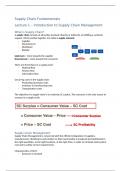
The objective of a supply chain is to maximize SC surplus. The consumer is the only source of
revenue in a supply chain.
Supply Chain Management
Supply Chain Management is concerned with the efficient integration of suppliers,
manufacturers, distributors and retailers so that merchandise is produced and distributed in
the right quantities, to the right locations, at the right time, in order to minimize total system
cost and to satisfy service requirements.
Characteristics of SCM:
- Everyone is involved
, - Systems approach to reducing costs
- Integration is key
Major challenges in SCM:
- Supply Chain is complex (production, distribution, competitors)
- Conflicting objectives (purchasing, manufacturing, warehousing, customers)
- Uncertainties always exist and do so in all forms
Problems with uncertainty:
- Cannot be eliminated
- Forecasting does not always help
- Demand is not the only source of
uncertainty:
o Production capacity
o Transportation times
o Natural disasters
o Component availability
- More difficult to match supply with
demand
Three golden rules of forecasting:
- Forecasting is always wrong
- The longer the horizon, the worse the forecast
- Aggregate forecasts are more accurate
Challenges in SCM nowadays:
- Globalization adds complexity
o Supplier landscape
o Challenging global markets for labor (incl. rising wages)
o Global competition
o Growing exposure to different regulation requirements
o Increasing financial volatility
- More demanding customers
o Increasing volatility of customer demand
o Increasing consumer expectations and service quality
o Increasing complex patterns of customer demand
- Sustainability concerns
Approaches for these challenges is to optimize every step (manufacturing process, inventory,
distribution) by balancing cost and service level. Also, the use of a supply chain coordination
contract, a strategic alliance (vendor management inventory) and different approaches to
deal with uncertainty (forecasting, pull system, risk pooling, postponement) are important.
Cross-docking = Bringing the separate products from the manufacturer to a warehouse,
where they get order picked and then transported to the retailor.
Lecture 1 – Introduction to Supply Chain Management
What is Supply Chain?
A supply chain consists of all parties involved, directly or indirectly, in fulfilling a customer
request. All the parties together are called a supply network.
- Supplier
- Manufacturer
- Distributor
- Retailer
Upstream = more towards the supplier
Downstream = more towards the consumer
There are three flows in a supply chain:
- Material flow
- Finance flow
- Information flow
Occurring costs in the supply chain:
- Production/purchase costs
- Inventory & warehousing costs
- Transportation costs
The objective of a supply chain is to maximize SC surplus. The consumer is the only source of
revenue in a supply chain.
Supply Chain Management
Supply Chain Management is concerned with the efficient integration of suppliers,
manufacturers, distributors and retailers so that merchandise is produced and distributed in
the right quantities, to the right locations, at the right time, in order to minimize total system
cost and to satisfy service requirements.
Characteristics of SCM:
- Everyone is involved
, - Systems approach to reducing costs
- Integration is key
Major challenges in SCM:
- Supply Chain is complex (production, distribution, competitors)
- Conflicting objectives (purchasing, manufacturing, warehousing, customers)
- Uncertainties always exist and do so in all forms
Problems with uncertainty:
- Cannot be eliminated
- Forecasting does not always help
- Demand is not the only source of
uncertainty:
o Production capacity
o Transportation times
o Natural disasters
o Component availability
- More difficult to match supply with
demand
Three golden rules of forecasting:
- Forecasting is always wrong
- The longer the horizon, the worse the forecast
- Aggregate forecasts are more accurate
Challenges in SCM nowadays:
- Globalization adds complexity
o Supplier landscape
o Challenging global markets for labor (incl. rising wages)
o Global competition
o Growing exposure to different regulation requirements
o Increasing financial volatility
- More demanding customers
o Increasing volatility of customer demand
o Increasing consumer expectations and service quality
o Increasing complex patterns of customer demand
- Sustainability concerns
Approaches for these challenges is to optimize every step (manufacturing process, inventory,
distribution) by balancing cost and service level. Also, the use of a supply chain coordination
contract, a strategic alliance (vendor management inventory) and different approaches to
deal with uncertainty (forecasting, pull system, risk pooling, postponement) are important.
Cross-docking = Bringing the separate products from the manufacturer to a warehouse,
where they get order picked and then transported to the retailor.


