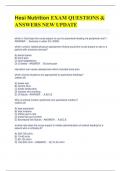
Hesi Nutrition EXAM QUESTIONS & ANSWERS NEW UPDATE
Hesi Nutrition EXAM QUESTIONS & ANSWERS NEW UPDATE which Iv fluid does the nurse expect to use for parenteral feeding via peripheral vein? - ANSWER dextrose in water 5% (D5W) which nutrition related physical assessment finding would the nurse expect to see in a patient with anorexia nervosa? A) dental caries B) bone pain C) heart palpitations D) GI bleed - ANSWER B) bone pain starvation can cause osteoporosis which includes bone pain. which clinical situations are appropriate for parenteral feedings? (select all) A) bowel rest B) severe ileus C) bowel obstruction D) nausea and vomiting E) GI fistula - ANSWER A,B,C,E Why is enteral nutrition preferred over parenteral nutrition? (select all) A) less expensive B) less invasive C) allows gut to rest D) preserves gut function E) decreased risk factors - ANSWER A,B,D,E at what rate does the nurse expect to initiate administration of enteral feeding for a patient who is critically ill? A) 240-720 ml/hr B) 10-40 ml/hr C) 60-120 ml/hr D) 150-520 ml/hr - ANSWER B) 10-40 ml/hr patients who are critically ill cannot tolerate large feedings for a long time. which is a benefit of administering parenteral nutrition over enteral? A) faster wound healing B) preservation of the GI tract C) fewer complications D) short term - ANSWER D) short term which is a primary consideration when choosing an access route for parenteral nutrition? A) patient's disease state B) osmolality of the solution C) duration of infusion administration D) frequency of nutrition administration - ANSWER B) osmolality the osmolality of the solution is the primary consideration when choosing an access route for parenteral nutrition. A higher osmolality solution is a reflection of the concentration of total particles. for example small peripheral veins, usually in the arm, are used to deliver less concentrated solutions the other answers are all taken into consideration, but the osmolality requires specific access routes making it the primary consideration. which biochemical marker is measured after initiation of enteral nutrition? A) fluid balance B) creatinine C) amylase D) pre-albumin - ANSWER D) pre-albumin pre-albumin is a biochemical marker for protein malnutrition. fluid balance is not a biochemical marker. Creatinine and amylase are not biochemical markers measured after initiation of enteral nutrition. which type of enteral formula is designed for a patient with a fully functional GI tract ? A) Polymeric B) Semi-elemental D) Single nutrient E) hydrolyzed elemental - ANSWER A) polymeric polymeric formulas are made from intact nutrients for use with a fully functional GI tract. the others are used for patients with out a a fully functional GI tract because these formulas are readily absorbed with minimal residue. which enteral feeding route poses the highest risk for aspiration? A) nasogastric B) jejunostomy C) nasoduodenal D) gastrostomy - ANSWER A) nasogastric
Document information
- Uploaded on
- April 27, 2024
- Number of pages
- 31
- Written in
- 2023/2024
- Type
- Exam (elaborations)
- Contains
- Questions & answers