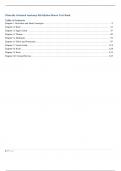
Test Bank Clinically Oriented Anatomy 8th Edition MooreTable of Contents Chapter 1 Overview and Basic Concepts ................................ ............................ 2 Chapter 2: Back ................................ ................................ ............... 12 Chapter 3: Upper Limb ................................ ................................ ......... 37 Chapter 4: Thorax ................................ ................................ ............. 49 Chapter 5: Abdomen ................................ ................................ ........... 72 Chapter 6: Pelvis and Perineum ................................ ................................ .. 97 Chapter 7: Lower Limb ................................ ................................ ........ 112 Chapter 8: Head ................................ ................................ .............. 120 Chapter 9: Neck ................................ ................................ .............. 131 Chapter 10: Cranial Nerves ................................ ................................ ..... 147
1 | P a g eChapter 1 Overview and Basic Concepts
MULTIPLE CHOICE.
Choose the one alternative that best completes the statement or answers thequestion.
1) What is a vertical section through the body, dividing it into anterior and posterior regions called?
A) transverse
B) sagittal
D) frontal
Answer: D
2) One of the functional characteristics of life is irritability. This refers to
A) the nervous system causing all living things to sometimes experience anger
B) sensing changes in the environment and then reacting or responding to them
C) the necessity for all organisms to reproduce
D) indigestible food residues stimulating the excretory
system.
Answer: B
3) Which of the following describes a parasagittal plane?
A) two cuts dividing the body into left and right halves
B) a transverse cut just above the knees
C) any sagittal plane except the median
D) any cut dividing the body into anterior
and posterior
Answer: C
4) Which one of the following systems responds to environmental stimuli?
A) nervous
B) lymphatic
D) muscular
Answer: A
5) The cavities housing the eyes are called
B) nasal
A) cranial
D)frontal
Answer: C
6) f you consider your home air conditioner in terms of homeostasis, then the wallthermostat
would be the _.
A) control center
Answer: A
B) effector
C) receptor
7) The dorsal body cavity is the site of which of the following?
A) intestines
B) liver
D) brain
Answer: D
2 | P a g e
C) lungs
D) variable
_ cavities.
C) orbital
C) immune
.
C) median8) Choose the anatomical topic and definition that is not correctly matched.
A) Cytology: study of the structures in a particular region.
B) Gross anatomy: study of structures visible to the eye.
C) Embryology: study of the changes in an individual from conception to birth.
D) Microscopic anatomy: study of structures too small to be seen by the
naked eye.
Answer: A
9) The term pollex refers to the
A) calf
.
B) thumb
D) great toe
Answer: B
10) The study of the heart may incorporate many aspects of anatomy but as a whole you would
say it is
anatomy.
A) developmental
Answer: D
B) microscopic
C) systemic
D) gross
C) fingers
11) What is the posterior side of the patella called?
A) popliteal
B) crural
D) sural
Answer: A
12) Which of these is not part of the dorsal cavity?
A) cranial cavity
B) spinal cord
D) vertebral cavity
Answer: C
13) An increased rate of breathing as a result of an increased buildup of carbon
dioxide in the bloodstream would be best described as an example of _
B) responsiveness
A) metabolism
C) maintaining boundaries
Answer: D
14) The anatomical position is used
.
A) only when a body is lying down
B) rarely, because people don't usually assume this position
C) as a standard reference point for directional terms regardless of
the actualposition of the body
D) as the most comfortable way to stand when dissecting a
specimen
Answer: C
3 | P a g e
D) excretion of metabolic waste
C) thoracic cavity
C) antecubital
.15) Which of the following organs or structures would be found in the left iliac region?
A) stomach
B) appendix
Answ
er: D
Expla
natio
n:
A
)
B)
C)
D)
16) An oblique cut is one that is cut
.
A) vertical right and left
B) perpendicular to vertical and horizontal
C) horizontal right and left
D) diagonally between the vertical and
horizontalAnswer: D
Explanation:
A
)
B)
C)
D)
17) What is the specific name for the hip region?
B) manus
A) coxal
inguinalAnswer: A
Explanation:
A
)
B)
C)
D)
18) Which of the following describes the operation of the heart and blood vessels?
B) cardiovascular physiology
A) systemic anatomy
C) systemic physiology
anatomyAnswer: D
Explanation:
A
)
B)
C)
D)
19) Choose the following statement that is not completely correct regarding serous membranes.
4 | P a g e
D) cardiovascular
18)
17)
C) pedal
D)
16)
C) liver
D) intestines19)
A) Serous membranes are divided into parietal and visceral
membranes with apotential space between the two.
B) Visceral pericardium covers the surface of the heart, and parietal
pericardiumlines the walls of the heart.
C) Serous membranes secrete a watery lubricating fluid.
D) Serosa are very thin, double- layered
structures.Answer: B
Explanation:
A
)
B)
C)
D)
20) The single most abundant chemical substance of the body, accounting for 60% to
0
% of body weight, is _
A) protein
Explanation:
.
B) oxygen
C) water
D) hydrogenAnswer: C
8
5 | P a g e20)
A
)
B)
C)
D)
21) What is the main, general purpose of negative feedback?
A) to regulate excretion
C) to control all bodysystem tissues
sugar highAnswer: B
Explanation:
A
)
B)
C)
D)
22) Homeostasis is the condition in which the body maintains .
A) a relatively stable internal environment, within limits
B) a dynamic state within an unlimited range
C) the lowest possible energy usage
D) a static state with no deviation from
preset pointsAnswer: A
Explanation:
A
)
B)
C)
D)
23) Which body cavity protects the nervous system?
B) cranial
A) dorsal
vertebralAnswer: A
Explanation:
A
)
B)
C)
D)
24)
A) Orbital
cavities are spaceswithin joints.
B) Oral
D) NasalAnswer: C
Explanation:
)
6 | P a g e
A
24)
C) Synovial
23)
C) thoracic
D)
22)
B) to maintain homeostasis
D) to keep the body's
21)B)
C)
D)
25) Which of the following imaging devices would best localize a tumor in a person's brain? 25)
A) DSA
B) MRI
D) PETAnswer: B
Explanation:
)
A
B)
C)
D)
26) A structure that is composed of two or more tissues would be a(n)
B) complex tissue
A) organ system
complex cellAnswer: C
Explanation:
A
)
B)
C)
D)
27) Average body temperature is _
degrees centigrade.
37
Answ
er: C
Expla
natio
n:
A
)
B)
C)
D)
28) The parietal pleural would represent a serous membrane .
A) covering individual lungs
C) lining the thoracic cavity
cavityAnswer: C
Explanation:
A
)
B)
C)
D)
7 | P a g e
B) covering the heart
D) lining the abdominal
28)
27) A) 68
D) 98
B) 47
C)
C) organ
. 26)
D)
C) X ray29) A good example of a positive feedback mechanism would be _
. 29)
A) regulating glucose levels in the blood
C) body temperature regulation
regulationAnswer: B
Explanation:
A
)
B)
C)
D)
30) Place the following in correct sequence from simplest to most complex:
1. molecules
2. atoms
3.
tissues
4. cells
5. organ
A) 2- 1- 3- 4- 5
Answer: C
Explanation:
B) 1- 2- 4- 3- 5
C) 2- 1- 4- 3- 5
D) 1- 2- 3- 4- 5
B) enhancement of labor contractions
D) blood calcium level
8 | P a g e30)
A
)
B)
C)
D)
31) Select the most correct statement.
A) Organ systems operate independently of each other to maintain life.
B) The endocrine system is not a true structural organ system.
C) The immune system is closely associated with the lymphatic system.
D) Organ systems can be composed of cells or tissues, but
not both.Answer: C
Explanation:
A
)
B)
C)
D)
32) Which of the following statements is the most correct regarding homeostatic imbalance? 32)
A) Positive feedback mechanisms are overwhelmed.
B) Negative feedback mechanisms are functioning normally.
C) It is considered the cause of most diseases.
D) The internal environment is becoming more
stable.Answer: C
Explanation:
A
)
B)
C)
D)
33) What is a vertical section through the body, dividing it into left and right, called?
B) transverse
A) regional
frontalAnswer: C
Explanation:
A
)
B)
C)
D)
34) The heart lies in the _
A) pericardial
C) pleural
Answ
er: A
Expla
9 | P a g e
cavity.
B) superior mediastinal
D) dorsal
34)
C) sagittal
D)
33)
31)natio
n:
A
)
B)
C)
D)
35) Which of the following would not be a functional characteristic of life?
A) maintenance of boundaries
35)
B) responsiveness to external stimuli
C) decay
Answ
er: C
Expla
natio
n:
A
)
B)
C)
D)
36) Histology would be best defined as a study of .
A) cells
C) the gross structuresof the body
tissuesAnswer: D
Explanation:
A
)
B)
C)
D)
37) Which of the following are survival needs of the body?
A) nutrients, water, growth, and reproduction
B) nutrients, water, atmospheric pressure, and oxygen
C) nutrients, water, movement, and reproduction
D) water, atmospheric pressure, growth, and
movementAnswer: B
Explanation:
A
)
B)
C)
D)
38) The anatomical position is characterized by all of the following except
B) body erect
A) palms turned posteriorly
10 | P a g e
. 38)
37)
36)
B) cell chemistry
D)
D) movementC) thumbs pointed laterally
D) arms
at sidesAnswer: A
Explanation:
A
)
B)
C)
D)
39) Which of the following statements is true concerning feedback mechanisms?
39)
A) Negative feedback mechanisms work to prevent sudden severe changes within the body.
B) Positive feedback mechanisms always result in excessive damage to the host.
C) Blood glucose levels are regulated by positive feedback mechanisms.
D) Negative feedback mechanisms tend to increase the original
stimulus.Answer: A
Explanation:
A
)
B)
C)
D)
40) In which cavities are the lungs located?
A) mediastinum, thoracic, and ventral
C) pleural, dorsal, and abdominal
thoracicAnswer: B
Explanation:
A
)
B)
C)
D)
Ans wer Key
Testname:
C1
1) D
2) B
3) C
4) A
5) C
6) A
7) D
8) A
9) B
10) D
11 | P a g e
40)
B) pleural, ventral, and thoracic
D) pericardial, ventral, and11) A
12) C
13) D
14) C
15) D
16) D
17) A
18) D
19) B
20) C
21) B
22) A
23) A
24) C
25) B
26) C
27) C
28) C
29) B
30) C
31) C
32) C
33) C
34) A
35) C
36) D
37) B
38) A
39) A
40) B
Chapter 2: Back
Multiple Choice Questions
1. There are
enlargements of the spinal cord where nerves supplying theextremitiesenter
and leave.
A. two
B. three
C. four
D. five
E. six
Bloom's Level: 1. Remember
12 | P a g eHAPS Objective: H10.01 Describe the gross anatomy of the spinal cord and spinal nerves andspecify their
location relative to the anatomy of the skeletal system.
HAPS Objective: H10.02 Identify the anatomical features seen in a cross
sectional view of the spinal cord. Learning Outcome: 12.01A. Describe the
general structure of the spinal cord.
Section:
12.01 Type:
Study Guide
2. The spinal cord
A. controls the reticular activating system.
B. stores reflexive memory.
C. forms memory engrams.
D. links the peripheral nervous system to the brain.
E. is characterized by conscious activity.
Bloom's Level: 1. Remember
HAPS Objective: H03.01 List the parts of the nervous system that constitute the central
nervous system (CNS) and those that constitute the peripheral nervous system (PNS).
HAPS Objective: H10.01 Describe the gross anatomy of the spinal cord and spinal nerves andspecify their
location relative to the anatomy of the skeletal system.
Learning Outcome: 12.01A. Describe the general
structure of the spinal cord. Section: 12.01
Type: Study Guide
3. The spinal cord begins at the
A. cerebellum.
B. medulla oblongata.
C. foramen magnum.
D. conus medullaris
E. 1st cervical vertebrae.
Bloom's Level: 1. Remember
HAPS Objective: H10.01 Describe the gross anatomy of the spinal cord and spinal nerves andspecify their
location relative to the anatomy of the skeletal system.
Learning Outcome: 12.01A. Describe the general
structure of the spinal cord. Section: 12.01Type:
Study Guide
4. The conus medullaris
A. anchors the spinal cord to the coccyx.
B. is a tapered, cone like region immediately inferior to the lumbar enlargement.
C. marks the exit of nerves to the upper extremity.
D. is located adjacent to the foramen magnum.
E. is inferior to the cauda equina.
13 | P a g eBloom's Level: 1. Remember
HAPS Objective: H10.01 Describe the gross anatomy of the spinal cord and spinal nerves andspecify their
location relative to the anatomy of the skeletal system.
HAPS Objective: H10.02 Identify the anatomical features seen in a cross
sectional view of the spinal cord. Learning Outcome: 12.01A. Describe the
general structure of the spinal cord.
Section:
12.01 Type:
Study Guide
5. The spinal cord ends at the
A. sacrum.
B. coccyx.
C. 5th lumbar vertebrae.
D. 2nd lumbar vertebrae.
Bloom's Level: 1. Remember
HAPS Objective: H08.02 Identify the meninges and describe their functional relationship to thebrain and
cranial bones.
HAPS Objective: H10.01 Describe the gross anatomy of the spinal cord and spinal nerves andspecify their
location relative to the anatomy of the skeletal system.
Learning Outcome: 12.01A. Describe the gene1ra8 l
structure of the spinal cord. Section: 12.01
Type: Study Guide
6. The thickest of the meninges is the
A. pia mater.
B. arachnoid mater.
C. subdural space.
D. subarachnoid space.
E. dura mater.
Bloom's Level: 1. Remember
HAPS Objective: H08.02 Identify the meninges and describe their functional relationship to thebrain and
cranial bones.
HAPS Objective: H08.03 Describe the functions of cerebrospinal fluid, as well as the details of its
production, its circulation within the central nervous system, and its ultimate
reabsorption into the bloodstream.
HAPS Objective: H08.04 Describe the structural basis for, and the importance of the blood brainbarrier.
HAPS Objective: H10.01 Describe the gross anatomy of the spinal cord and spinal nerves andspecify their
location relative to the anatomy of the skeletal system.
HAPS Objective: H10.02 Identify the anatomical features seen in a cross sectional view of thespinal cord.
Learning Outcome: 12.01B. Name the meninges (sing. meninx) and theirrelated
spaces surrounding the spinal cord. Section: 12.01
Type: Study Guide
7. The sac surrounding the spinal cord is the
14 | P a g eA. dural sac.
B. meningeal sac.
C. thecal sac.
D. epidural sac.
Bloom's Level: 1. Remember
HAPS Objective: H08.02 Identify the meninges and describe their functional relationship to thebrain and
cranial bones.
HAPS Objective: H08.03 Describe the functions of cerebrospinal fluid, as well as the details of its
production, its circulation within the central nervous system, and its ultimate
reabsorption into the bloodstream.
HAPS Objective: H08.04 Describe the structural basis for, and the importance of the blood brainbarrier.
HAPS Objective: H10.01 Describe the gross anatomy of the spinal cord and spinal nerves andspecify their
location relative to the anatomy of the skeletal system.
HAPS Objective: H10.02 Identify the anatomical features seen in a cross sectional view of thespinal cord.
Learning Outcome: 12.01B. Name the meninges (sing. meninx) and theirrelated
spaces surrounding the spinal cord. Section: 12.01
Type: Study Guide
8. The middle, thin, spider-like meninx is the
A. dura mater.
B. pia mater.
C. ectomater.
D. arachnoid mater.
Bloom's Level: 1. Remember
HAPS Objective: H08.02 Identify the meninges and describe their functional relationship to thebrain and
cranial bones.
HAPS Objective: H08.03 Describe the functions of cerebrospinal fluid, as well as the details of its
production, its circulation within the central nervous system, and its ultimatereabsorption into the
bloodstream.
HAPS Objective: H08.04 Describe the structural basis for, and the importance of the blood brainbarrier.
HAPS Objective: H10.01 Describe the gross anatomy of the spinal cord and spinal nerves andspecify their
location relative to the anatomy of the skeletal system.
HAPS Objective: H10.02 Identify the anatomical features seen in a cross sectional view of thespinal cord.
Learning Outcome: 12.01B. Name the meninges (sing. meninx) and theirrelated
spaces surrounding the spinal cord. Section: 12.01
Type: Study Guide
9. What space, found between the vertebral wall and the dura mater, is the area for injecting
anesthesia for childbirth?
A. subarachnoid space
B. subdural space
C. epidural space
D. epipial space
Bloom's Level: 1. Remember
HAPS Objective: H08.02 Identify the meninges and describe their functional relationship to thebrain and
cranial bones.
15 | P a g eHAPS Objective: H08.03 Describe the functions of cerebrospinal fluid, as well as the details of its
production, its circulation within the central nervous system, and its ultimate
reabsorption into the bloodstream.
HAPS Objective: H08.04 Describe the structural basis for, and the importance of the blood brainbarrier.
HAPS Objective: H09.04 Describe the location of the cranial nerve nuclei and the ganglia associated
with the cranial nerves.
HAPS Objective: H10.01 Describe the gross anatomy of the spinal cord and spinal nerves andspecify their
location relative to the anatomy of the skeletal system.
Learning Outcome: 12.01B. Name the meninges (sing. meninx) and theirrelated
spaces surrounding the spinal cord. Section: 12.01
Type: Study Guide
10. During a spinal tap, cerebrospinal fluid is obtained from which of the following
locations?
A. dural sinus
B. epidural space
C. subarachnoid space
D. subdural space
E. sagittal sinus
Bloom's Level: 1. Remember
HAPS Objective: H08.02 Identify the meninges and describe their functional relationship to thebrain and
cranial bones.
HAPS Objective: H08.03 Describe the functions of cerebrospinal fluid, as well as the details of its
production, its circulation within the central nervous system, and its ultimatereabsorption into the
bloodstream.
HAPS Objective: H08.04 Describe the structural basis for, and the importance of the blood brainbarrier.
HAPS Objective: H10.01 Describe the gross anatomy of the spinal cord and spinal nerves andspecify their
location relative to the anatomy of the skeletal system.
HAPS Objective: H10.02 Identify the anatomical features seen in a cross sectional view of thespinal cord.
Learning Outcome: 12.01B. Name the meninges (sing. meninx) and theirrelated
spaces surrounding the spinal cord. Section: 12.01
Type: Study Guide
11. What structure anchors the thecal sac and conus medullaris to the coccyx?
A. filum terminale
B. denticulate ligaments
C. pia mater
D. cauda equina
Bloom's Level: 1. Remember
HAPS Objective: H08.02 Identify the meninges and describe their functional relationship to thebrain and
cranial bones.
HAPS Objective: H08.03 Describe the functions of cerebrospinal fluid, as well as the details of its
production, its circulation within the central nervous system, and its ultimate
reabsorption into the bloodstream.
HAPS Objective: H08.04 Describe the structural basis for, and the importance of the blood brainbarrier. HAPS
Objective: H10.01 Describe the gross anatomy of the spinal cord and spinal nerves andspecify their location
relative to the anatomy of the skeletal system.
HAPS Objective: H10.02 Identify the anatomical features seen in a cross sectional view of thespinal cord.
16 | P a g eLearning Outcome: 12.01B. Name the meninges (sing. meninx) and theirrelated
spaces surrounding the spinal cord. Section: 12.01
Type: Study Guide
12. Where is cerebrospinal fluid found around the spinal cord?
A. subdural space
B. epidural space
C. thecal sac
D. subarachnoid space
Bloom's Level: 1. Remember
HAPS Objective: H08.02 Identify the meninges and describe their functional relationship to thebrain and
cranial bones.
HAPS Objective: H08.03 Describe the functions of cerebrospinal fluid, as well as the details of its
production, its circulation within the central nervous system, and its ultimatereabsorption into the
bloodstream.
HAPS Objective: H08.04 Describe the structural basis for, and the importance of the blood brainbarrier.
HAPS Objective: H10.01 Describe the gross anatomy of the spinal cord and spinal nerves andspecify their
location relative to the anatomy of the skeletal system.
HAPS Objective: H10.02 Identify the anatomical features seen in a cross sectional view of thespinal cord.
Learning Outcome: 12.01B. Name the meninges (sing. meninx) and theirrelated
spaces surrounding the spinal cord. Section: 12.01
Type: Study Guide
13. Which of the following is false?
A. The dorsal root of the spinal cord conveys sensory (afferent) nerve impulses to thespinalcord.
B. The posterior horn of the cord contains the cell bodies of motor neurons.
C. The ventral root is formed by the axons of neurons in the lateral and anterior horns.
D. The dorsal and ventral roots unite to form spinal nerves.
E. The ventral root of the spinal cord conveys motor (efferent) nerve impulses away fromthespinal
cord.
Bloom's Level: 2. Understand
HAPS Objective: H10.04 Identify the dorsal root ganglia, dorsal and ventral roots, and spinalnerves.
HAPS Objective: H10.05 Discuss how the structures root, nerve, ramus, plexus, tract and
ganglion relate to one another. Learning Outcome: 12.01C. Draw andlabel a cross section
of the spinal cord with its dorsal and ventral nerve roots.
Section:
12.01 Type:Study
Guide
14. The ventral root of a spinal nerve contains
A. only sensory fibers.
B. only motor fibers.
C. only afferent fibers.
D. both sensory and motor fibers.
E. a ganglion.
17 | P a g eBloom's Level: 1. Remember
HAPS Objective: H10.04 Identify the dorsal root ganglia, dorsal and ventral roots, and spinalnerves.
HAPS Objective: H10.05 Discuss how the structures root, nerve, ramus, plexus, tract and
ganglion relate to one another. Learning Outcome: 12.01C. Draw andlabel a cross section
of the spinal cord with its dorsal and ventral nerve roots.
Section:
12.01 Type:
Study Guide
15. The sensory root of a spinal nerve is also referred to as
A. anterior root.
B. dorsal root.
C. efferent root.
D. ventral root.
E. lateral root.
Bloom's Level: 1. Remember
HAPS Objective: H10.04 Identify the dorsal root ganglia, dorsal and ventral roots, and spinalnerves.
HAPS Objective: H10.05 Discuss how the structures root, nerve, ramus, plexus, tract and
ganglion relate to one another. Learning Outcome: 12.01C. Draw andlabel a cross section
of the spinal cord with its dorsal and ventral nerve roots.
Section:
12.01 Type:
Study Guide
16. The motor root of a spinal nerve is also referred to as the
A. afferent root.
B. dorsal root.
C. posterior root.
D. ventral root.
E. sensory root.
Bloom's Level: 1. Remember
HAPS Objective: H10.04 Identify the dorsal root ganglia, dorsal and ventral roots, and spinalnerves.
HAPS Objective: H10.05 Discuss how the struc2t3ures root, nerve, ramus, plexus, tract and
ganglion relate to one another. Learning Outcome: 12.01C. Draw and
label a cross section of the spinal cord with its dorsal and ventral nerve roots.
Section:
12.01 Type:Study
Guide
18 | P a g e24
17. The cross-sectional view of the spinal cord reveals white matter on the
19 | P a g eA. inside, gray matter on the outside, and a dorsal motor root.
B. outside, gray matter on the inside, and a ventral motor root.
C. inside, gray matter on the outside, and a dorsal sensory root.
D. outside, gray matter on the inside, and a ventral sensory root.
Bloom's Level: 1. Remember
HAPS Objective: H10.02 Identify the anatomical features seen in a cross sectional view of thespinal cord.
HAPS Objective: H10.03 Contrast the relative position of gray matter and white matterin the spinal
cord with the corresponding arrangement of gray and white matter in the brain.
Learning Outcome: 12.01C. Draw and label a cross section of the spinal cordwith its
dorsal and ventral nerve roots. Section: 12.01
Type: Study Guide
18. In the spinal cord, white matter is organized into
A. horns and the gray matter into columns.
B. horns and the gray matter into roots.
C. columns and the gray matter into horns.
D. columns and the gray matter into tracts.
Bloom's Level: 1. Remember
HAPS Objective: H10.02 Identify the anatomical features seen in a cross sectional view of thespinal cord.
HAPS Objective: H10.03 Contrast the relative position of gray matter and white matterin the spinal
cord with the corresponding arrangement of gray and white matter in the brain.
Learning Outcome: 12.01C. Draw and label a cross section of the spinal cordwith its
dorsal and ventral nerve roots. Section: 12.01
Type: Study Guide
19. What structure makes the dorsal root different from the ventral root?
A. The dorsal root has a ganglion.
B. The dorsal root has a tract.
C. The dorsal root has a nucleus.
D. The dorsal root appears the same as the ventral root.
Bloom's Level: 1. Remember
HAPS Objective: H10.02 Identify the anatomical features seen in a cross
sectional view of the spinal cord. HAPS Objective: H10.04 Identify the dorsal root
ganglia, dorsal and ventral roots, and spinal nerves.
HAPS Objective: H10.05 Discuss how the structures root, nerve, ramus, plexus,
tract and
ganglion relate to one another. Learn25i ng Outcome: 12.01C. Draw and label a cross
section of the spinal cord with its dorsal and ventral nerve roots.
Section:
12.01 Type:Study
Guide
20 | P a g e21 | P a g e26
20. What is found in the dorsal root ganglion?
A. The cell bodies of multipolar motor neurons.
B. The cell bodies of pseudo-unipolar sensory neurons.
C. The cell bodies of multipolar interneurons.
D. The cell bodies of bipolar sensory neurons.
Bloom's Level: 1. Remember
HAPS Objective: H10.04 Identify the dorsal root ganglia, dorsal and ventral roots, and spinalnerves.
HAPS Objective: H10.05 Discuss how the structures root, nerve, ramus, plexus, tract and
ganglion relate to one another. Learning Outcome: 12.01C. Draw andlabel a cross section
of the spinal cord with its dorsal and ventral nerve roots.
Section:
12.01 Type:
Study Guide
21. What is found the lateral gray horns of the spinal cord?
A. The cell bodies of somatic motor neurons.
B. The cell bodies of sensory neurons.
C. The cell bodies of autonomic motor neurons.
D. The cell bodies of somatic sensory neurons.
Bloom's Level: 1. Remember
HAPS Objective: H10.04 Identify the dorsal root ganglia, dorsal and ventral roots, and spinalnerves.
HAPS Objective: H10.05 Discuss how the structures root, nerve, ramus, plexus, tract and
ganglion relate to one another. Learning Outcome: 12.01C. Draw andlabel a cross section
of the spinal cord with its dorsal and ventral nerve roots.
Section:
12.01 Type:
Study Guide
22. Structurally, the simplest reflex is the
A. stretch reflex.
B. Golgi tendon reflex.
C. reciprocal reflex.
D. alternating reflex.
E. withdrawal reflex.
Bloom's Level: 1. Remember
HAPS Objective: H11.02 Describe reflex responses in terms of the major structural and
functional components of a reflex arc.
HAPS Objective: H11.05 Describe a stretch reflex, a flexor (withdrawal) reflex, and a
crossed-extensor reflex, and name all components of each reflex arc.
HAPS Objective: H11.06 Demonstrate a stretc2h7reflex (e.g., patellar or plantar).
22 | P a g eLearning Outcome: 12.02B. Compare and contrast the features of a stretch reflex, a Golgitendon reflex, a
withdrawal reflex, and a crossed extensor reflex
Section:
12.02 Type:Study
Guide
23 | P a g e28
23. Reflex arcs
A. are capable of receiving a stimulus and yielding a response.
B. are the basic structural units of the nervous system.
C. occur primarily in the cerebral cortex of the brain.
D. involve inhibitory neurons.
E. do not involve the spinal cord.
Bloom's Level: 1. Remember
HAPS Objective: H11.02 Describe reflex responses in terms of the major structural and
functional components of a reflex arc. Learning Outcome: 12.02A. Describe the components
of a monosynaptic and a polysynaptic reflex arc.
Section:
12.02 Type:
Study Guide
24. Which portion of a reflex arc is most likely to be located entirely within
thecentralnervous system?
A. sensory neuron
B. motor neuron
C. effector cell
D. interneuron
E. receptor cell
Bloom's Level: 1. Remember
HAPS Objective: H11.02 Describe reflex responses in terms of the major structural and
functional components of a reflex arc. Learning Outcome: 12.02A. Describe the components
of a monosynaptic and a polysynaptic reflex arc.
Section:
12.02 Type:
Study Guide
25. Reflexes
A. are homeostatic.
B. are not homeostatic.
C. are voluntary conscious responses to a stimulus.
24 | P a g eD. are integrated in the spinal cord, but not the brain.
E. are integrated in the brain, but not the spinal cord.
Bloom's Level: 1. Remember
HAPS Objective: H11.01 Define the term reflex.
HAPS Objective: H11.02 Describe reflex responses in terms of the major structural and
functional components of a reflex arc. Learning Outcome: 12.02A. Describe the components
of a monosynaptic and a polysyna2p9tic reflex arc.
Section:
12.02 Type:Study
Guide
26. Reflexes function in
A. removing the body from painful stimuli.
B. keeping the body from falling.
C. maintaining blood pressure.
D. maintaining blood CO2 levels.
E. All of these choices are correct.
Bloom's Level: 1. Remember
HAPS Objective: H11.01 Define the term reflex.
HAPS Objective: H11.02 Describe reflex responses in terms of the major structural and
functional components of a reflex arc. Learning Outcome: 12.02A. Describe the components of a
monosynaptic and a polysynaptic reflex arc.
Learning Outcome: 12.02B. Compare and contrast the features of a stretch reflex, a Golgitendon
reflex, a withdrawal reflex, and a crossed extensor reflex
Section:
12.02 Type:
Study Guide
27. Place the following parts of a reflex arc in the correct order beginning with thesensory
receptor.
(1) motor neuron
(2) interneuron
(3) effector
(4) sensory neuron
(5) sensory receptorA. 5,
1, 2, 3, 4
B. 5, 3, 2, 4, 1
C. 5, 4, 3, 2, 1
D. 5, 2, 3, 4, 1
E. 5, 4, 2, 1, 3
Bloom's Level: 2. Understand
25 | P a g eHAPS Objective: H11.02 Describe reflex responses in terms of the major structural and
functional components of a reflex arc.
HAPS Objective: H11.05 Describe a stretch reflex, a flexor (withdrawal) reflex, and a
crossed-extensor reflex, and name all components of each reflex arc.
Learning Outcome: 12.02A. Describe the components of a
monosynaptic and a polysynaptic reflex arc. Section: 12.02Type:
Study Guide
28. The sensory receptor of the stretch reflex is the
A. Golgi tendon organ.
B. muscle spindle.
C. dorsal root ganglion.
D. collateral axon.
E. alpha motor neurons.
Bloom's Level: 1. Remember
HAPS Objective: H11.05 Describe a stretch reflex, a flexor (withdrawal) reflex, and a
crossed-extensor reflex, and name all components of each reflex arc.
HAPS Objective: H11.06 Demonstrate a stretch reflex (e.g., patellar or plantar).
Learning Outcome: 12.02B. Compare and contrast the features of a stretch reflex, a Golgitendon reflex, a
withdrawal reflex, and a crossed extensor reflex
Section: 12.02
29. Stretch reflexes
A. are learned voluntary responses.
B. aid in maintaining proper posture.
C. prevent muscles from being damaged by excessive tension.
D. cause the removal of limbs from painful stimuli.
E. prevent falling.
Bloom's Level: 1. Remember
HAPS Objective: H11.05 Describe a stretch reflex, a flexor (withdrawal) reflex, and acrossed-
extensor reflex, and name all components of each reflex arc.
HAPS Objective: H11.06 Demonstrate a stretch reflex (e.g., patellar or plantar).
Learning Outcome: 12.02B. Compare and contrast the features of a stretch reflex, a Golgitendon
reflex, a withdrawal reflex, and a crossed extensor reflex
Section:
12.02 Type:Study
Guide
30. Which of the following events in a stretch reflex occurs last?
A. alpha motor neurons transmit action potentials to muscle causing contraction
B. muscle spindle detects stretch of muscle
C. afferent neurons conduct action potentials to the spinal cord
D. afferent neurons synapse with alpha motor neurons
E. muscle is stretched
26 | P a g eBloom's Level: 1. Remember
HAPS Objective: H11.05 Describe a stretch reflex, a flexor (withdrawal) reflex, and a
crossed-extensor reflex, and name all components of each reflex arc.
HAPS Objective: H11.06 Demonstrate a stretch reflex (e.g., patellar or plantar).
Learning Outcome: 12.02B. Compare and contrast the features of a stretch reflex, a Golgitendon
reflex, a withdrawal reflex, and a crossed extensor reflex
Section: 12.02
31. Muscle spindles
A. are innervated by gamma motor neurons.
B. originate in the spinal cord.
C. are specialized nerve cells.
D. are found encapsulated in nerve endings.
E. are innervated by alpha motor neurons.
Bloom's Level: 1. Remember
HAPS Objective: H11.02 Describe reflex responses in terms of the major structural and
functional components of a reflex arc.
HAPS Objective: H11.05 Describe a stretch reflex, a flexor (withdrawal) reflex, and acrossed-
extensor reflex, and name all components of each reflex arc.
Learning Outcome: 12.02B. Compare and contrast the features of a stretch reflex, a Golgitendon
reflex, a withdrawal reflex, and a crossed extensor reflex
Section:
12.02 Type:Study
Guide
32. Muscles and glands that are capable of producing a response when stimulated bymotor
neurons are called
A. aponeuroses.
B. effectors.
C. neuromodulators.
D. receptors.
E. sensory organs.
Bloom's Level: 1. Remember
HAPS Objective: H11.02 Describe reflex responses in terms of the major structural and
functional components of a reflex arc.
HAPS Objective: H11.05 Describe a stretch reflex, a flexor (withdrawal) reflex, and acrossed-
extensor reflex, and name all components of each reflex arc.
HAPS Objective: H12.02 Describe the locations and functions of the upper and lower motor
neurons in a motor pathway.
HAPS Objective: H13.03 Describe examples of specific effectors dually innervated by the two
branches of the autonomic nervous system and explain how each branch influences function ina given
effector.
Learning Outcome: 12.02B. Compare and contrast the features of a stretch reflex, a Golgitendon
reflex, a withdrawal reflex, and a crossed extensor reflex
Section: 12.02
27 | P a g e33. The knee-jerk reflex involves which of the following?
A. sensory and motor neurons
B. sensory, association and motor neurons
C. sensory, motor and inhibitory interneurons
D. sensory and association neurons
E. the brain
Bloom's Level: 1. Remember
HAPS Objective: H11.02 Describe reflex responses in terms of the major structural and
functional components of a reflex arc.
HAPS Objective: H11.05 Describe a stretch reflex, a flexor (withdrawal) reflex, and acrossed-
extensor reflex, and name all components of each reflex arc.
HAPS Objective: H12.03 Explain how decussation occurs in sensory and motor pathways and
predict how decussation impacts the correlation of brain damage andsymptoms in stroke
patients.
HAPS Objective: H13.06 Describe visceral reflex arcs, including structural and
functional details of sensory and motor (autonomic) components.
Learning Outcome: 12.02A. Describe the components of a monosynaptic and a polysynaptic reflexarc.
Learning Outcome: 12.02B. Compare and contrast the features of a stretch reflex, a Golgitendon
reflex, a withdrawal reflex, and a crossed extensor reflex
Section: 12.02
34. Gamma motor neurons
A. are located in tendons.
B. transmit action potentials to skeletal muscle.
C. regulate the sensitivity of the muscle spindle.
D. enable the brain to perceive that a muscle has been stretched.
E. innervate the whole muscle.
Bloom's Level: 1. Remember
HAPS Objective: H11.02 Describe reflex responses in terms of the major structural and functional
components of a reflex arc.
HAPS Objective: H11.05 Describe a stretch reflex, a flexor (withdrawal) reflex, and a
crossed-extensor reflex, and name all components of each reflex arc.
HAPS Objective: H12.03 Explain how decussation occurs in sensory and motor pathways and
predict how decussation impacts the correlation of brain damage andsymptoms in stroke
patients.
HAPS Objective: H13.06 Describe visceral reflex arcs, including structural and
functional details of sensory and motor (autonomic) components.
Learning Outcome: 12.02A. Describe the components of a
monosynaptic and a polysynaptic reflex arc. Section: 12.02
35. The muscles of the back contract to straighten so that you sit at a more erect posture and
subsequently the muscles are suddenly stretched as you nod off. Which of the following best
represents the sequence of events when you start to nod off?
(1) muscles of the back are stretched
(2) the muscle spindle is stretched
(3) action potentials in sensory neurons of the muscle spindles increase
28 | P a g e(4) action potentials in alpha motor neurons of skeletal muscle fibers increase
(5) skeletal muscle of the back contract
A. 1, 2, 3, 4, 5
B. 1, 5, 2, 3, 4
C. 1, 5, 3, 2, 4
D. 5, 2, 3, 4, 1
E. 4, 5, 3, 2, 1
Bloom's Level: 2. Understand
HAPS Objective: H12.02 Describe the locations and functions of the upper and lower motor neurons
in a motor pathway.
HAPS Objective: H12.03 Explain how decussation occurs in sensory and motor pathways and
predict how decussation impacts the correlation of brain damage andsymptoms in stroke
patients.
HAPS Objective: H13.06 Describe visceral reflex arcs, including structural and
functional details of sensory and motor (autonomic) components.
Learning Outcome: 12.02A. Describe the components of a monosynaptic and a polysynaptic reflexarc.
Learning Outcome: 12.02B. Compare and contrast the features of a stretch reflex, a Golgitendon
reflex, a withdrawal reflex, and a crossed extensor reflex
Section: 12.02
35
36.
Doctor Johansson wants to test a patient's reflexes by briskly striking the patellar tendon with areflex
hammer. Which reflex is Dr. Johansson testing?
A. the Golgi tendon reflex.
B. the withdrawal reflex.
C.
the knee-jerk reflex.
D. the crossed extensor reflex.
E. reciprocal innervation.
Bloom's Level: 3. Apply
HAPS Objective: H11.05 Describe a stretch reflex, a flexor (withdrawal) reflex, and acrossed-
extensor reflex, and name all components of each reflex arc.
HAPS Objective: H11.06 Demonstrate a stretch reflex (e.g., patellar or plantar).
Learning Outcome: 12.02B. Compare and contrast the features of a stretch reflex, a Golgitendon
reflex, a withdrawal reflex, and a crossed extensor reflex
Section:
12.02 Type:
Study Guide
37. The reflex that prevents excessive tension in a muscle is the
A. stretch reflex.
29 | P a g eB. withdrawal reflex. C. Golgi tendon reflex. D. reciprocal reflex. E. crossed extensor reflex.
Bloom's Level: 1. Remember HAPS Objective: H11.05 Describe a stretch reflex, a flexor (withdrawal) reflex, and acrossedextensor reflex, and name all components of each reflex arc. Learning Outcome: 12.02B. Compare and contrast the features of a stretch reflex, a Golgitendon reflex, a withdrawal reflex, and a crossed extensor reflex Section: 12.02
38.
Sam is curling very heavy weights and suddenly drops them. Which reflex forced thisaction by Sam to prevent tendon damage?
A. muscle spindle reflex B.
Golgi tendon reflex C. gamma motor reflex D.
withdrawal reflex E.