

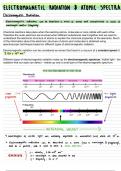
ELECTROMAGNETIC RADIATION 31 ATOMIC SPECTRA
Electromagnetic Radiation
Electromagnetic radiation can be described in terms of waves and characterised in terms of
wavelength and or frequency
Chemical reactions take place when the reacting atoms, molecules or ions collide with each other.
Therefore the outer electrons are involved when di erent substances react together and we need to
understand the electronic structure of atoms to explain the chemical properties of the elements. Much
of the information about the electronic structure of atoms and molecules is obtained using
spectroscopic techniques based on di erent types of electromagnetic radiation.
Electromagnetic radiation can be considered as waves that travel in a vacuum at a constant speed of
3OO x 108ms .
Di erent types of electromagnetic radiation make up the electromagnetic spectrum. Visible light - the
radiation that our eyes can detect - makes up only a small part of the electromagnetic spectrum.
lower s higher
frequencies frequencies
v 1
INCREASING ENERGY
wavelengths of visible light are normally expressed in nanometers nm which are 10am
radiation can be described as a wave has a
Electromagnetic wavelength 31frequency
and as a particle and is said to have a DUALNATURE
velocity 3.00 108 ms
c f X wavelength m often converted to nm
f frequency Hz or s
, Electromagnetic Waves measuredmostcommonly in nm Ioam
wavelength the distance between adjacent
points of a wave eg crests troughs This distance
can bemeasured in meters However in chemistry
theunitof wavelength most often used is nanometre nm
One nanometer is 10am the symbolforwavelengthis
the Greekletter lambda X
Frequency the number of wavelengths thatpass a fixed point in one second The symbol for
frequency is f Frequency is measured as Ytime and so has units of 5 This is also known as
the Hertz H2
All types of electromagnetic radiation travel at the SAME VELOCITY in a vacuum The velocity
is 3.00 x 10⁸ms This value is given the symbol c and it is assumed to be the constantvelocity
of electromagnetic radiation anywhere
The relationship between frequency velocity and wavelength is C
f
Wave number is the reciprocal of wavelength i This is the number of waves in one
unit length of radiation i e the number of waves permetre m
Wave Particle Duality
◦Electromagnetic radiation can be absorbed or emitted. When it is absorbed or emitted by
matter it behaves like a stream of particles. These participles are known as photons.
◦Electromagnetic radiation can be considered both a stream of photons and as waves with
characteristic properties (wavelength/frequency). Therefore we say electromagnetic radiation
has a dual nature: wave motion and streams of photons.
◦Photons can be describes as ‘little pockets of energy’ which carry quantised energy proportional
to the frequency of radiation.
Electromagnetic radiation that has a SHORT WAVELENGTH and HIGH FREQUENCY such as
gamma rays is at the HIGH ENERGY endofthe electromagnetic spectrum
Radio waves and other radiation with a LONG WAVELENGH and LOW FREQUENCY are at the
LOW ENERGY end of the electromagnetic spectrum
Electromagnetic Radiation
Electromagnetic radiation can be described in terms of waves and characterised in terms of
wavelength and or frequency
Chemical reactions take place when the reacting atoms, molecules or ions collide with each other.
Therefore the outer electrons are involved when di erent substances react together and we need to
understand the electronic structure of atoms to explain the chemical properties of the elements. Much
of the information about the electronic structure of atoms and molecules is obtained using
spectroscopic techniques based on di erent types of electromagnetic radiation.
Electromagnetic radiation can be considered as waves that travel in a vacuum at a constant speed of
3OO x 108ms .
Di erent types of electromagnetic radiation make up the electromagnetic spectrum. Visible light - the
radiation that our eyes can detect - makes up only a small part of the electromagnetic spectrum.
lower s higher
frequencies frequencies
v 1
INCREASING ENERGY
wavelengths of visible light are normally expressed in nanometers nm which are 10am
radiation can be described as a wave has a
Electromagnetic wavelength 31frequency
and as a particle and is said to have a DUALNATURE
velocity 3.00 108 ms
c f X wavelength m often converted to nm
f frequency Hz or s
, Electromagnetic Waves measuredmostcommonly in nm Ioam
wavelength the distance between adjacent
points of a wave eg crests troughs This distance
can bemeasured in meters However in chemistry
theunitof wavelength most often used is nanometre nm
One nanometer is 10am the symbolforwavelengthis
the Greekletter lambda X
Frequency the number of wavelengths thatpass a fixed point in one second The symbol for
frequency is f Frequency is measured as Ytime and so has units of 5 This is also known as
the Hertz H2
All types of electromagnetic radiation travel at the SAME VELOCITY in a vacuum The velocity
is 3.00 x 10⁸ms This value is given the symbol c and it is assumed to be the constantvelocity
of electromagnetic radiation anywhere
The relationship between frequency velocity and wavelength is C
f
Wave number is the reciprocal of wavelength i This is the number of waves in one
unit length of radiation i e the number of waves permetre m
Wave Particle Duality
◦Electromagnetic radiation can be absorbed or emitted. When it is absorbed or emitted by
matter it behaves like a stream of particles. These participles are known as photons.
◦Electromagnetic radiation can be considered both a stream of photons and as waves with
characteristic properties (wavelength/frequency). Therefore we say electromagnetic radiation
has a dual nature: wave motion and streams of photons.
◦Photons can be describes as ‘little pockets of energy’ which carry quantised energy proportional
to the frequency of radiation.
Electromagnetic radiation that has a SHORT WAVELENGTH and HIGH FREQUENCY such as
gamma rays is at the HIGH ENERGY endofthe electromagnetic spectrum
Radio waves and other radiation with a LONG WAVELENGH and LOW FREQUENCY are at the
LOW ENERGY end of the electromagnetic spectrum


