
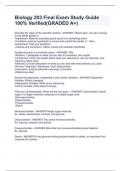
Biology 203 Final Exam Study Guide 100% Verified(GRADED A+)
Describe the steps of the scientific method - ANSWER -Observation: Use all 5 senses to see whats going on. -Hypothesis: Make an educated guess about how something works. -Prediction: Assume hypothesis is correct and predict the results. If... then... -Experiment: Test your prediction -Analysis and conclusion: Gather results and evaluate hypothesis Explain the parts of a scientific paper - ANSWER -Title -Abstract: 1 paragraph on what you did, why it's important, and results. -Introduction: Inform the reader about what your research is, why it's important, and reference others work. -Methods: Concise description of what you did, describe what statistics you used. -Results: Data/stats, differences. Don't analyze data. -Discussion: Analyze data with meanings, conclusion. -References cited Explain the dependent, independent, and control variables - ANSWER Dependent Variable- What's changing Independent Variable- What you're measuring Control Variable- What doesn't change What are Carbohydrates? What are the four types. - ANSWER Carbohydrate: simple sugar or a larger molecule composed of multiple sugar units. -Monosaccharides -Disaccharides -Polysaccharides -Starch Monosaccharides - ANSWER Single sugar molecule. Ex: ribose, deoxyribose, fructose, and glucose. Disaccharides - ANSWER Two joined monosaccharides. Ex: sucrose, maltose, and lactose. Polysaccharides - ANSWER More than two monosaccharides joined together. Ex: glucose Starch - ANSWER A key glucose-storing polysaccharide in plants, an important food molecule for humans. Proteins - ANSWER A diverse group of macromolecules. Many are structural components of muscle, bone, hair, fingernails, and toenails, among other tissues. All proteins are chains of amino acids. Benedict's Solution - ANSWER Tests for carbohydrates. Small carbohydrate molecules react upon heating with the copper-containing compound. Lugol's Solution (IKI) - ANSWER Tests for carbohydrates. Dilute solution of potassium Iodine reacts with starch and forms deep blue/black. Biuret reagent - ANSWER Tests for proteins. The greater the number of peptide bonds, the more intense the color reaction with Biuret. Sudan IV - ANSWER Tests for lipids. Drop solution on a piece of uncoated paper, if it leave behind oil then it contains a lipid. - ANSWER Enzyme - ANSWER Proteins that function as biological catalysts. Agents that speed up cellular reactions. Activation Energy - ANSWER The amount of energy necessary for a chemical reaction to proceed. Enzyme-substrate Complex - ANSWER When substrate molecules combine with enzyme molecules. Substrate - ANSWER The reactant (substance being acted upon) in an enzyme-catalyzed reaction. Product - ANSWER Formed from a reaction. Active Site - ANSWER A special region of the enzyme where the substrate binds. Cofactor - ANSWER Non-protein organic molecules and metal ions that are part of the structure of the active site, making the formation of the enzyme-substrate complex possible. Benzoquinone - ANSWER The brown coloration of a damaged apple or the blackening
Document information
- Uploaded on
- April 26, 2024
- Number of pages
- 9
- Written in
- 2023/2024
- Type
- Exam (elaborations)
- Contains
- Questions & answers


