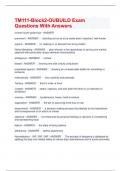
TM111-Block2-OUBUILD Exam Questions With Answers
TM111-Block2-OUBUILD Exam Questions With Answers inverse fourth power law - ANSWER prominent - ANSWER standing out so as to be easily seen; important, well-known organic - ANSWER of, relating to, or derived from living matter. Niche Marketing - ANSWER plan wherein a firm specializes in serving one market segment with particularly unique demand characteristics ambiguous - ANSWER unclear biased - ANSWER favoring one side unduly; prejudiced prejudiced against - ANSWER showing an unreasonable dislike for something or someone meticulously - ANSWER very carefully and precisely Tertiary - ANSWER third in order or level curated - ANSWER select, organize, and look after the items in (a collection or exhibition) onerous - ANSWER burdensome; heavy; hard to endure supposition - ANSWER the act of assuming to be true or real discernment - ANSWER a decision-making process that attends to the implications and consequences of an action or choice objective - ANSWER not influenced by personal feelings or opinions in considering and representing facts tedium - ANSWER the state of being tedious adherence - ANSWER faithful attachment Normalisation - 1NF, 2NF, 3NF - ANSWER The process of designing a database by splitting the data into related tables to reduce data redundancies and to avoid anomalies such as update, insert and delete which threaten the integrity and usability of the database. Entity Relationship Diagram - ANSWER A methodology for documenting databases illustrating the relationship between various entities in the database. instance - ANSWER A single occurrence of a database entity - such as a named individual in a database of students entity - ANSWER An individual object about which data is stored in a database. Entities can be described as tangible where they represent physical objects, or intangible where they represent processes or events. attribute - ANSWER An individual item of data belonging to an entity in a relational database. Individual attributes are represented by fields access control lists (ACLs) - ANSWER A set of instructions that can be applied to network devices to provide basic packet filtering, for example, stopping selected packets. Accessibility - ANSWER The principle that everyone should have equal access to products, information and services, regardless of physical or developmental abilities or impairments. Access Network - ANSWER The part of a telecommunications network that connects the end user to the core network Access point (AP or wireless AP) - ANSWER In wireless communications, the wireless device that users connect to and through which they communicate with other devices and networks. Access points sometimes also manage authentication of users and encryption of data. acknowledge (ACK) frame - ANSWER An automatically generated data unit transmitted to a data source to acknowledge receipt of a data unit. The data units are usually referred to as 'frames' and typically contain many bytes of data. ad hoc mode - ANSWER In Wi-Fi, a temporary, short range peer-to-peer network with no central administration like that typically provided by an access point. Affordances - ANSWER The attributes of an object that indicate to people how it is to be used. Algorithm - ANSWER A set of unambiguous, self-contained step-by-step instructions guaranteed to complete a particular task in a finite amount of time. Amplitude - ANSWER A measure of the maximum disturbance of a wave over a period of time. Amplitude Shift Keying (ASK) - ANSWER A form of modulation to enable a radio wave to convey data. The amplitude of the wave is varied between set values in order to represent zeros, ones or patterns of ones and zeros.
Documentinformatie
- Geüpload op
- 25 april 2024
- Aantal pagina's
- 29
- Geschreven in
- 2023/2024
- Type
- Tentamen (uitwerkingen)
- Bevat
- Vragen en antwoorden