Exam 2 Review PHIL 2303
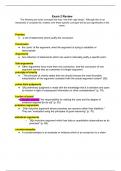
This text provides a review of concepts that may be encountered in Exam 2. It discusses the premise as a set of statements that justify the conclusion and the conclusion as the main point of the argument. Arguments are collections of statements used to justify a specific point, and sub-arguments can have multiple conclusions, serving as premises for larger arguments. The principle of charity suggests choosing the most favorable interpretation of an argument. Prima facie judgments are tentative and open to revision. The burden of proof refers to the responsibility of making a case with the required evidence. Probative arguments are based on reasons, while statistical arguments rely on quantitative observations. Counterexamples are exceptions to a claim. Necessary and sufficient conditions are discussed, and fallacies related to confusing these conditions are highlighted. Modus ponens and modus tollens are rules of inference used to draw conclusions. Deductive form and its properties, such as validity/invalidity and soundness, are explained. Inductive form, strength, and weakness are also mentioned. Fallacies like red herring, guilt by association, straw person, hasty generalization, irrelevant standard, two wrongs, ad hominem, appeal to popularity, appeal to tradition, anecdotal evidence, false dilemma, argument from absence of evidence, slippery slope, equivocation, problematic premise, and begging the question are described. The fallacies of affirming the consequent and denying the antecedent are discussed in relation to logical reasoning.
Geschreven voor
Documentinformatie
- Geüpload op
- 23 april 2024
- Aantal pagina's
- 4
- Geschreven in
- 2023/2024
- Type
- College aantekeningen
- Docent(en)
- Brommage
- Bevat
- Alle colleges
Onderwerpen
- denying the antecedent
- affirming the consequent
- begging the question
- slippery slope
- false dilemma
- two wrongs make a right
- ad hominem
-
red herring
-
deductive validityinvalidity

Ook beschikbaar in voordeelbundel