AP Biology Chapter 16 Practice Questions
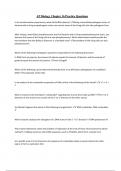
AP Biology Chapter 16 Practice Questions In his transformation experiments, what did Griffith observe? Mixing a heat-killed pathogenic strain of bacteria with a living nonpathogenic strain can convert some of the living cells into the pathogenic form. After mixing a heat-killed, phosphorescent strain of bacteria with a living nonphosphorescent strain, you discover that some of the living cells are now phosphorescent. Which observations would provide the best evidence that the ability to fluoresce is a heritable trait? Descendants of the living cells are also phosphorescent. Which of the following investigators was/were responsible for the following discovery? In DNA from any species, the amount of adenine equals the amount of thymine, and the amount of guanine equals the amount of cytosine. Erwin Chargaff Which of the following can be determined directly from X-ray diffraction photographs of crystallized DNA? the diameter of the helix In an analysis of the nucleotide composition of DNA, which of the following will be found? A + C = G + T What is meant by the description "antiparallel" regarding the strands that make up DNA? The 5' to 3' direction of one strand runs counter to the 5' to 3' direction of the other strand. An Okazaki fragment has which of the following arrangements? 5' RNA nucleotides, DNA nucleotides 3' Which enzyme catalyzes the elongation of a DNA strand in the 5' → 3' direction? DNA polymerase III The enzyme telomerase solves the problem of replication at the ends of linear chromosomes by which method? adding numerous short DNA sequences such as TTAGGG, which form a hairpin turn At a specific area of a chromosome, the sequence of nucleotides below is present where the chain opens to form a replication fork: 3' C C T A G G C T G C A A T C C 5' An RNA primer is formed starting at the underlined T (T) of the template. Which of the following represents the primer sequence? 5' A C G U U A G G 3' To repair a thymine dimer by nucleotide excision repair, in which order do the necessary enzymes act? endonuclease, DNA polymerase I, DNA ligase The difference between ATP and the nucleoside triphosphates used during DNA synthesis is that the nucleoside triphosphates have the sugar deoxyribose; ATP has the sugar ribose. A new DNA strand elongates only in the 5' to 3' direction because DNA polymerase can only add nucleotides to the free 3' end. What is the role of DNA ligase in the elongation of the lagging strand during DNA replication? It joins Okazaki fragments together. Individuals with the disorder xeroderma pigmentosum are hypersensitive to sunlight. This occurs because their cells are impaired in what way? They cannot repair thymine dimers. Which of the enzymes removes the RNA nucleotides from the primer and adds equivalent DNA nucleotides to the 3' end of Okazaki fragments? DNA polymerase I Which of the enzymes covalently connects segments of DNA? ligase Which of the following sets of materials are required by both eukaryotes and prokaryotes for
Written for
- Institution
- AP Biology Chapter 16 Practice
- Course
- AP Biology Chapter 16 Practice
Document information
- Uploaded on
- April 23, 2024
- Number of pages
- 3
- Written in
- 2023/2024
- Type
- Exam (elaborations)
- Contains
- Questions & answers
Subjects
-
ap biology chapter 16 practice questions

Also available in package deal