BIOD 171 Module 2 Exam Questions & Answers Rated 100% Correct!!
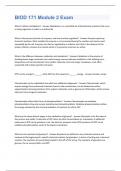
What is cellular metabolism? - Answer-Metabolism is a controlled set of biochemical reactions that occur in living organisms in order to maintain life What is the primary function of enzymes, and how are they regulated? - Answer-Enzymes speed up chemical reactions. Most notably, the enzyme is not consumed during the reaction and can be used repeatedly by the cell. Enzymes can also be regulated by a cofactor such that in the absence of the proper cofactor, enzymes are inactive while in its presence enzymes are active. What is the difference between catabolism and anabolism? - Answer-Catabolism is the process of breaking down larger molecules into useful energy sources whereas anabolism is the building up or biosynthesis od macromolecules from smaller molecular units into larger complexes, most often associated with cellular growth and repair ATP has the energy to ______, while ADP has the capacity to ______ energy. - Answer-Donate, accept Chemotrophs can be subdivided into what two additional subgroups? - Answer-Chemotrophs, which acquire energy from preformed chemicals found in the environment, can be divided into either organotrophs (removing electrons from organic molecules such as glucose) or lithotrophs, which remove electrons from inorganic molecules Chemotrophs utilize which form of phosphorylation? - Answer-Chemotrophs use oxidative phosphorylation (may also accept substrate level phosphorylation). Oxidative phosphorylation utilizes the energy released by the chemical oxidation of nutrients to reform ATP What are the three distinct stages in the catabolism of glucose? - Answer-Glycolysis is the first step of this process and yields 2 molecules of ATP. Next, by either fermentation (or respiration) 2 additional molecules of ATP can be produces. Last, the electron transport chain (ETC) produces 34 ATP via an oxidative phosphorylation event at the plasma membrane. What are the reactants of glycolysis? - Answer-Reactants are defined as any molecules present and involved at the beginning of a specific chemical reaction (ie) glycolysis. In terms of writing out a chemical reaction, the reactants are everything located to the left of the arrow. The reactants of glycolysis are glucose, the co-enzyme NAD+ and ATP.How are the TCA and ETC related? - Answer-The end products of the Kreb's (TCA) cycle are used to fuel the electron transport chain. In other words, as the Kreb's cycle (TCA) produces an abundance of reduced electron carriers (NADH and FADH2), it fuels the ETC. As the electrons are transferred from NADH/FADH2 to terminal electron acceptors a proton motor force is generated, ATP synthase is activated and up to 34 molecules of ATP can be produced. In the absence of sugars, are entirely different metabolic pathways used to process alternative sugar sources (fructose or lactose)? - Answer-No. Additional enzymatic steps are simply required at the beginning of catabolism to convert complex sugars into usable forms of either glucose or a glucose intermediate (glucose-6-phosphate) Proteases are used to catabolize what? - Answer-Proteases are used to breakdown proteins (whereas lipases are used to breakdown lipids) Excluding sugars, what are the other sources of energy? Which is highest in energy? - AnswerCarbohydrates, proteins, and lipids can all serve as potential energy sources in the absence of sugar. Lipids are rich in energy, often having several reduced carbon molecules (high in hydrogen content) that can be used in both the TCA and ETC cycles In what organelle does photosynthesis take place? - Answer-Photosynthesis, the process of capturing sunlight and converting it into a usable energy source, occurs in the chloroplasts. Chloroplasts are double-membrane enclosed organelles. Each chloroplast contains the green photosynthetic pigment chlorophyll. What are the two main strategies for replenishing cellular concentrations of NAD+, and when are these strategies utilized? - Answer-Fermentation and respiration are the two strategies used by the cell to convert NADH (end product of glycolysis) back to NAD+. Fermentation occurs in the absence of oxygen (anaerobic conditions) while respiration occurs under aerobic (presence of oxygen) conditions. Notably, respiration is more efficient than fermentation. In phosphorylation, the light reactions always occur where? - Answer-The process of converting light energy into chemical energy (photophosphorylation) always occurs in the membrane. Similar to the electron transport chain, one of its main functions is to generate a proton concentration gradient to generate ATP.What are the byproducts of light reactions used for in dark reactions? - Answer-The ATP and NADPH produced via light reactions are used in dark reactions to convert carbon dioxide and water into organic carbon compounds as well as useful carbohydrates (a process called carbon fixation) What is the chemical reaction for the Calvin cycle? - Answer-6 CO2 + 18 ATP + 12 NADPH + 12 H2O --> C6H12O6 + 18 ADP + 12 NADP+ What determines the specificity of an enzyme? - Answer-The specificity of an enzyme is heavily influenced by its active site - a unique chemical structure bound only by select target molecules. The structure is influenced by the amino acid composition of the protein as this in turn influences the fold, shape, and 'appearance' of the enzyme. The active site (and its target protein) can be thought of as a lock-and-key relationship. The active site provides specificity (like a lock) that only specific target proteins can bind - much like how only a specific key will fit into, unlock, and 'activate' a lock Do catabolic reactions release or consume energy? - Answer-Rel
Written for
- Institution
- BIOD 171 Module 2
- Course
- BIOD 171 Module 2
Document information
- Uploaded on
- April 22, 2024
- Number of pages
- 10
- Written in
- 2023/2024
- Type
- Exam (elaborations)
- Contains
- Questions & answers
Subjects

Also available in package deal