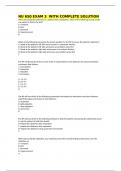
Nu 650 Exam 3 With Complete Solution
NU 650 EXAM 3 WITH COMPLETE SOLUTION When percussing the abdomen in a patient with constipation, which of the following sounds would you expect to find in the LLQ? A. Tympanic B. Dull C. Resonant D. Hyperresonant B Which of the following represents the proper position for the NP to assess the patient's abdomen? A. Stand at the patient's left side and proceed in a systematic fashion. B. Stand at the patient's left side and assess any problem areas first C. Stand at the patient's right side and process in a systemic fashion D. Stand at the patient's right side and assess any problem areas first C The NP will demonstrate the correct order of examination for the abdomen by using examination techniques that follows: 1. Auscultation 2. Inspection 3. Palpation 4. Percussion A. 1-2-3-4 B. 2-3-4-1 C. 3-4-1-2 D. 2-1-3-4 D The NP will use which of the following examination techniques to determine muscular resistance, superficial organs and masses in the abdomen A. inspection B. light palpation C. deep palpation D. percussion B The NP will use which of the following methods to help the patient relax during the abdominal exam? A. ask the patient to hold their breath B. Palpate the abdomen after inspiration C. palpate the abdomen after expiration D. Palpate the abdomen using quick short movements C When percussing the abdomen, you would document the normal finding of percussion over the intestines as: A. Tympanic B. Dull C. Resonant D. Hyperresonant A The NP will use her third finger to strike or deliver a rapid tap or blow against another finger placed against the surface of the chest or abdomen to evoke a sound wave. The striking or tapping finger is called the: Plexor finger Identify the correct examination sequence for each body system: 1. Auscultation, 2. Inspection, 3. Palpation, 4. percussion a: posterior thorax & lungs b: anterior thorax & CV system c: abdomen a. Posterior thorax & lungs: 2-3-4-1 b. Anterior thorax & CV system: 2-3-4-1 c. Abdomen: 2-1-4-3 A patient is seen in the office for amenorrhea, for which you obtain a urine pregnancy test in the office that returns negative. You would document this finding in which of the following sections of the encounter?A. HPIB. CCC. Subjective DataD. Objective Data D The NP can determine higher cognitive function by asking the patient to perform which of the following tasks?A. Explain the meaning of a proverbB. Identify the day of the week, month, season, date and yearC. Recall details of historical eventsD. Spell a five-letter word such as WORLD backward A A 36-year-old female patient is seen in the clinic for a reported fever and back pain. She complained of pain when the NP percussed over the left CVA angle. This finding supports which of the following differential diagnosis?A. PyelonephritisB. Left lower lobe pneumoniaC. SplenomegalyD. Cholecystitis A The liver border can be palpated normally below the costal margin at the:A. Left mid-clavicular lineB. Right mid-axillary lineC. Right mid-calvicular lineD. Left mid-axillary line C The NP will recognize which of the following subjective or objective findings as worrisome for an abdominal aortic aneurysm?A. aortic width of 2.8 cmB. 25 pack-year smoking historyC. age of 60D. Female gender B The NP will use which of the following examination techniques to determine muscular resistance, superficial organs and masses in the abdomenA. inspectionB. light palpationC. deep palpationD. percussion B The parents of a 4-month-old infant share concern about their child's umbilical hernia at a well-child visit. The NP will correctly inform them that:A. Most umbilical hernias disappear by 12 months of ageB. The hernia can be surgically repaired before the child reaches adolescenceC. This finding indicates that their child is at high risk for other herniasD. There is a strong familial history for umbilical hernias A Which of the following abdominal exam findings would prompt the NP to consider cholecystitis as a differential diagnosis?A. Positive psoas signB. Positive Rovsing's signC. Positive Obturator signD. Positive murphy's sign D Which of the following symptoms would you expect from a young adolescent in the early phase of appendicitis?A. Abdominal pain two hours after eatingB. CVA tendernessC. Severe RLQ pain with pallor and sweatingD. Constipation C A 57-year-old maintenance worker comes to your office for evaluation of pain in his legs. He has smoked two packs per day since the age of 16, but he is otherwise healthy. You are concerned that he may have peripheral vascular disease. Which of the following is part of common or concerning symptoms for the peripheral vascular system?A) Intermittent claudicationB) Chest pressure with exertionC) Shortness of breathD) Knee pain A Which area of the arm drains to the epitrochlear nodes?A) Ulnar surface of the forearm and hand, little and ring fingers, and ulnar middle fingerB) Radial surface of the forearm and hand, thumb and index fingers, and radial middle fingerC) Ulnar surface of the forearm and hand; second, third, and fourth fingersD) Radial surface of the forearm and hand; second, third, and fourth fingers A Mr. E complains of cramps and difficulties with walking. The cramps occur in his calves consistently after walking about 100 yards. After a period of rest, he can start to walk again, but after 100 yards these same symptoms recur. Which of the following would suggest spinal stenosis as a cause of this pain?A) Coldness and pallor of the legsB) Relief of the pain with bending at the waistC) Color changes of the skinD) Swelling with tenderness of the skin B Which of the following pairs of ischemic symptoms versus vascular supply is correct?A) Lower calf/superficial femoralB) Erectile dysfunction/iliac or pudendalC) Buttock/common femoralD) Upper calf/tibial or peroneal B A patient demonstrates left facial droop but can wrinkle both sides of the forehead. The examiner should suspect a problem with:(A) Central innervation of cranial nerve VII (facial)(B) Cranial nerve V (trigeminal)(C) Peripheral innervation of cranial nerve VII(D) Frontalis muscle A Mr. T. is complaining of a headache. He has just awakened from a nap and states that the headache always begins behind one eye, "feels like an icepick," and is accompanied by tearing and a runny nose. You suspect Mr. T has:(A) Migraine headache(B) Tension headache(C) Cluster headache(D) A stroke C
Document information
- Uploaded on
- April 22, 2024
- Number of pages
- 10
- Written in
- 2023/2024
- Type
- Exam (elaborations)
- Contains
- Questions & answers