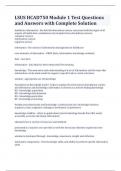
LSUS HCAD750 Module 1 Test Questions and Answers with Complete Solution
LSUS HCAD750 Module 1 Test Questions and Answers with Complete Solution healthcare informatics - the field of information science concerned with the mgmt of all aspects of health data; combination of principles from: disciplinary science, computer science, information science, cognitive science informatics - the science of information management in healthcare core elements of informatics - DIKW (data, information, knowledge, wisdom) data - raw facts information - data that has been interpreted for meaning knowledge - The awareness and understanding of a set of information and the ways that information can be made useful to support a specific task or reach a decision. wisdom - appropriate use of knowledge Foundation of Knowledge model - helps to explain the ties between disciplinary science and informatics and knowledge; informatics is viewed as a tool for finding knowledge KA - knowledge acquisition KD - knowledge dissemination KG - knowledge generation KP - knowledge processing Healthcare professionals and knowledge - professionals are: knowledge workers, acquirers, users, engineers, managers, developers or generators knowledge viability - refers to applications (most technology based) that offer easily accessible, accurate and timely information obtained from a variety of resources and methods presented in a manner as to provide us with the necessary elements to generate new knowledge. wisdom is developed through - knowledge, experience, insight and reflection informatics competency - the knowledge, skills, and ability to perform specific informatics tasks AHIMA-AMIA task force - 5 domains for all healthcare workers: 1. Health information literacy and skills 2. Health informatics skills using the EHR 3. Privacy and confidentiality of health information 4. Health information/ data technical security 5. Basic computer literacy skills criteria of valuable meaningful information - accessible, accurate, timely, complete, cost effective, flexible, reliable, relevant, simple, verifiable, and secure data integrity - whole, complete, correct, and consistent data compromises data integrity - human error, viruses, worms, other bugs, hardware failures or crashes, transmission errors, and/or hacker entering the system dirty data - errors in the database - duplicate, incomplete, or outdated records characteristics of quality information - accessibility, security, timeliness, accuracy, relevancy, completeness, flexibility, reliability, objectivity, utility, transparency, verifiability, and reproducibility information science - studying the application and usage of information and knowledge; studies everything that deals with information; multidisciplinary science that involves aspects from computer science, cognitive science, social science, communication science, and library science information processing - conversion of latent information (not apparent) into manifest (obvious/clearly apparent) information information system (IS) - a set of hardware, software, data, people, and procedures that work together to collect, create, and distribute useful information; computer-based information systems (CBISs) Systems Development Life Cycle (SDLC) - the traditional process used to develop information systems that fit with the strategic business plan of an organization waterfall model - sequential development process; each phase must be completely finished before the next begins rapid prototyping or rapid application development (RAD) - fast way to add functionality through prototyping and user testing object oriented systems development (OOSD) - approach to systems development that combines the logic of the systems development life cycle with the power of object-oriented modeling and programming dynamic systems development method (DSDM) - highly iterative and incremental approach with a high level of user input and involvement; 3 phases - pre-project, project life cycle (feasibility and business studies, functional model iteration, design and build iteration, implementation), post-project computer-aided software engineering (CASE) tools - Software tools that provide automated support for some portion of the systems development process. Open Source Software (OSS) and Free/OSS - Software that is free and whose code can be accessed and potentially modified by anyone. interoperability - the ability to exchange and use computer information within and across networks; paramount under the HITECH Act Health Information Technology for Economic and Clinical Health (HITECH) - provision of the American Recovery and Reinvestment Act (ARRA) of 2009 to provide reimbursement incentives for eligible professionals and hospitals who are successful in becoming "meaningful users" of certified electronic health record (EHR) technology applied healthcare informatics - emphasizes the use of the computer-based applications in delivering and documenting healthcare services five categories of current and emerging tech in healthcare - 1. capture of various types of data and formats; 2. efficient access to, and flow of, data and information; 3. managerial and clinical decision making; 4. diagnosis, treatment, and care of patients; 5. security of data and information Clinical data repository (CDR) - a component of the EHR that captures data; different data types and formats discrete data - structured data; coded and alphanumeric; fields are predefined and limited; patient lab order/results; searchable free-text data - unstructured data, not predefined or limited, not easily searchable; transcribed radiology/pathology result, history and physical, clinical notes, etc. bit-mapped data - unstructured; diagnostic image data (x-ray or CT scan); each bit is saved raster image - the smallest unit of which is a picture element or pixel; hundreds of pixels simulate the image analog - diagnostic image data on photographic films, must be digitally scanned
Document information
- Uploaded on
- April 20, 2024
- Number of pages
- 9
- Written in
- 2023/2024
- Type
- Exam (elaborations)
- Contains
- Questions & answers