NUR 231 Exam 2 Questions And Answers 100% Solved
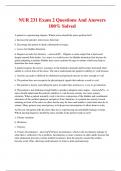
NUR 231 Exam 2 Questions And Answers 100% Solved A patient is experiencing oliguria. Which action should the nurse perform first? a. Increase the patient's intravenous fluid rate. b. Encourage the patient to drink caffeinated beverages. c. Assess for bladder distention. d. Request an order for diuretics. - answerC - Oliguria is urine output that is decreased despite normal fluid intake. As a nurse we would assess for bladder distention first because by gently palpating a patients bladder may cause a patient the urge to urinate which may help us determine the urine output. A patient requests the nurse's assistance to the bedside commode and becomes frustrated when unable to void in front of the nurse. The nurse understands the patient's inability to void because: a. Anxiety can make it difficult for abdominal and perineal muscles to relax enough to void. b. The patient does not recognize the physiological signals that indicate a need to void. c. The patient is lonely, and calling the nurse in under false pretenses is a way to get attention. d. The patient is not drinking enough fluids to produce adequate urine output. - answerA - A nurse should understand the patients inability to void because anxiety can cause urinary retention. When a patient normally voids it involves contraction of the bladder and coordinated relaxation of the urethral sphincter and pelvic floor; therefore, if a patient has anxiety toward urinating in front of the nurse or others he/she may be tense and unable to relax their muscles to urinate. Many patients may need privacy to help prevent interruptions to allow them to relax. An 86 year old patient tells the nurse that she is experiencing uncontrollable leakage of urine. Which nursing diagnosis should the nurse include in the patient's plan of care? a. Urinary retention b. Hesitancy c. Urgency d. Urinary Incontinence - answerUrinary incontinence, which is the involuntary leakage of urine that is sufficient to be a problem. Incontinence is more common in older adults because the intra-abdominal pressure exceeds urethral resistance, then the muscles around the urethra become weak. Thus, allowing small amounts of urine to leak spontaneously. The patient expresses difficulty voiding and the constant urge to urinate. The nurse should follow up by: a. Using a bladder scanner to determine if there is post-void residual. b. Telling the patient to run water when voiding. c. Instructing the patient to perform Kegel exercises. d. Checking the patient's vital signs. - answerA - The bladder scanner helps assess for post- void residual (PVR). Residual urine or post-void residual occurs if a patient has urinary retention or cannot empty the bladder completely. This measurement would help the nurse see if the patient has urine left in the bladder after voiding and/or if there is another issue with voiding. A normal void the bladder should empty completely A patient asks about treatment for urge incontinence. The nurse's best response is to advise the patient to: (Choose all that apply.) a. perform pelvic floor exercises. b. Bladder retraining c. avoid voiding frequently. d. Wear absorbent products. - answerA, B, D - Improve the strength of pelvic floor muscles and consist of repetitive contractions of muscle groups. The exercises are noninvasive and carry a low risk of adverse effects. In bladder training the goal is to reduce the voiding frequency and perhaps the bladder capacity. The retraining will hopefully help restore a normal pattern of voiding by teaching patients to keep the patient continent.Wearing absorbent pads promotes the comfort of a patient. An incontinent patient gains comfort from having clean, dry clothing To obtain a clean-catch voided urine specimen for a female patient, the nurse should teach the patient to: (Choose all that apply.) a. Cleanse the urethral meatus from back to front. b. Initiate the first part of the urine stream directly into the collection cup. c. Hold the labia apart while voiding into the specimen cup. d. Transport to laboratory within 15 to 30 minutes or refrigerate immediately. - answerC, D - If labia closes then the specimen is contaminated and becomes unsterile for laboratory purposes. If the patient fails to hold the labia open then the procedure may have to perform again including the perennial care. Because bacteria grow quickly in urine not received by laboratory within 30 minutes should be refrigerated
Written for
- Institution
- NUR 231
- Module
- NUR 231
Document information
- Uploaded on
- April 19, 2024
- Number of pages
- 12
- Written in
- 2023/2024
- Type
- Exam (elaborations)
- Contains
- Questions & answers
Subjects
-
nur 231 exam 2 questions and answers 100 solved

Also available in package deal