AP Calculus AB Final Exam Review
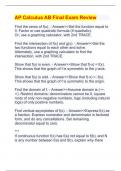
Find the zeros of f(x). - Answer>>Set the function equal to 0. Factor or use quadratic formula (if quadratic).
Or, use a graphing calculator, with 2nd TRACE.
Find the intersection of f(x) and g(x). - Answer>>Set the two functions equal to each other and solve.
Alternately, use a graphing calculator to find the intersection, with 2nd TRACE.
Show that f(x) is even. - Answer>>Show that f(-x) = f(x). This shows that the graph of f is symmetric to the y-axis.
Show that f(x) is odd. - Answer>>Show that f(-x) = -f(x). This shows that the graph of f is symmetric to the origin.
Find the domain of f. - Answer>>Assume domain is (-∞, ∞). Restrict domains: denominators cannot be 0, square roots of only non-negative numbers, logs (including natural
logs) of only positive numbers.
Find vertical asymptotes of f(x). - Answer>>Express f(x) as
a fraction. Express numerator and denominator in factored
form, and do any cancellations. Set remaining denominator equal to zero.
***
If continuous function f(x) has f(a) not equal to f(b), and N is any number between f(a) and f(b), explain why there must be a value c, such that a<c<b and f(c)=N. - Answer>>This is the IVT (Intermediate Value Theorem).
***
Find lim x→a f(x) - Answer>>Step 1: Find f(a). If you get a zero in the denominator,
Step 2: Factor both numerator and denominator of f(x). Do
any cancellations and go back to Step 1. If you still get a zero in the denominator, the answer is either ∞, -∞, or does not exist. Check the signs of the left-side and right-
side limits for equality.
Alternately, try l'Hospital's Rule.
Find lim x→a f(x) where f(x) is a piecewise function. - Answer>>Determine if the left-side and right-side limits are
equal by plugging in a to f(x), x<a and f(x), x>a. If they are not equal, the limit does not exist.
Show that f(x) is continuous. - Answer>>Show that:
1) lim x→a f(x) exists
2) f(a) exists
3) lim x→a f(x) = f(a)
***
Find lim x→∞ f(x) or lim x→-∞ f(x) - Answer>>Express f(x) as a fraction. Determine location of the highest power:
Denominator: the limit is zero
Numerator: the limit is either positive or negative infinity (plug in really large numbers to determine)
Tie: ratio of the highest power coefficients (horizontal asymptote)
Find the zeros of f(x). - Answer>>Set the function equal to 0. Factor or use quadratic formula (if quadratic).
Or, use a graphing calculator, with 2nd TRACE.
Find the intersection of f(x) and g(x). - Answer>>Set the two functions equal to each other and solve.
Alternately, use a graphing calculator to find the intersection, with 2nd TRACE.
Show that f(x) is even. - Answer>>Show that f(-x) = f(x). This shows that the graph of f is symmetric to the y-axis.
Show that f(x) is odd. - Answer>>Show that f(-x) = -f(x). This shows that the graph of f is symmetric to the origin.
Find the domain of f. - Answer>>Assume domain is (-∞, ∞). Restrict domains: denominators cannot be 0, square roots of only non-negative numbers, logs (including natural
logs) of only positive numbers.
Find vertical asymptotes of f(x). - Answer>>Express f(x) as
a fraction. Express numerator and denominator in factored
form, and do any cancellations. Set remaining denominator equal to zero.
***
If continuous function f(x) has f(a) not equal to f(b), and N is any number between f(a) and f(b), explain why there must be a value c, such that a<c<b and f(c)=N. - Answer>>This is the IVT (Intermediate Value Theorem).
***
Find lim x→a f(x) - Answer>>Step 1: Find f(a). If you get a zero in the denominator,
Step 2: Factor both numerator and denominator of f(x). Do
any cancellations and go back to Step 1. If you still get a zero in the denominator, the answer is either ∞, -∞, or does not exist. Check the signs of the left-side and right-
side limits for equality.
Alternately, try l'Hospital's Rule.
Find lim x→a f(x) where f(x) is a piecewise function. - Answer>>Determine if the left-side and right-side limits are
equal by plugging in a to f(x), x<a and f(x), x>a. If they are not equal, the limit does not exist.
Show that f(x) is continuous. - Answer>>Show that:
1) lim x→a f(x) exists
2) f(a) exists
3) lim x→a f(x) = f(a)
***
Find lim x→∞ f(x) or lim x→-∞ f(x) - Answer>>Express f(x) as a fraction. Determine location of the highest power:
Denominator: the limit is zero
Numerator: the limit is either positive or negative infinity (plug in really large numbers to determine)
Tie: ratio of the highest power coefficients (horizontal asymptote)