Social In uence
Social In uence
Types of conformity majority = 3 or
more people
Conformity: Yielding to group pressure (majority in uence)
Compliance
‣ Weakest form of conformity
‣ When individuals adjust their behaviour and opinions to be the same as a group, to
avoid being rejected or embarrassed
‣ Publicly, but not privately going along with majority in uence to gain approval
‣ E.g. saying you like a TV show because everyone else does, even if you actually don’t
Identi cation
‣ When an individual adjusts their behaviour and opinions to those of a group they want
to become a member of and then forgets that behaviour when not with the group
‣ Conforming to the behaviour of a role model and identifying with them
‣ Public and private acceptance to majority in uence in order to gain group acceptance
‣ E.g. In the army, you adopt the beliefs and behaviours of your fellow soldiers, but this
may change when you leave the army to go home
Internalisation
‣ Strongest form of conformity
‣ When individuals genuinely adjust their behaviours and opinions to those of a group
‣ Public and private acceptance of majority in uence, through adoption fo the groups’
majority beliefs
‣ Permanent
‣ E.g. If you are in uenced by a group of religious beliefs so that you truly convert your
faith - then these religious views will continue without the in uence of the group
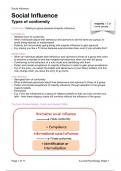
The Dual Process Model - Dutch and Gerard (1955)
Page 1 of 17 A Level Psychology Paper 1
fi fl fl fl fl fl fl fl
, Social In uence
Normative Social In uence
‣ Occurs when people want to t in and feel accepted
‣ People conform because they don’t want to feel embarrassed or left out
‣ E.g. In an away stand at a football game - you have to stand up when everyone else
does even though you don’t support the team
Asch’s Line Study (1951) - NSI confederate = an
Aim actor in on the aims
To identify whether participants would comply to majority in uence of the experiment
Procedure
‣ 123 participants (male undergraduate students) were used
‣ One at a time, they were seated in a room with 6-7 confederates and asked to look at 3
lines of di erent lengths
‣ They were asked to state which line was the same as the standard
‣ The real participant was always sat either second to last or last around the table
‣ Confederates were instructed to give the same incorrect answer on 12 of the 18 trails
Findings
‣ On the 12 ‘incorrect answer’ trials, 37% of responses made by true participants were
incorrect
Conclusion
‣ Shows that you want to t in and not feel embarrassed so you go along with the others
Evaluation of the Study
Strengths Weaknesses
There was a control group so we know Lacks mundane realism - it isn’t a normal
the incorrect answers were due to day to say task where people would normal
conformity conform
High ecological validity - Americans Poor reliability - Pemn and Spencer (1980)
were more likely to conform at this time carried it out with Maths and Engineering
due to McCarthyism students and 1/396 trails conformed
Low ecological validity - it is an arti cial
task
Androcentric - only male participants so
may not generalise to females - low
population validity
Lab experiment - you would know you’re in
an experiment so behaviour may be changed
Informational Social In uence
‣ Occurs with people who feel the need to be right
‣ When someone is unsure of how to behave as it is an ambiguous situation
‣ People look to others for the correct answer and act like them in order to be right
‣ E.g. If someone goes to a posh restaurant for the rst time and doesn’t know which
cutlery to use, so will start looking around
Page 2 of 17 A Level Psychology Paper 1
flff fl flfi fi fi fi fl
, Social In uence
Jenness’s Jelly Bean Study (1932) - ISI
Aim
To investigate whether individual judgement of jellybeans in a jar can be in uenced by
discussion in groups
Procedure
1. Participants made private, individual estimates of the number of jellybeans in a jar
2. Participants discussed their estimates either in a large group or several smaller groups
3. A group estimate was created
4. Participants then made a second private, individual estimate
Findings
‣ Individuals’ second, private estimates tended to move towards the group estimate
‣ The average change of opinion was greater among females - women conformed more
Conclusion
‣ It is an ambiguous situation in which you want to be right, so you are likely to go along
with the group average estimate
Evaluation of the Study
Strengths Weaknesses
High control over the variables in the Lacks mundane realism - lab based
experiment experiment using an arti cial, unusual situation
It is more ethically sound as Doesn’t help us understand conformity in non-
deception is less severe than Asch’s ambiguous situations
study
EXTRA - Cognitive Dissonance
‣ When individuals have two simultaneous contradictory ideas which can lead to an
unpleasant feeling known as cognitive dissonance
‣ Festinger (1957) said that changing cognitions would reduce cognitive dissonance and
the easiest way to do this was by conforming
STRENGTH
P: A strength of ISI is that there is research support.
E: Lucas et al (2006) asked students to give answers to easy and more di cult maths
problems. Conformity to incorrect answers when questions were harder, more likely if
students’ believed they had poor maths ability.
E: As the question gets harder, the situation becomes more ambiguous so they are
looking to the group for the answer.
L: The dual process model is a helpful explanation for explaining conformity.
CP: This study was only taken with students, so you don’t know if you can generalise
the ndings to older or non-educated people
Page 3 of 17 A Level Psychology Paper 1
fi fl fi flffi
Social In uence
Types of conformity majority = 3 or
more people
Conformity: Yielding to group pressure (majority in uence)
Compliance
‣ Weakest form of conformity
‣ When individuals adjust their behaviour and opinions to be the same as a group, to
avoid being rejected or embarrassed
‣ Publicly, but not privately going along with majority in uence to gain approval
‣ E.g. saying you like a TV show because everyone else does, even if you actually don’t
Identi cation
‣ When an individual adjusts their behaviour and opinions to those of a group they want
to become a member of and then forgets that behaviour when not with the group
‣ Conforming to the behaviour of a role model and identifying with them
‣ Public and private acceptance to majority in uence in order to gain group acceptance
‣ E.g. In the army, you adopt the beliefs and behaviours of your fellow soldiers, but this
may change when you leave the army to go home
Internalisation
‣ Strongest form of conformity
‣ When individuals genuinely adjust their behaviours and opinions to those of a group
‣ Public and private acceptance of majority in uence, through adoption fo the groups’
majority beliefs
‣ Permanent
‣ E.g. If you are in uenced by a group of religious beliefs so that you truly convert your
faith - then these religious views will continue without the in uence of the group
The Dual Process Model - Dutch and Gerard (1955)
Page 1 of 17 A Level Psychology Paper 1
fi fl fl fl fl fl fl fl
, Social In uence
Normative Social In uence
‣ Occurs when people want to t in and feel accepted
‣ People conform because they don’t want to feel embarrassed or left out
‣ E.g. In an away stand at a football game - you have to stand up when everyone else
does even though you don’t support the team
Asch’s Line Study (1951) - NSI confederate = an
Aim actor in on the aims
To identify whether participants would comply to majority in uence of the experiment
Procedure
‣ 123 participants (male undergraduate students) were used
‣ One at a time, they were seated in a room with 6-7 confederates and asked to look at 3
lines of di erent lengths
‣ They were asked to state which line was the same as the standard
‣ The real participant was always sat either second to last or last around the table
‣ Confederates were instructed to give the same incorrect answer on 12 of the 18 trails
Findings
‣ On the 12 ‘incorrect answer’ trials, 37% of responses made by true participants were
incorrect
Conclusion
‣ Shows that you want to t in and not feel embarrassed so you go along with the others
Evaluation of the Study
Strengths Weaknesses
There was a control group so we know Lacks mundane realism - it isn’t a normal
the incorrect answers were due to day to say task where people would normal
conformity conform
High ecological validity - Americans Poor reliability - Pemn and Spencer (1980)
were more likely to conform at this time carried it out with Maths and Engineering
due to McCarthyism students and 1/396 trails conformed
Low ecological validity - it is an arti cial
task
Androcentric - only male participants so
may not generalise to females - low
population validity
Lab experiment - you would know you’re in
an experiment so behaviour may be changed
Informational Social In uence
‣ Occurs with people who feel the need to be right
‣ When someone is unsure of how to behave as it is an ambiguous situation
‣ People look to others for the correct answer and act like them in order to be right
‣ E.g. If someone goes to a posh restaurant for the rst time and doesn’t know which
cutlery to use, so will start looking around
Page 2 of 17 A Level Psychology Paper 1
flff fl flfi fi fi fi fl
, Social In uence
Jenness’s Jelly Bean Study (1932) - ISI
Aim
To investigate whether individual judgement of jellybeans in a jar can be in uenced by
discussion in groups
Procedure
1. Participants made private, individual estimates of the number of jellybeans in a jar
2. Participants discussed their estimates either in a large group or several smaller groups
3. A group estimate was created
4. Participants then made a second private, individual estimate
Findings
‣ Individuals’ second, private estimates tended to move towards the group estimate
‣ The average change of opinion was greater among females - women conformed more
Conclusion
‣ It is an ambiguous situation in which you want to be right, so you are likely to go along
with the group average estimate
Evaluation of the Study
Strengths Weaknesses
High control over the variables in the Lacks mundane realism - lab based
experiment experiment using an arti cial, unusual situation
It is more ethically sound as Doesn’t help us understand conformity in non-
deception is less severe than Asch’s ambiguous situations
study
EXTRA - Cognitive Dissonance
‣ When individuals have two simultaneous contradictory ideas which can lead to an
unpleasant feeling known as cognitive dissonance
‣ Festinger (1957) said that changing cognitions would reduce cognitive dissonance and
the easiest way to do this was by conforming
STRENGTH
P: A strength of ISI is that there is research support.
E: Lucas et al (2006) asked students to give answers to easy and more di cult maths
problems. Conformity to incorrect answers when questions were harder, more likely if
students’ believed they had poor maths ability.
E: As the question gets harder, the situation becomes more ambiguous so they are
looking to the group for the answer.
L: The dual process model is a helpful explanation for explaining conformity.
CP: This study was only taken with students, so you don’t know if you can generalise
the ndings to older or non-educated people
Page 3 of 17 A Level Psychology Paper 1
fi fl fi flffi