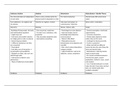
Substance dualism Idealism Behaviorism Reductionism / Identity Theory
The mind and body are independent There is only a mental world, the The mind is behaviour Mental states ARE certain brain
of each other physical world is dependent on that states
Two substances, res cogitans and Only the res cogitans, monism Only input and output, no Brain-centric, materialism
res extensa consciousness / black box
Descartes Berkeley Skinner, Watson, Ryle Kripke
-Doubtng of being awake, the body, - Esse est percipi, empiricism - Psychology has to be objectve - General assumpton: mind-body
and mathematcal equatons - You don’t see a substance, only - Input and output, but no supervenience
- Cogito ergo sum propertes knowledge about black box - Conscious chauvinism
- God exists and wouldn’t deceive, - Only secondary propertes exist (consciousness) - Mental states depend on brain
no malign genie so also res extensa - God watches everything - Watson: litle Albert states, they are the same
- Patrick Swayze problem - Philosophers became - Contngent & gecessary truths
- 2 diferent substances, but they behaviourists to be objectve and - A priori, a posteriori
are connected scientfic - Water and H2O are diferent
- Pineal gland - Ryle: mind is about dispositons, names but also the same thing, like
- God takes care of interacton category mistake brain and mental states
occasionalism and parallelism - Logical Positvism: want to be - Reductonism: reducing mental
- Elizabeth von Platz, why can’t we objectve, science, empiricism states to brain states
talk through walls - Pro: found correlatons between
- Clairvoyance & Electric voice mind & brain states, easiest
phenomena explanaton, Ockham’s razor, causal
- Theory of ladenness of percepton role analysis
- Con: if mental state pain is a brain
state, fish don’t have brain, but feel
pain, are mental states then
multple realizable=
Problems: Problems: Problems: Problems:
The mind and body are independent There is only a mental world, the The mind is behaviour Mental states ARE certain brain
of each other physical world is dependent on that states
Two substances, res cogitans and Only the res cogitans, monism Only input and output, no Brain-centric, materialism
res extensa consciousness / black box
Descartes Berkeley Skinner, Watson, Ryle Kripke
-Doubtng of being awake, the body, - Esse est percipi, empiricism - Psychology has to be objectve - General assumpton: mind-body
and mathematcal equatons - You don’t see a substance, only - Input and output, but no supervenience
- Cogito ergo sum propertes knowledge about black box - Conscious chauvinism
- God exists and wouldn’t deceive, - Only secondary propertes exist (consciousness) - Mental states depend on brain
no malign genie so also res extensa - God watches everything - Watson: litle Albert states, they are the same
- Patrick Swayze problem - Philosophers became - Contngent & gecessary truths
- 2 diferent substances, but they behaviourists to be objectve and - A priori, a posteriori
are connected scientfic - Water and H2O are diferent
- Pineal gland - Ryle: mind is about dispositons, names but also the same thing, like
- God takes care of interacton category mistake brain and mental states
occasionalism and parallelism - Logical Positvism: want to be - Reductonism: reducing mental
- Elizabeth von Platz, why can’t we objectve, science, empiricism states to brain states
talk through walls - Pro: found correlatons between
- Clairvoyance & Electric voice mind & brain states, easiest
phenomena explanaton, Ockham’s razor, causal
- Theory of ladenness of percepton role analysis
- Con: if mental state pain is a brain
state, fish don’t have brain, but feel
pain, are mental states then
multple realizable=
Problems: Problems: Problems: Problems: