Networking Fundamentals Final Exam Review Questions with 100% Correct Answers
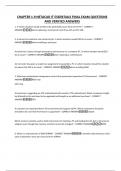
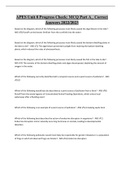
Networking Fundamentals Final Exam Review Questions with 100% Correct Answers Which of the following is a broadcast MAC address? 1) FF:FF:FF:FF:FF:FF 2) FF:FF:FF:EE:EE:EE 3) 255 4) 255.255.255.255 - answerFF:FF:FF:FF:FF:FF What does the acronym VPN stand for? - answerVirtual Private Network Order the layers of the OSI model, starting at Layer 1, the Physical Layer. ____ Network ____ Transport ____ Application ____ Presentation ___ Datalink ____ Session ____ Physical - answerApplication Presentation Session Transport Network Datalink Physical The layer of the OSI model that IP addresses are part of is the:______layer. - answerNetwork Layer The part of the OSI model that handles flow control, sequence, and error checking is the______layer. - answerTransport Which of the following is a valid TCP/IP v4 IP address? 0001:FC22:FFFF:51DD::0012 192.168.1.1 255.255.255 172.16.200.20 - answer192.168.1.1 Briefly describe the difference between switching and routing. - answerswitching sends packets within the network using mac addresses. routing routes packets between networks using two ip addresses Network devices that "fail open" are always best for security. Question options: True False - answerFalse The purpose of the ping command is to: Question options: Calculate physical distance to the next node Check connectivity and response time to another host Obtain an IP address from DHCP Configure firewall settings - answerCheck connectivity and response time to another host for the FQDN of "", the hostname is______and the domain name is______ - answerHostname: www Domain Name : C Match up the following IPv6 terms: Specifies a single node on a network, and may be a global or link local address. Packets are delivered to all nodes in the targeted group. This type of address can identify multiple addresses, however packets will only be delivered to the closest one. 1. Unicast address 2. Multicast address 3. Anycast address - answerUnicast address - Specifies a single node on a network, and may be a global or link local address. Multicast address-Packets are delivered to all nodes in the targeted group. Anycast address - This type of address can identify multiple addresses, however packets will only be delivered to the closest one. If a network is making use of both
Written for
- Institution
- Networking Fundamentals
- Course
- Networking Fundamentals
Document information
- Uploaded on
- April 15, 2024
- Number of pages
- 17
- Written in
- 2023/2024
- Type
- Exam (elaborations)
- Contains
- Questions & answers
Subjects
-
networking fundamentals final exam review question