Hoogtepunten British Civilization
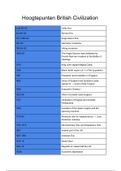
Until AD 43 Celtic Era
43-409 AD Roman Era
410-1066 AD Anglo-Saxon Era
449 AD Germanic invasions
789-95 AD Viking invasions
1066 AD The Anglo-Saxons were defeated by
French-Norman invaders at the Battle of
Hastings.
1215 King John signed Magna Carta
1348 Black death wipes out ⅓ of the population
1381 Peasants revolt rebellion in England
1603 Union of England and Scotland under
James VI → Union of the Crowns
1649 Execution Charles I
1653-58 Oliver Cromwell ruled England
1707 Unification of English and Scottish
Parliaments
1769 Invention of the steam engine and the
spinning machine
1775-83 American war for Independence → Loss
American colonies
1793-1815 Revolutionary War and Napoleonic War
1801 Ireland part of the UK
1837-1901 Victorian Era
1914-18 World War I
1921-22 Republic or Ireland left the UK
1930s Economic depression
, 1939-45 World War II
1979 Margaret Thatcher first female prime
minister
2005 Labour Party received third victory in the
elections
2007-2010 Credit Cruch
2016 Referendum leading to Brexit / Theresa
May replaces David Cameron (both Tory)
2017 Theresa May reelected without absolute
majority, alliance with Northern Irish SNP
party.
Geschiedenis in grote lijnen
Till 43 AD → Celtic
Roman Era → 43-410 AD
→ Celtic mixes with Latin
→ Roman beliefs: Roman Polytheism / Christianity
Anglo-Saxon Era → 410-1066 AD
→ Different influences and leaders
→ Now also Germanic beliefs: Germanic polytheism / Christianity
→ Language: English, Brythonic and Gaelic
→ Viking settlements in 8th and 9th century
Anglo-Norman Era → 1066-1350 AD
(Norman is from France)
→ 1066: Battle of Hastings
→ 1215: Magna Carta
→ Language: Engels, Brythonic and Gaelic supplemented with Norman French
→ Western Christianity (Catholicism)
Late Middle Ages → 1350-1485 AD
→ Hundred years’ war 1337-1453 AD
→ English, Welsh, Cornish, Gaelic
→ Western Christianity (Catholicism)
, Tudor England → 1485-1603 AD
→ Henry VIII, first Catholic, started his own religion → Church of England (Anglican)
→ English, Welsh, Cornish, Gaelic
→ Catholicism, Anglicanism, Scottish Presbyterianism (Church of Scotland) and small
Jewish communities
Early Stuart Britain → 1603-1649 AD
→ James I, first king of Scotland, England and Ireland (Anglican)
→ King James Bible → still used
→ Language and beliefs stay the same
→ Charles I
Commonwealth → 1649-1660 AD
Now calles Commonwealth because there is no king, so it cannot be called ‘Kingdom’.
→ Execution Charles I
→ Oliver Cromwell he is a Lord protector (Puritan)
→ Puritanical Anglicanism, Scottish Presbyterianism, Catholicism and small Jewish
communities.
Restoration → 1660-1688 AD
→ Charles II (Anglican)
→ James II (Catholicism)
→ Bloodless revolution / Glorious revolution: William of Orange and Mary take over
(Anglican)
→ Anglicanism, Scottish Presbyterianism, Catholicism and small Jewish communities.
The Revolution 1688 - 1714 AD
→ 1707 Act of Union England and Scotland
Georgian Era → 1714 - 1837 AD
→ American Revolution / American war for independence→ 1775-1783 (loss American
colonies)
→ Steam engine accelerating the Industrial Revolution (1765-1830)
→ Irish Act of Union 1801 → One Parliament in London
Victorian Era → 1837 - 1901 AD
→ Colonisation of Australia
→ Colonisation India, Pakistan, Bangladesh
→ Expansion trade and military power
→ Spread of English and Christianity
Edwardian Era → 1901 - 1914 AD
Until AD 43 Celtic Era
43-409 AD Roman Era
410-1066 AD Anglo-Saxon Era
449 AD Germanic invasions
789-95 AD Viking invasions
1066 AD The Anglo-Saxons were defeated by
French-Norman invaders at the Battle of
Hastings.
1215 King John signed Magna Carta
1348 Black death wipes out ⅓ of the population
1381 Peasants revolt rebellion in England
1603 Union of England and Scotland under
James VI → Union of the Crowns
1649 Execution Charles I
1653-58 Oliver Cromwell ruled England
1707 Unification of English and Scottish
Parliaments
1769 Invention of the steam engine and the
spinning machine
1775-83 American war for Independence → Loss
American colonies
1793-1815 Revolutionary War and Napoleonic War
1801 Ireland part of the UK
1837-1901 Victorian Era
1914-18 World War I
1921-22 Republic or Ireland left the UK
1930s Economic depression
, 1939-45 World War II
1979 Margaret Thatcher first female prime
minister
2005 Labour Party received third victory in the
elections
2007-2010 Credit Cruch
2016 Referendum leading to Brexit / Theresa
May replaces David Cameron (both Tory)
2017 Theresa May reelected without absolute
majority, alliance with Northern Irish SNP
party.
Geschiedenis in grote lijnen
Till 43 AD → Celtic
Roman Era → 43-410 AD
→ Celtic mixes with Latin
→ Roman beliefs: Roman Polytheism / Christianity
Anglo-Saxon Era → 410-1066 AD
→ Different influences and leaders
→ Now also Germanic beliefs: Germanic polytheism / Christianity
→ Language: English, Brythonic and Gaelic
→ Viking settlements in 8th and 9th century
Anglo-Norman Era → 1066-1350 AD
(Norman is from France)
→ 1066: Battle of Hastings
→ 1215: Magna Carta
→ Language: Engels, Brythonic and Gaelic supplemented with Norman French
→ Western Christianity (Catholicism)
Late Middle Ages → 1350-1485 AD
→ Hundred years’ war 1337-1453 AD
→ English, Welsh, Cornish, Gaelic
→ Western Christianity (Catholicism)
, Tudor England → 1485-1603 AD
→ Henry VIII, first Catholic, started his own religion → Church of England (Anglican)
→ English, Welsh, Cornish, Gaelic
→ Catholicism, Anglicanism, Scottish Presbyterianism (Church of Scotland) and small
Jewish communities
Early Stuart Britain → 1603-1649 AD
→ James I, first king of Scotland, England and Ireland (Anglican)
→ King James Bible → still used
→ Language and beliefs stay the same
→ Charles I
Commonwealth → 1649-1660 AD
Now calles Commonwealth because there is no king, so it cannot be called ‘Kingdom’.
→ Execution Charles I
→ Oliver Cromwell he is a Lord protector (Puritan)
→ Puritanical Anglicanism, Scottish Presbyterianism, Catholicism and small Jewish
communities.
Restoration → 1660-1688 AD
→ Charles II (Anglican)
→ James II (Catholicism)
→ Bloodless revolution / Glorious revolution: William of Orange and Mary take over
(Anglican)
→ Anglicanism, Scottish Presbyterianism, Catholicism and small Jewish communities.
The Revolution 1688 - 1714 AD
→ 1707 Act of Union England and Scotland
Georgian Era → 1714 - 1837 AD
→ American Revolution / American war for independence→ 1775-1783 (loss American
colonies)
→ Steam engine accelerating the Industrial Revolution (1765-1830)
→ Irish Act of Union 1801 → One Parliament in London
Victorian Era → 1837 - 1901 AD
→ Colonisation of Australia
→ Colonisation India, Pakistan, Bangladesh
→ Expansion trade and military power
→ Spread of English and Christianity
Edwardian Era → 1901 - 1914 AD