
SAE3701 ASSIGNMENT summary 100%verified
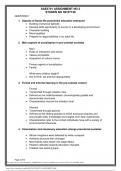
QUESTION 2 1. What was taught in schools in the 19th century Work discipline Christian doctrine Catechists and teaches how to organise their services. How to spread their Gospel Manual work and practical training. 2. Validity of criticisms Racism and subordination – mission schools were segregated on lines of colour. White Black people were doing things separately. Industrial and manual education – the missionaries belief in the value of hard work. Industrial training that was included in the curriculum was not of high enough standard to prepare people to take up skilled jobs in different sorts of economy. Critics say that separation, Christian values, humanity, pity, discipline and different levels of school helped to prepare black people to accept a subordinate position in the society. Sexism and woman’s subordination – brought together the place of woman in society. Critics’ belief that woman was only trained for domesticity and they were not part of the economy as they had the right to be. Higher levels of education were aimed at men not women. 3. The type of education the National Party introduced through the Bantu Education Act of 1953 The NP wanted to create the minimal conditions of social reproduction within the urban areas. Therefore, the NP permitted major expansion in urban housing and Education. Bantu Education policy stabilised the educational system. The policy attempted to establish a new hegemony to assist forces to work for the government. They created new sources of resentment in the education system. Government insisted on primary education Taught a policy of job reservation to generate shortage of skilled labour. Created mass education that turned students in to powerful social forces with a common identity. This study source was downloaded by from CourseH on :33:09 GMT -06:00 SAE3701 ASSIGNMENT NO 2 STUDEN NO Page 3 of 6 4. Major criticisms of Bantu Education Poor teaching training Double sessions for teachers Overcrowded classrooms Education was built on a shallow foundation Provision of adequate finance for black education. This study source was downloaded by from CourseH on :33:09 GMT -06:00 SAE3701 ASSIGNMENT NO 2 STUDEN NO Page 4 of 6 QUESTION 3 1. Who initiated the 1976 Student Revolt and why? It was initiated by SOW
Document information
- Uploaded on
- April 14, 2024
- Number of pages
- 6
- Written in
- 2023/2024
- Type
- Exam (elaborations)
- Contains
- Questions & answers


