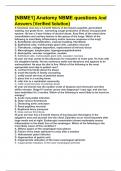
[NBME1] Anatomy NBME questions And Answers (Verified Solution
[NBME1] Anatomy NBME questions And Answers (Verified Solution) A homeless man has a 3-month history of decreased a-peptide, generalized wasting, low grade fever , worsening cough productive of blood, mucopurulent sputum. He has a 3-year history of alcohol abuse. Xray films of the chest show consolidation and cavitary lesions in the apices of the lungs. Which of the following is most likely inflammatory and/or immune response in the lung? A. Endothelial cell proliferation, vascular budding, fibroblasts B. Epithelioid cells, multinucleate giant cells, caseation necrosis C. Fibroblasts, collagen deposition, replacement of intrinsic tissue D. Macrophages, lymphocytes, hypergammaglobulinemia E. Neutrophils, vascular congestion, exudate B. Epithelioid cells, multinucleate giant cells, caseation necrosis 82 year old man comes to the physician for evaluation of chest pain. He lives with his daughters family. He has numerous welts and abrasions and appears to be malnourished. He says his diet is fine. Which of the following is the most appropriate next step in patient care? A. confront his family about the abuse B. enroll the family in family counseling C. notify social services of potential abuse D. place him in a nursing home E. refer him to a residential community C. notify social services of potential abuse 67 year old woman has the sudden onset of dyspnea and chest pain and dies within minutes. Stage IV ovarian cancer was diagnosed 1 year ago, and she has been bedridden for 2 months. Which of the following is most likely to be found on autopsy? A. Acute myocardial infarction B. Deep venous thrombosis C. Dissecting aortic aneurysm D. Renal papillary necrosis E. Rupttured berry aneurysm B. Deep venous thrombosis 45 year old man has a 6-month history of burning pain that begins in the epigastric area and ascends into the chest. Episodes occur most frequently after large meals and at night. Endoscopic examination shows moderately severe inflammation in the distal 3cm of the esophagus. Which of the following is the most likely cause of this condition? A. Diffuse spasm of the esophageal musculature B. Failure of the lower sphincter to relax after a swallow C. Helicobacter pylori infection D. Hypersection of gastric acid E. Inappropriate relaxation of the lower esophageal sphincter E. Inappropriate relaxation of the lower esophageal sphincter 45- year old woman has an acute coronary occlusion. Within seconds, the ischemic region shows mitochondrial swelling and depletion of glycogen granules. Which of the following metabolic events is most likely cause of these cellular changes? A. Accumulation of free fatty acids B. ATP depletion C. Degradation of membrane phospholipid D. Efflux of K+ E. Influx of Na+ C. Degradation of membrane phospholipid 65-year old man dies of bronchopneumonia. He has a 6-year history of progressive loss of facial expression, tremors, rigidity, and slowing of voluntary movement. At autopsy, loss of pigmented cells is noted in the substantial nigra. Which of the following additional abnormalities is most likely to be present? A. Eosinophilic inclusions in neurons of the substantial nigra B. Loss of neurons in the caudate nuclei C. Microglial nodules and multinucleated giant cells in the white matter D. Neurofibrillary tangles in the cortical neurons E. Viral inclusions in the oligodendrocytes A. Eosinophilic inclusions in neurons of the substantial nigra 50 year old man has a 10-year history of poorly controlled hypertension. Vital signs are: Pulse 96/min Respirations 16/min Bp of left arm 226/120 mmHg Bp of right arm 218/118mmHg With the patient in the left lateral decubitus position, a late diastolic sound is heard best with the bell at the apex. Which of the following is the most likely explanation for this auscultatory finding? A. Aortic insufficiency B. Aortic stenosis C. Mitral insufficiency D. Mitral stenosis E. Opening snap F. Pulmonic insufficiency G. Pulmonic stenosis H.S3 I.S4 J. Tricuspid insufficiency I.S4 in gout, hyperuricemia resulting from overproduction of urate is most likely to result from a lack of feedback inhibition by ADP or GDP at which enzyme? A. Adenosine deaminase B. Dihydrofolate reductase C. Glucose 6-phosphate dehydrogenase D. Nucleotide phosphorylase E. Phosphoribosylprophosphate synthetase E. Phosphoribosylprophosphate synthetase a female neonate has profound hypotonia. the only known complication of pregnancy was polyhydramnios. The mother has a lack of facial expression and weak muscles; she says she did not have any problems as an infant or child. Which of the following best explains the difference in presentations in the mother and child? A. Anticipation B. Delayed onset C. Genetic heterogeneity D. Incomplete penetrance E. Pleiotropy A. Anticipation An alcohol-dependent 40 year old woman who is a health-care worker has had episodic symptoms of hypoglycemia for the past year. During one of these episodes, plasma glucose concentration is decreased, plasma insulin concentration is increased, and serum C-peptide concentration is not detectable. Which of the following is the most likely cause of the hypoglycemia? A. acute hepatic failure B. ingestion of a sulfonylurea C. Pancreatic beta-cell neoplasm D. Retroperitoneal fibrosarcoma E. Surreptitious use of insulin E. Surreptitious use of insulin Double-stranded DNA can be denatured by heating and renatured by cooling. Renaturation under conditions of high stringency has which of the following effects? A. Considerable base mismatching is permitted B. GC base pairing is promoted C. GT base pairing is promoted D. Mismatch DNA hybridization is preverted D. Mismatch DNA hybridization is preverted 22-year old woman who is pregnant with her first child comes to the physicians office for a routine visit at 24 weeks gestation. The size of her uterus has increased very little during the past 4 weeks. Ultrasonography shows little fluid in the amniotic sac. Which of the following fetal organ systems is most likely to be malfunctioning? A. Cardiovascular B. Central nervous C. Gastrointestinal D. hepatic E. Renal E. Renal 35 year old woman comes to the physician for an initial visit. She refuses to fill out a questionnaire form about personal data and her medical history. When the physician greets her in the examination room, she says, "lets get this over with." which of the following questions is most likely to facilitate communication with the patient? A. "Are you always such an angry person?" B. "I can see that you are upset. Please tell me what is bothering you." C. "Ok, tell me what brings you in." D. "Should we reschedule your appointment for when you are in a better mood?" E. "Why are you angry with me?" F. "You know, you do not have to be here if you do not want to." B. "I can see that you are upset. Please tell me what is bothering you." 80 year old woman comes to the physician because of a 2-week history of mild constipation and occasional inability to completely empty the bladder. She takes OTC medications frequently. Vital signs are normal. Evaluation shows bladder distention and mild confusion. Which of the following drugs is most likely cause of her symptoms? A. Cimetidine B. Diphenhydramine C. Docusate sodium D.Guaifenesin E. Ibuprofen B. Diphenhydramine 27 year old man is found to have a solitary thyroid nodule during a routine health maintenance examination. A thyroid scintiscan shows uptake of radioactive iodine by the nodule. Which of the following is the most likely diagnosis? A. Chronic autoimmune thyroiditis B. Follicular adenoma C. Granulomatous thyroiditis D. Medullary carcinoma E. Papillary carcinoma B. Follicular adenoma 32 year old man with AIDS has a 6 week history of progressive weakness of his right hand, expressive aphasia, mild headache. CT scan of the head shown. Which of the following is most likely causal organism? A. Cryptococcus neoformans B. Cytomegalovirus C. Pneumocystis carinii D. Toxoplasma gondii E. Treponema papilldum D. Toxoplasma gondii 50 year old woman is evaluated for occult blood in the stool. Colonoscopy shows a 5cm sessile mass with a velvety surface that projects about 2cm above the mucosa of the rectosigmoid. Microscopic examination of tissue obtained on biopsy of the mass shows papillae composed of delicate fibrovascular cores covered by dysplastic columnar epithelium. This patient is at increased risk for
Written for
- Institution
- NBME1
- Course
- NBME1
Document information
- Uploaded on
- April 13, 2024
- Number of pages
- 41
- Written in
- 2023/2024
- Type
- Exam (elaborations)
- Contains
- Questions & answers
Subjects
-
nbme1 anatomy nbme questions and answers verifi

Also available in package deal