Summary AP Physics C: E&M - OpenStax University Physics Volume 2, Chapter 11 Problems 15, 17, 19, 21, 23, 25, 27, 57
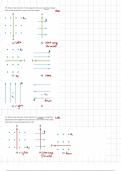
AP Physics C: Electricity and Magnetism. OpenStax University Physics Volume 2, Chapter 11 Problems 15, 17, 19, 21, 23, 25, 27, 57 with Answers and Work. 11.2 Magnetic Fields and Lines 15. What is the direction of the magnetic force on a positive charge that moves as shown in each of the six cases? 17. What is the direction of the velocity of a negative charge that experiences the magnetic force shown in each of the three cases, assuming it moves perpendicular to B? 19. What is the direction of the magnetic field that produces the magnetic force on a positive charge as shown in each of the three cases, assuming B⃗ is perpendicular to v⃗ ? 21. (a) Aircraft sometimes acquire small static charges. Suppose a supersonic jet has a 0.500-μC charge and flies due west at a speed of 660. m/s over Earth’s south magnetic pole, where the 8.00×10⁻⁵−T magnetic field points straight down into the ground. What are the direction and the magnitude of the magnetic force on the plane? (b) Discuss whether the value obtained in part (a) implies this is a significant or negligible effect. 23. An electron moving at 4.00×10³m/s in a 1.25-T magnetic field experiences a magnetic force of 1.40×10⁻¹⁶N. What angle does the velocity of the electron make with the magnetic field? There are two answers. 11.3 Motion of a Charged Particle in a Magnetic Field 25. A cosmic-ray electron moves at 7.5×10⁶m/s perpendicular to Earth’s magnetic field at an altitude where the field strength is 1.0×10⁻⁵T. What is the radius of the circular path the electron follows? 27. (a) An oxygen-16 ion with a mass of 2.66×10⁻²⁶kg travels at 5.0×10⁶m/s perpendicular to a 1.20-T magnetic field, which makes it move in a circular arc with a 0.231-m radius. What positive charge is on the ion? (b) What is the ratio of this charge to the charge of an electron? (c) Discuss why the ratio found in (b) should be an integer. 11.7 Applications of Magnetic Forces and Fields 57. (a) Triply charged uranium-235 and uranium-238 ions are being separated in a mass spectrometer. (The much rarer uranium-235 is used as reactor fuel.) The masses of the ions are 3.90×10⁻²⁵kg and 3.95×10⁻²⁵kg, respectively, and they travel at 3.0×10⁵m/s in a 0.250-T field. What is the separation between their paths when they hit a target after traversing a semicircle? (b) Discuss whether this distance between their paths seems to be big enough to be practical in the separation of uranium-235 from uranium-238.
Livre connecté
École, étude et sujet
- Établissement
- Senior / 12th grade
- Cours
- AP Physics C: Electricity and Magnetism
- Année scolaire
- 4
Infos sur le Document
- Livre entier ?
- Non
- Quels chapitres sont résumés ?
- Volume 2, chapter 11
- Publié le
- 13 avril 2024
- Nombre de pages
- 3
- Écrit en
- 2023/2024
- Type
- Resume
Sujets
- physics c
- physics
- electricity
- magnetism
- openstax
- chapter 11
- volume 2
-
university physics
-
college physics
-
advanced placement
-
magnetic field
-
field lines
-
charges
-
ap

Document également disponible en groupe