

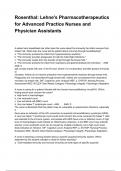
Rosenthal: Lehne's Pharmacotherapeutics for Advanced Practice Nurses and Physician Assistants Que & Ans
A patient who breastfeeds her infant asks the nurse about the immunity the infant receives from breast milk. What does the nurse tell the patient about immunity through breastfeeding? a. "The immunity protects the infant from hypersensitivity reactions." b. "The immunity provides phagocytes to help the infant fight infections." c. "The immunity results from the transfer of IgA through the breast milk." d. "The immunity protects the infant from respiratory and gastrointestinal (GI) microbes." - ANS ANS: C IgA crosses breast milk and, in the GI tract, where it is not absorbed, provides passive immunity to microbes. Infants do not receive protection from hypersensitivity reactions through breast milk. Phagocytes are not transmitted through breast milk. Infants are not protected from respiratory microbes via breast milk. DIF: Cognitive Level: Analysis REF: p. 574TOP: Nursing Process: Assessment MSC: NCLEX Client Needs Category: Physiologic Integrity: Physiologic Adaptation A nurse is caring for a patient infected with the human immunodeficiency virus(HIV). Which finding would most concern the nurse? a. High level of macrophages b. Low neutrophil count c. Low red blood cell (RBC) count d. Very low helper T lymphocyte count - ANS ANS: D The nurse understands that this patient may be vulnerable to opportunistic infections, especially if there were an indication of the HIV conversion to acquired immunodeficiency syndrome (AIDS). A very low helper T lymphocyte count would most concern the nurse, because the helper T cells are essential to the immune system, and people with AIDS have a low or deficient count. A high level of macrophages could indicate an inflammatory response. A low RBC count may indicate anemia. A low neutrophil count can be caused by multiple conditions, but a high count most likely indicates an infection. DIF: Cognitive Level: Analysis REF: p. 572TOP: Nursing Process: Evaluation MSC: NCLEX Client Needs Category: Physiologic Integrity: Physiologic Adaptation A nurse is teaching a nursing student about a specific acquired immunity system. Which statement by the student indicates a need for further teaching? a. "Cell-mediated immunity and humoral immunity are both types of specific acquired immune responses." b. "Each exposure to an antigen causes a faster, more intense response." c. "Immune responses occur only after exposure to a foreign substance." d. "The skin is a factor in specific acquired immunity." - ANS ANS: D The skin is a physical barrier that confers natural immunity. It is not a factor in specific acquired immunity. Cell-mediated and humoral immunity are both types of specific acquired immunity. In sp
Document information
- Uploaded on
- April 9, 2024
- Number of pages
- 67
- Written in
- 2023/2024
- Type
- Exam (elaborations)
- Contains
- Questions & answers


