
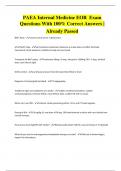
PAEA Internal Medicine EOR Exam Questions With 100% Correct Answers | Already Passed
Bell's Palsy - causes cranial nerve 7 dysfunction S/S of Bell's Palsy - Has forehead involvement (whereas a stroke does not affect forehead movement), facial weakness, inability to keep one eye closed Treatment for Bell's palsy - Prednisone 60mg x 5 days, Valcyclovir 1000mg TID x 7 days, artificial tears, lacri lube at night Define stroke - any disease process that interrupts blood flow to brain Diagnosis of stroke (gold standard) - CT angiography Traditional signs and symptoms of a stroke - sudden numbness/weakness, sudden confusion/aphasia, memory deficit, visual deficit, dizzy, sudden HA with no cause When can I use tPA? - ischemic stroke presenting within 3 hrs and CT head negative Dosing of tPA - 0.9 mg/kg IV, max dose of 90 mg. 10% administered as bolus with rest infused over next 60 minutes How do you treat high BP with stroke? - Nitroprusside (short half life, easy to titrate) or IV labetalol What do you use for anticoagulation/antiplatelet therapy in stroke? - ASA (not in hemorrhagic), heparin for thrombosis What do you do differently to treat hemorrhagic stroke? - Give prophylactic anticonvulsant like phenytoin because of increased seizure risk, antiplatelet therapy contraindicated Ischemic stroke is the most common type (87%) and has what signs and symptoms? - No headache, not visible on CT without contrast until 6 hours post stroke What are the types of Ischemic Stroke? - 1. Thrombotic: narrowing of damaged vascular lumen by an in situ process, usually clot. 2. Embolic (20%): obstruction of normal vascular lumen by intravascular material from remote source Types of Hemorrhagic Stroke - 1. Intracerebral (10%): results from rupture of small arterioles 2. Subarachnoid (3%): rupture of arterial aneurysms (hemorrhage into subarachnoid space) Causes of Intracerebral hemorrhagic stroke are what? - HTN, amyloidosis, iatrogenic anticoagulation, vascular malformations, cocaine use Causes of Subarachnoid hemorrhagic stroke are what? - berry aneurysm rupture, vascular malformation rupture Signs and symptoms of Intracerebral hemorrhagic stroke are what? - ICP rises, vasoconstriction- sweating Signs and symptoms of Subarachnoid hemorrhagic stroke are what? - may be preceded by warning headache, neck/back pain, "worst headache of my life," thunderclap, may have loss of consciousness Treatment of Subarachnoid hemorrhage - surgery, control hypertension, analgesics What is the name for the disease that beings following an operation, a fracture, or vascular event such as stroke or heart attack? - Complex regional pain syndrome (CRPS) Signs and symptoms of complex regional pain syndrome are what? - regional pain in affected limb, restricted mobility, edema, color changes of skin, spotty bone thinning. Hallmark is severe burning or throbbing pain with associated allodynia in affected extremity. Treatment for complex regional pain syndrome - Amitriptyline, nortriptyline, gabapentin, pregabalin, lamotrigine; NSAIDs; Calcitonin to reduce pain as adjunctive therapy; Bisphosphonates, IVIG, regional nerve blocks, dorsal column stimulation Ruptured saccular berry aneurysm counts for _____% of nontraumatic cases of subarachnoid hemorrhage. - 75% Imaging modality used to diagnose Subarachnoid Hemorrhage? - CT without contrast. If CT negative but still suspect SAH, do LP to look for RBC or xanthochromia (will not develop until 12hrs after onset) Delirium - transient disorder characterized by impaired attention, perception, memory and cognition. Sleep wake cycles interrupted ("sundowning"). Reduced alertness, activity levels change rapidly. Treatment of Delirium - treat underlying cause, Haloperidol 5-10mg for agitation, Lorazepam 0.5-2 mg Dementia - Loss of mental capacity. Psychosocial level and cognitive abilities deteriorate and behavioral problems develop. Largest categories are Alzheimer dz and vascular dementia. Hallucinations, delusion, depression, repetitive behavior are common. Treatment of Dementia - Antipsychotics to manage psychosis GCS - Essential tremor does not occur at rest, occurs bilaterally, and has no indication of other neuro signs. How do you treat essential tremor? - Propranolol, Primidone (can combine these 2 if needed) Guillian Barre Syndrome
Document information
- Uploaded on
- April 7, 2024
- Number of pages
- 289
- Written in
- 2023/2024
- Type
- Exam (elaborations)
- Contains
- Questions & answers


