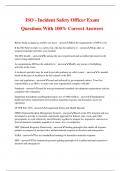
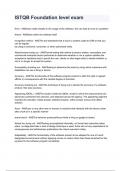
ISO - Incident Safety Officer Exam Questions With 100% Correct Answers
ISO - Incident Safety Officer Exam Questions With 100% Correct Answers Before being assigned as an ISO, you must: - answerMeet the requirements of NFPA 1521 If the ISO believes there is a safety risk, s/he has the authority to: - answerStop, alter, or suspend responder activities at an incident The ISO should: - answerBe among the most experienced and accredited personnel on the tactics being implemented An organizations ISO has the authority to: - answerModify any rescue or firefighting activities at the scene A technical specialist may be used to provide guidance on safety issues: - answerAs needed, based on the type of incident or by the counsel of the ISO laws and regulations - answerIssued and enforced by governmental entities. Your first responsibility as an ISO is to make sure your organization complies with this Standards - answerIssued by non-governmental standards development organizations and are complied with voluntarily Superfund Amendment and Reauthorization Act of 1986 (SARA) - answerStandardized health and safety requirements for hazardous materials response and hazardous waste site operations 29 CFR Part 1910 - answerOccupational Safety and Health Hazards NIMS (National Incident Management System) - answerBased on the ICS structure and was developed to provide a consistent, nationwide approach for federal, state, local, and tribal governments to work effectively and efficiently together to prepare for, respond to, and recover from all domestic incidents regardless of cause, size, or complexity NRF (National Response Framework) - answerGuiding principles that enable all response partners to prepare for and provide a unified national response to disasters and emergencies SARA - answerThis act standardized training for hazardous materials response NRF - answerThis framework presents guiding principles for a unified national response to disasters and emergencies HAZWOPER - answerThis regulation establishes the procedures and protocol for response to an incident involving HazMats NIMS - answerThis system provides a template for consistent nationwide incident management NFPA - answerA voluntary standards development organization that serves as an authoritative source of information on fire prevention and public safety NFPA 1521 - answerStandard for Fire Department Safety Officer NFPA 1561 - answerStandard on Emergency Services Incident Management System Underwriters Laboratory (UL) - answerInfluential agency in terms of third party testing and certification that offers compliance testing, evaluation, and certification for a wide range of PPE American Society for Testing and Materials (ASTM) - answerStandards are used around the world to improve product quality and enhance safety. SOPs - answerWritten formal processes for all incident activities. The intent is to establish specific operational or administrative processes that are followed routinely during the performance of designated activities Emergency Alerting and Response Procesures section - answerThe section of a LERP that identifies how the public will be notified of an emergency is the: 1. Sources of specialized people and equipment 2. Emergency equipment available from facilities in the community 3. What type of equipment is appropriate for varying degrees of response risk - answerIdentify THREE types of information contained in the the PPE and Emergency Equipment section of a LERP 1. incident management experience 2. able to enforce the organizations SOPs 3. knowledge of the incident management system - answerIdentify THREE skills an individual predesignated as the ISO should possess: Five steps to develop an adequate risk management plan - answer1. Risk Identification 2. Risk Evaluation 3. Risk Prioritization 4. Risk Control 5. Risk Management Monitoring During the risk identification process, additional considerations include - answerArea- specific hazards Records, data, and information Infection control concerns Identify THREE emergency response items, activities, or operations that must be included or addressed in an operations risk management plan - answer1. Resource management, including personnel accountability 2. Situational factors that have historically led to responder injuries and fatalities 3. Directives dealing with SOPs such as apparatus positioning and rest and rehab Identify THREE ways in which the Safety Officer can affect cultural change for the fire service - answer1. Lead by example 2. Examine your attitudes and behaviors regarding safety 3. Realize that change is not a threat to the organization Safe condition - answerAbsent of danger or risks that can lead to injuries and death, or one in which any hazards, conditions, or operations are in controlled states. Unsafe conditions - answerA reduction in the degree of safety that is normally present Dangerous conditions - answerPresent immediate threat to life, causes serious physical harm, pose an threat that could cause death, and prevent escape from being available The 4 dangerous atmospheric conditions - answerToxic (by-products of combustion) Flammable (propane or natural gas leak) Oxygen deficient (oxygen displaced in a confined space) Oxygen enriched (leaking oxygen tank) The 2 imminent danger conditions - answer1. Energy 2. Unknown The NFPA is - answerA voluntary standards development organization The competencies described in the NFPA training and Professional Qualification standards: - answerDefine the knowledge and skills required to gain certification for a specific task or job The OSHA regulation most relevant to an ISO is: - answer29 CFR 1910.120, Hazardous Waste Operations and Emergency Response
Written for
- Institution
- Incident Safety Officer
- Course
- Incident Safety Officer
Document information
- Uploaded on
- April 6, 2024
- Number of pages
- 19
- Written in
- 2023/2024
- Type
- Exam (elaborations)
- Contains
- Questions & answers
Subjects
-
iso incident safety officer exam questions with

Also available in package deal