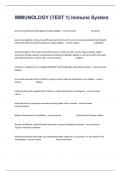
IMMUNOLOGY (TEST 1) Immune System Practice Exam Question And Answer.
process of being protected against foreign antigens - correct answer immunity aka immunoglobins, these are specific glycoproteins found in serum or plasma produced by B-lymphs when body detects harmful substances called antigens - correct answer antibodies aka immunogens, these large molecules found on surface of cells, viruses, fungi, bacteria, pollen, chemicals, foreign particles causing body to produce antibodies against it; can be formed in the body with bacterial toxins or tissue cells - correct answer antigens portions or fragments of an antigen that REACT with antibodies and lymph receptors - correct answer epitope very small molecules that can bind to a larger carrier molecule and behave as an antigen - correct answer hapten molecule that when coupled with a hapten, renders the hapten immunogenic - correct answer carrier main function is to recognize microbes as being either self or nonself - correct answer immune system defense, homeostasis, surveillance - correct answer 3 functions of immune system first line of defense, natural (innate) immunity, acquired (adaptive) immunity - correct answer 3 types of immune response defense mechanism that body uses immediately after exposure to a microbe; it is non-specific and nonadaptive - correct answer natural immunity components include phagocytic cells along with mast cells, neutros and macrophages - correct answer cellular component components include complement proteins, lysozymes, interferons - correct answer humoral components proteins that produce inflammatory effects and destroy cells when activated - correct answer complement proteins enzyme secreted by macrophages that attack cell walls of some bacteria - correct answer lysozymes proteins produced by many cells in response to viral infections to BLOCK replication of virus in other cells - correct answer interferons immunity that becomes operational when natural immunity is overwhelmed; it is antigen-specific - correct answer adaptive immunity (acquired) results in production of antibodies to combat non-self antigens - correct answer humoral response involves activation of specific lymphocytic cells to combat non-self antigens - correct answer cell-mediated reponse intitial response for removal of microbes; innate or immunity we are born with; nonantigen specific; nonadaptive; includes mast cells, neutros, macrophages; humoral components include complement proteins, lysozymes and interferons - correct answer natural immunity secondary defense mechanism; acquired thru life; antigen specific; adaptive; cellular components include antigen presenting cells, macrophages, T-lymphs, B-lymphs; humoral components include antibodies, cytokines - correct answer adaptive immunity includes bone marrow where T-lymphs and B-lymphs are produced and the thymus found near trachea where stem cells develop into T-cells - correct answer primary lymphoid organs include mucosa-associated lymphoid tissue (MALT), lymph nodes, and spleen - correct answer secondary lymphoid organs and tissues composed of small concentrations of lymphoid tissue and provide 1st line of defense against orally ingested pathogens - correct answer MALT (mucosa-associated lymphoid tissue) bundles of tissue found throughout human body filled with lymphocyte cells that act as filters by removing microorganisms from circulation; part of secondary organs - correct answer lymph nodes largest of the secondary organs that acts as a filter by trapping and removing foreign materials out the the blood and removes old/damaged RBCs - correct answer spleen soluble proteins secreted by cells and are chemical mediators that transmit messages between cells to regulate growth and function - correct answer cytokines principle leukocyte associated with phagocytosis performed inside body's peripheral tissue and breaks down ingested material and kills microorganisms - correct answer neutrophils include neutrophils, basophils, eosinophils, mast cells, monocytes/macrophages - correct answer granulocytes accumulate at inflammatory sites and release histamines, which cause allergic responses; activated by IgE antibody - correct answer basophils invade microorganisms including certain parasites and also control allergic reactions by emitting histaminase - correct answer eosinophils tissue cells that play major role in hypersensitivity reactions - correct answer mast cells monocytes, which are found in blood, become ________________ when they enter the tissue and serve to ingest antigens and are antigen-producing cells (APC). - correct answer macrophages
Geschreven voor
- Instelling
- IMMUNOLOGY.
- Vak
- IMMUNOLOGY.
Documentinformatie
- Geüpload op
- 4 april 2024
- Aantal pagina's
- 7
- Geschreven in
- 2023/2024
- Type
- Tentamen (uitwerkingen)
- Bevat
- Vragen en antwoorden
Onderwerpen
-
immunology test 1 immune system

Ook beschikbaar in voordeelbundel