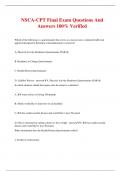
NSCA-CPT Final Exam Questions And Answers 100% Verified
NSCA-CPT Final Exam Questions And Answers 100% Verified Which of the following is a questionnaire that serves as a non-invasive, minimal health-risk appraisal designed to determine contraindications to exercise? A. Physical Activity Readiness Questionnaire (PAR-Q) B. Readiness to Change Questionnaire C. Health History Questionnaire D. Liability Waiver - answerA. Physical Activity Readiness Questionnaire (PAR-Q) In which situation should the trainer refer the client to a dietitian? A. Bill wants advice on losing 100 pounds B. Shelly would like to learn how to eat healthier C. Bob has cardiovascular disease and would like to lose 30 pound D. Gina is interested in cutting calories to lose weight - answerC. Bob has cardiovascular disease and would like to lose 30 pound What information does the Health History Questionnaire collect? a. Evidence of disclosure. b. Previous exercise history including adherence experience. c. Detailed medical and health information. d. Fitness measurement data. - answerc. Detailed medical and health information. What information does the Informed Consent form collect? a. Evidence of disclosure. b. Previous exercise history. c. Detailed medical and health information. d. Fitness measurement data. - answera. Evidence of disclosure. What blood pressure measurement is considered to be a risk factor for cardiovascular disease? a. 130/70 mmHg b. 120/80 mmHg c. 121/81 mmHg d. 140/90 mmHg - answerd. 140/90 mmHg Chronic Obstructive Pulmonary Disease (COPD) is s condition that affects mainly which system? a. Musculoskeletal b. Integumentary c. Cardiovascular d. Respiratory - answerd. Respiratory When answering the Physical Activity Readiness Questionnaire (PAR-Q), your client answers "yes" to a bone or joint problem that could be made worse by a change in physical activity. What is the next step in his fitness program? a. Begin training at a low intensity. b. Talk with her doctor about her readiness for exercise. c. Conduct a fitness appraisal. d. Fill out a Health History Questionnaire. - answerb. Talk with her doctor about her readiness for exercise. When answering the Physical Activity Readiness Questionnaire (PAR-Q), your client answers "yes" to chest pain during physical activity as well as currently taking a prescription blood pressure medication. What is the next step in his fitness program? a. Begin training at a low intensity. b. Talk with his doctor about his readiness for exercise. c. Conduct a fitness appraisal. d. Fill out a Health History Questionnaire. - answerb. Talk with his doctor about his readiness for exercise. Which of the following is a method used by personal trainers for gathering dietary intake data in which clients report what they have eaten in the past 24 hours? a. Dietary recall b. Diet records c. Dietary history d. Dietary synopsis - answera. Dietary recall Your new client informs you that she has diabetes and is taking insulin. What is the most important thing to do for this client? a. Make sure she eats a large meal before exercising. b. Refer her to a physician prior to beginning an exercise program c. Monitor her blood glucose levels throughout the session. d. Have her fill out a waiver of liability prior to exercise. - answerb. Refer her to a physician prior to beginning an exercise program Mike is a 35-year-old male who weighs 150 pounds. He is moderately active throughout the day. Approximately how many calories should Mike consume daily? a. 2,000 calories b. 2500 calories c. 2800 calories d. 3000 calories - answerc. 2800 calories Your client eats approximately 100 gr
Written for
- Institution
- NSCA-CPT
- Course
- NSCA-CPT
Document information
- Uploaded on
- April 1, 2024
- Number of pages
- 64
- Written in
- 2023/2024
- Type
- Exam (elaborations)
- Contains
- Questions & answers
Subjects
-
nsca cpt final exam questions and answers 100 ver

Also available in package deal