Module 3 Exam: HESI VN TXGRP 1912COHORT(VNE 39) (Quiz Score: 95.75 out of 100)
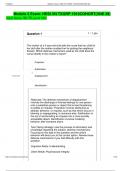
Module 3 Exam: HESI VN TXGRP 1912COHORT(VNE 39) (Quiz Score: 95.75 out of 100) Question 1 1 / 1 pts The mother of a 3-year-old child tells the nurse that her child hit her doll after the mother scolded her for picking the neighbors’ flowers. Which defense mechanism used by the child does the nurse identify in the mother’s report? Projection Sublimation Correct! Displacement Identification Rationale: The defense mechanism of displacement involves the discharge of intense feelings for one person onto a substitute person or object that is less threatening to satisfy an impulse. Projection involves attributing an attitude, behavior, or impulse, such as that which occurs in blaming or scapegoating, to someone else. Sublimation is the act of rechanneling an impulse into a more socially acceptable object. Identification involves modeling behavior after someone else's. Test-Taking Strategy: Use the process of elimination and knowledge regarding the subject, defense mechanisms. Focusing on the data in the question and the child’s behavior will direct you to the correct option. Review these defense mechanisms if you had difficulty with this question. Cognitive Ability: Understanding Client Needs: Psychosocial Integrity Integrated Process: Nursing Process/Data Collection Content Area: Mental Health A client says to the nurse, “I’ve been following my diet and taking my medication. What else do you want to talk about today?” Which response would be most helpful during the working phase of the therapeutic alliance? “Sounds fine to me. Let’s meet again in 6 months.” “I don’t believe that you have been following your diet because you haven’t lost any weight.” “Well, you’ve talked about diet in your terms, but perhaps I should test you on specific things.” Correct! “Some people have added exercise to diet and medication therapy and gotten positive results. Do you think that this would work for you?” Rationale: Although suggestion or overt giving of advice is sometimes nontherapeutic, these strategies are therapeutic when used in the working phase, because in this situation they will increase the client’s perception of all available options in the treatment plan. Answering “Sounds fine to me. Let’s meet again in 6 months” stops the communication process. Stating to the client that he or she has not lost any weight implies disbelief and does not explore the reasons for the client’s failure to lose weight. “Testing” challenges the client and is nontherapeutic. Test-Taking Strategy: Use the process of elimination and therapeutic communication techniques. Noting the words “working phase” in the question will direct you to the correct option. Review therapeutic communication techniques if you had difficulty with this question. Cognitive Ability: Applying Client Needs: Psychosocial Integrity Integrated Process: Communication and Documentation Content Area: Mental Health Question 3 1 / 1 pts As the nurse prepares to interview a client being admitted to the mental health unit, the client says, “I asked my family to bring me in here to talk to someone, but now I don’t know where to begin.” Which response by the nurse would be most helpful? “Why not just start talking and see where it takes you?” “If I were you, I’d begin with what you were doing this morning.” Correct! “Perhaps you can start by sharing some of your most recent concerns.” “Don’t worry. Everyone who comes in here for the first time feels reluctant to talk.” Rationale: The intake interview is usually the first contact with the client. It is intended to establish rapport, to help the nurse understand the client’s current problem and level of functioning, and to help the nurse formulate a nursing care plan. The clinician usually allows the client to set the pace of the interview and uses open-ended questions to elicit a comprehensive diagnostic picture of the client’s problems and level of coping. Sharing concerns is a good place to start the conversation because it will allow the client to express feelings. The response “Why not just start talking and see where it takes you?” is too general and does not provide the client with a focus on self. Telling the client not to worry is nontherapeutic and avoids addressing the client’s concerns. Test-Taking Strategy: Use your knowledge of therapeutic communication techniques. Focusing on the client’s feelings will direct you to the correct option. Review therapeutic communication techniques if you had difficulty with this question. Cognitive Ability: Applying Client Needs: Psychosocial Integrity Integrated Process: Communication and Documentation Content Area: Mental Health “You tell me you live rent free, yet you expect the same privileges as an adult who supports the household?” “Well, if you directly discussed your concerns with them, I guess it’s a case of ‘When in Rome, do as the Romans do.’” Rationale: The therapeutic nursing response uses reflection, in which the nurse directs the content of the client’s message back for the client to review from a new perspective. This technique also includes an element of focusing on the crux of the issue—in this case, that it is his parents’ home and they set the rules for living in their home, just as he someday will in his. Telling the client to move out is giving advice or suggestions to the client prematurely. Although this technique can be useful in the working phase, it is usually nontherapeutic when the nurse needs to promote client understanding and self- exploration. Stating “You tell me you live rent free, yet you expect the same privileges as an adult who supports the household?” is judgmental and poorly timed in that it humiliates the client unnecessarily. The client has acknowledged that he pays no rent, so there is no helpful purpose in reemphasizing this fact. Stating “Well, if you directly discussed your concerns with them, I guess it’s a case of ‘When in Rome, do as the Romans do’” is nontherapeutic in that it offers a cliché and expresses hopelessness and powerlessness, two emotions that the client is no doubt already experiencing. Test-Taking Strategy: Use your knowledge of therapeutic communication techniques. This will direct you to the correct option, the nursing response that focuses on the client’s concerns and feelings. Review therapeutic communication techniques if you had difficulty with this question. Cognitive Ability: Applying Client Needs: Psychosocial Integrity Integrated Process: Communication and Documentation Content Area: Mental Health Question 5 1 / 1 pts A nurse is participating in a care planning conference regarding care for a client whose spouse recently died. The registered nurse formulates a nursing diagnosis of dysfunctional grieving. Which priority intervention does the nurse expect to see incorporated into the plan? Monitoring the client’s sleep pattern Obtaining a physician’s prescription for an antidepressant Correct! Determining the client’s risk for violence toward self and others Assisting the client in resolving the grief through emotional, cognitive, and behavioral means Rationale: The priority intervention for a client with dysfunctional grieving is assessing the client’s risk for violence toward self and others. Although the nurse will assist the client in resolving the grief and will monitor the client’s sleep pattern, these are not priorities in the list of options given. Obtaining a physician’s prescription for an antidepressant is not a priority. Test-Taking Strategy: Use the process of elimination and the steps of the nursing process. Both monitoring the client’s sleep pattern and determining the client’s risk for violence toward self and others involve assessment. From these options, select the one that addresses the safety of the client. Review interventions for a client with dysfunctional grieving if you had difficulty with this question. Cognitive Ability: Applying Client Needs: Psychosocial Integrity Integrated Process: Communication and Documentation Content Area: Mental Health
Written for
- Institution
- HESI VN TXGRP 1912COHORT
- Course
- HESI VN TXGRP 1912COHORT
Document information
- Uploaded on
- April 1, 2024
- Number of pages
- 156
- Written in
- 2023/2024
- Type
- Exam (elaborations)
- Contains
- Questions & answers
Subjects
-
module 3 exam hesi vn txgrp 1912cohortvne 39

Also available in package deal