

Written by students who passed Immediately available after payment Read online or as PDF Wrong document? Swap it for free 4.6 TrustPilot
logo-home
Document preview thumbnail
Preview 2 out of 10 pages
Exam (elaborations)

Milady Chapter 17 Hair Removal Exam Questions with correct Answers 2023

Document preview thumbnail
Preview 2 out of 10 pages

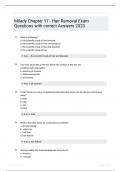
Milady Chapter 17 - Hair Removal Exam Questions with correct Answers 2023 What is Trichology? a. the scientific study of hair removal b. the scientific study of hair care products c. the scientific study of hair and diseases d. the scientific study of hair The main structures of the hair below the surface of the skin are: a. follicle, bulb and papilla b. arrector pili muscle c. sebaceous glands d. all answers A hair follicle is a mass of epidermal cells extending down into the dermis and forming what? a. bulb b. tube c. sac d. pore What is the other name for a pilosebacious follicle? a. dermal papilla b. vellus hair c. hair bulb d. hair follicle Strong, healthy hair received adequate amounts of: a. vitamins b. minerals c. nutrients d. all answers Hair growth is created by the activity of cells in the: a. stratum corneum b. pores c. basal layer d. dermis What are the oil ducts or sebaceous glands that are attached to the follicle responsible for? a. lubricating the skin and hair b. lubricating just the skin c. making the hair shiny d. protecting sensitive skin Hair found on a fetus is called: a. pre-birth hair b. peach fuzz c. down d. lanugo Vellus is: a. telogen hair b. short, fine, downy hair c. anagen hair d. catagen hair Hair growth occurs in these stages: a. anagen, catagen and telogen b. catagen and telogen c. anagen and telogen d. catagen and anagen Hair and skin are good barometers for what? a. state of a person's health b. state of mind c. attitide toward appearance d. lifestyle Hirsutism is: a. hypertrichosis b. excessive hair growt c. baldness d. thin hair The menopause moustache is caused by: a. estroge b. hormonal distress c. adrenocortical activity d. cumulative sun exposure The two types of hair removal are: a. deep and shallow b. temporary and permanent c. thinning and complete d. anagen and catagen Removing hair by using electricity is called: a. electrogoagulatio b. laser c. electrolysis c. thermolysis Galvanic, thermolysis, and blend are three methods of hair removal used by this method: a. electrolysis b. laser c. IPL d. photoepilation IPLs: a. use quick flashes of light b. shatter the targeted hair bulb without allowing heat to build up and burn the surrounding skin c. reduce hair and spider veins d. all answers What is depliation? a. removing the hair at the root b. removing the hair at or near the surface of the skin c. removing hair from the bottom of the follicle d. permanently removing the hair What is epilation? a. removes hair from the bottom of the follicle b. removes hair by breaking contact between the bulb and the papilla c. pulls hair out of the follicle d. all answers Folliculitis barbae is commonly called: a. baldness b. ingrown hair c. overgrowth of unhealthy hair d. patchy hair loss A product that removes hair is called: a. depilatory b. epilation c. depilation d. sugaring Which of the following answers accurately describes tweezing? a. using tweezers to pull hair out by the root one at a time b. using tweezers, thread or sugar to pull out unwanted hair c. a faster method than waxing for hair removal d. permanently removing the hair by pulling it out, one hair at a time. Which answer(s) best describes threading: a. uses 100% cotton thread b. thread is twisted and rolled along the surface of the skin c. entwines hair in the thread and lifts it out of the follicle d. all answers Waxing failures are caused by: a. skin that is not held taut b. wax has been used too many times c. fine hair d. hair is too long The two types of wax are: a. melted and solid b. hard and soft c. beads and disks c. blocks and pellets Common ingredients added to waxes are: a. azulene b. chamomile c. tea tree oil d. all answers Which of the following statement(s) accurately describe(s) hard waxes? a. gentle enough for the face b. strong enough to remove coarse hairs c. ofthen preferred for the bikini area and underarms d. all answers Basic waxing supplies include: a. wax and warmer, cleansers, and pre and post epilation solutions b. muslin or pellon, thread, scissors, and cotton supplies c. gloves disposable spatulas, tweezers and gauze d. all answers Wax that is water insoluble is removed by using a(n): a. water soluble lotion b. oil based solution c. warm water d. salt water Which of the following best describes a roll-on wax? a. wax that is in an applicator and dispensed by a roll-on head b. wax that is dispensed from the wax warmer and rolled onto the skin c. a messy form of waxing that is not performed by estheticians d. a slow method for applying wax

Content preview

Milady Chapter 17 - Hair Removal Exam
Questions with correct Answers 2023

1). What is trichology?
a. the scientific study of hair removal
b. the scientific study of hair care products
c. the scientific study of hair and diseases
d. the scientific study of hair

 Ans: c. the scientific study of hair and diseases


2). The main structures of the hair below the surface of the skin are:
a. follicle, bulb and papilla
b. arrector pili muscle
c. sebaceous glands
d. all answers

 Ans: d. all answers


3). A hair follicle is a mass of epidermal cells extending down into the dermis and forming
what?
a. bulb
b. tube
c. sac
d. pore

 Ans: b. tube


4). What is the other name for a pilosebacious follicle?
a. dermal papilla
b. vellus hair
c. hair bulb
d. hair follicle

 Ans: d. hair follicle


5). Strong, healthy hair received adequate amounts of:
a. vitamins
b. minerals


PaperStoc.com Page 1 of 10

, c. nutrients
d. all answers

 Ans: d. all answers


6). Hair growth is created by the activity of cells in the:
a. stratum corneum
b. pores
c. basal layer
d. dermis

 Ans: c. basal layer


7). What are the oil ducts or sebaceous glands that are attached to the follicle responsible for?
a. lubricating the skin and hair
b. lubricating just the skin
c. making the hair shiny
d. protecting sensitive skin

 Ans: a. lubricating the skin and hair


8). Hair found on a fetus is called:
a. pre-birth hair
b. peach fuzz
c. down
d. lanugo

 Ans: d. lanugo


9). Vellus is:
a. telogen hair
b. short, fine, downy hair
c. anagen hair
d. catagen hair

 Ans: b. short, fine, downy hair


10). Hair growth occurs in these stages:
a. anagen, catagen and telogen
b. catagen and telogen
c. anagen and telogen
d. catagen and anagen


PaperStoc.com Page 2 of 10

Document information

Uploaded on
April 1, 2024
Number of pages
10
Written in
2023/2024
Type
Exam (elaborations)
Contains
Questions & answers
$14.99

Wrong document? Swap it for free Within 14 days of purchase and before downloading, you can choose a different document. You can simply spend the amount again.
Written by students who passed
Immediately available after payment
Read online or as PDF

Seller avatar
Reputation scores are based on the amount of documents a seller has sold for a fee and the reviews they have received for those documents. There are three levels: Bronze, Silver and Gold. The better the reputation, the more your can rely on the quality of the sellers work.
Academik001
4.0
(2)
Sold
16
Followers
10
Items
2263
Last sold
1 year ago


Why students choose Stuvia

Created by fellow students, verified by reviews

Quality you can trust: written by students who passed their tests and reviewed by others who've used these notes.

Didn't get what you expected? Choose another document

No worries! You can instantly pick a different document that better fits what you're looking for.

Pay as you like, start learning right away

No subscription, no commitments. Pay the way you're used to via credit card and download your PDF document instantly.

Student with book image

“Bought, downloaded, and aced it. It really can be that simple.”

Alisha Student

Working on your references?

Create accurate citations in APA, MLA and Harvard with our free citation generator.

Working on your references?

Frequently asked questions

